How to move an atomic theory timeline project beyond research and reporting
An atomic theory timeline project sounds student-centered: students choose a scientist, conduct research, and report what they learn. But does the project require them to reason about how atomic models changed? Or, does it require them to only collect information?
In this article, I’ll show you how I rebuilt my atomic theory scientists lesson so students construct the timeline, connect models to discoveries, and place additional scientists by arguing from evidence.
IN THIS ARTICLE
- Why research and presentations may not be enough
- What my first atomic theory lesson revealed too soon
- How students build the timeline from a video resource
- How missing scientists create an evidence-based reasoning task
- How one student artifact makes learning visible
- When a conventional timeline project may still be the right choice
Why an Atomic Theory Timeline Project Isn’t Automatically Student-Centered
Atomic theory can feel like one of those unavoidable information-heavy lessons. We have dates, atomic theory scientists, experiments, discoveries, and a sequence of models stretching from the solid sphere to the modern atomic model. Certainly, students need to know why Thomson’s plum pudding model and Rutherford’s gold foil experiment matters. But how do we teach all of that without lecturing through a list?
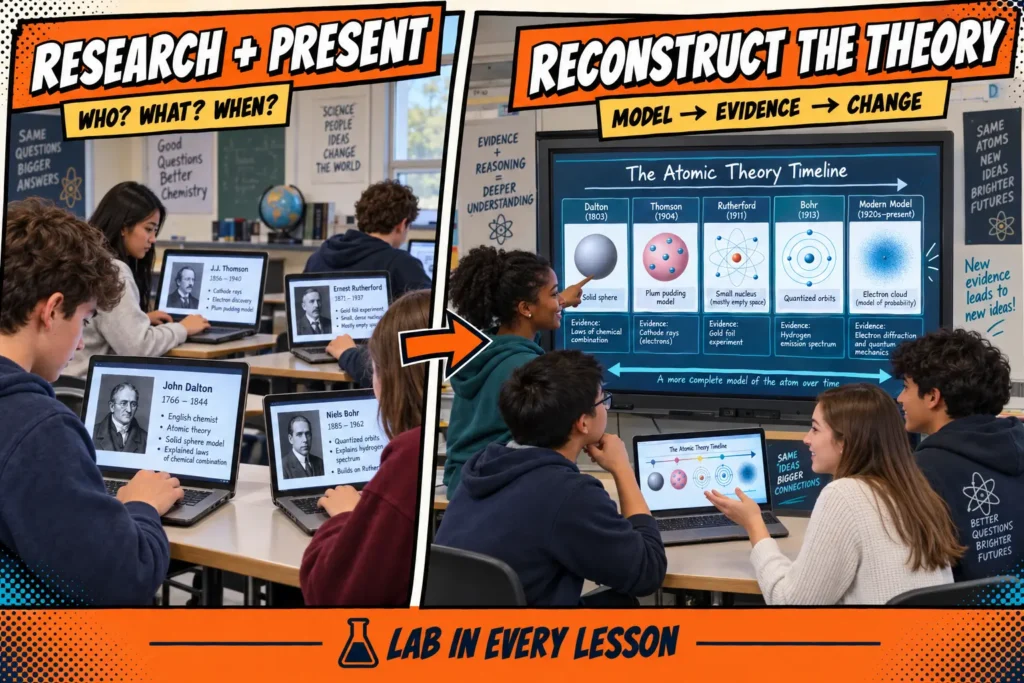
An atomic theory timeline project seems like a natural solution. Instead of giving students the information, we assign each student a scientist to research and present. That approach does offer real advantages:
- Students can exercise choice and agency over the scientist they investigate.
- They obtain, evaluate, and communicate scientific information.
- They collaborate as individual research becomes a shared class timeline.
- The teacher isn’t responsible for delivering every name, date, and discovery.
So yes, assigning a research project is a great alternative to list-style lecture!
But there are two questions I’d still ask:
- What critical thinking does the project require beyond collecting and reporting information?
- How much instructional time will the research and presentations consume?
A full project may require several class periods for research and several more for presentations. Meanwhile, the rest of the unit can’t move very far because students in high school chemistry will need the reference the timeline, or at least the scientists and models, as they continue along the sequence of lessons.
Remember! The history of atomic theory isn’t an isolated collection of biographies. Each new model depends upon the discoveries that came before it.
“A project can be active, collaborative, and student-centered but still leave out the most important lesson: reasoning.”
INITIAL INQUIRY ATTEMPT: What My First Atomic Theory Timeline Lesson Revealed Too Soon
My earlier lesson wasn’t a lecture or a set of textbook pages. I’d already begun searching for ways to make students active.
The essential question was broad: How has our understanding of the atom evolved over time?
Students were supposed to:
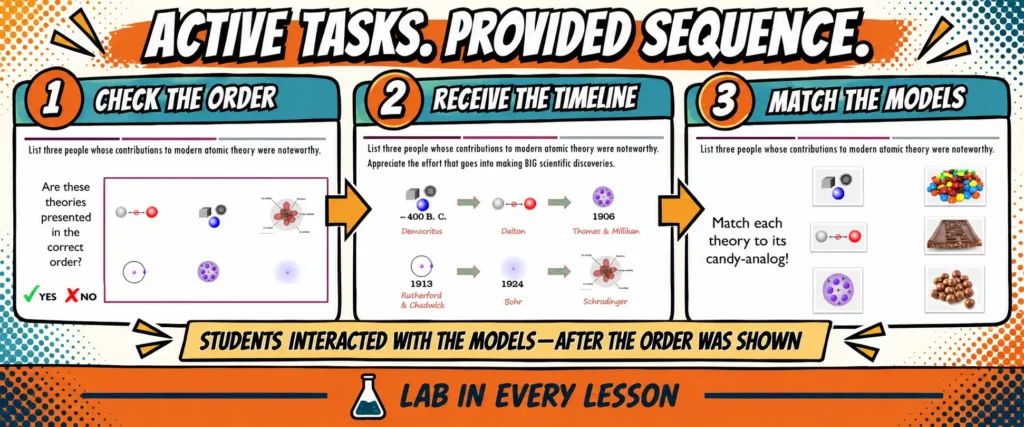
- List scientists whose contributions to modern atomic theory were noteworthy.
- Describe the ideas, discoveries, and models connected to those scientists.
- Appreciate the effort required to make major scientific discoveries.
Those goals weren’t terrible. The trouble was that the lesson repeatedly asked students to participate while I retained control of the thinking.
A Yes-or-No Question Created Participation, Not Reasoning
I began by showing several atomic models and asking whether they were presented in chronological order. Students could answer yes or no with a 50 percent chance of being correct. They didn’t need to examine the models, cite evidence, or explain their reasoning. They only needed to be present and willing to respond.
At the time, that looked like engagement … and, as the teacher, engagement was my goal! At that time, I didn’t realize that engagement is just an outcome of real learning goals in the process of being achieved.
I Gave Students the Atomic Model History Timeline
Immediately after that opening question, I rearranged the models, supplied the scientist names, and added dates. By the third slide of my PowerPoint slide deck, I had essentially given students the completed atomic model history timeline.
Again, in hindsight and having acquired years of inquiry-based design experience, I now realize how that single page of images could have, itself, become an inquiry-based, student-centered investigation!
I could have asked students to reorder the models and defend the sequence using visible changes as evidence. Instead, I worked out and presented that reasoning before students had the opportunity to sort it out for themselves.
The Candy Models Added Activity—but Not Enough Individual Thinking
The lesson also included candy analogies for the atomic models, and they are fantastic! Students matched each piece of candy to a model and discussed why the analogy worked. But when the conversation slowed or students seemed confused, I had explanations ready. That backup made it very easy to revert to teaching by telling.
REDESIGNED FOR REASONING: Start the Atomic Theory Lesson With Familiar Atomic Structure
In the redesigned lesson, students begin with a quick Review & Preview activity, a warm up task designed to both activate their prior knowledge and integrate into the next lesson context to give a preview of what the learning experience of the lesson will uncover:
- Who discovered the electron?
- How did scientists determine that a small, dense nucleus existed?
- How did our model develop into the structure students just reviewed?
They identify protons, neutrons, and electrons and position them accurately in the atom. It’s a low-stakes drag-and-drop task based on what should be acquired middle school knowledge. It also gives me a practical moment to take attendance and get class started without asking students to wait passively for everyone else.
Make Students Construct the Atomic Theory Timeline
The learning goal is straightforward: students will learn about the scientists whose work led to modern atomic theory and see how scientific knowledge changes over time. But the success criteria focus on what students will actually do.
Students will:
- Construct a chronological timeline of important atomic theory scientists.
- Match each scientist to an atomic model or major contribution.
- Connect written descriptions to visual models.
- Use new disciplinary terms accurately.
This is the paradigm shift that transforms a list-based lecture topic into an evidence-based exploration!
USE an Atomic Theory Video to create a Student Artifact
I send students to a well-produced, historically-accurate video on YouTube that contains the necessary information.
You might ask, “Isn’t using a video just like having a substitute teacher do the whole ‘teaching as telling’ thing?!”.
It certainly can be if students are charged on with watching it. The instructional shift comes from giving them something meaningful to do with it.
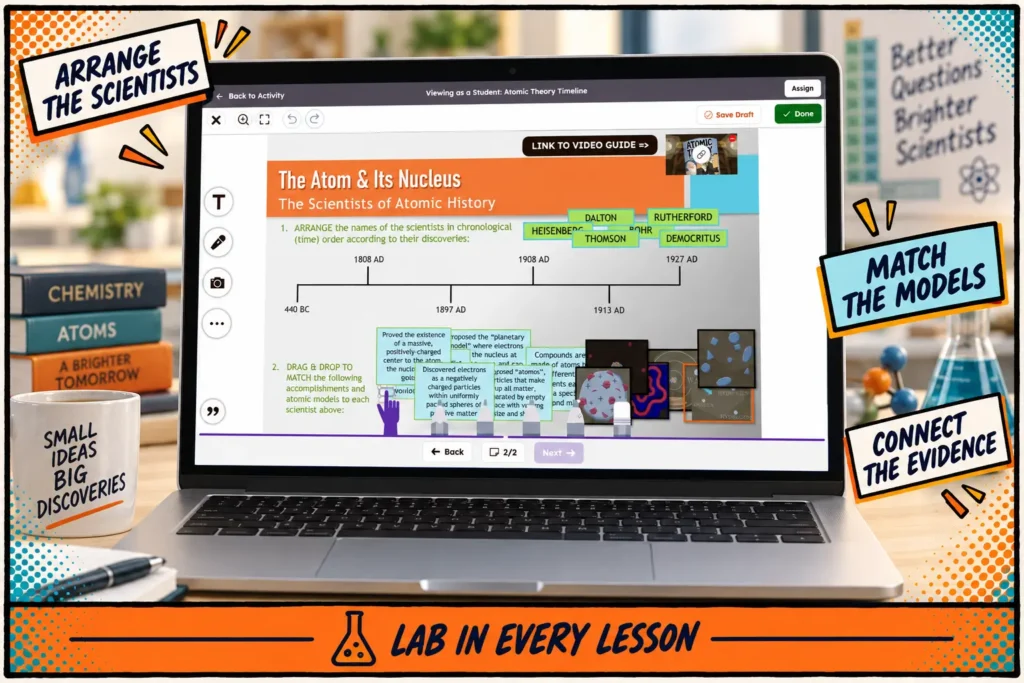
I pulled screenshots of the models from the video and used them to create a digital artifact in Seesaw. The timeline itself contains dated positions, but the important pieces require students to position them:
- images of the atomic models shown in the video
- names of the atomic theory scientists
- written descriptions of their discoveries and proposed models
Students watch for sequence, names, and visual changes. They may hear the scientist’s name, recognize whether the model belongs near the beginning or end of the timeline, and then match the written description by examining the model itself. The resource supplies the information; the student artifact makes them organize it.
“A video doesn’t become active learning because students press play. It becomes useful when they have something meaningful to do with what they observe.”
Use the Atomic Theory Timeline as Formative Assessment
By the end of the activity, every student has produced an individual artifact. I can immediately see who constructed the sequence accurately, who mismatched a scientist and model, who attached a description without examining it closely, and who was absent or didn’t complete the work.
That’s visible learning built into the main task.
LITERALLY! When learning happened, we were able to SEE IT.
I didn’t have to wait to review at the results of an exit ticket to discover whether students satisfied the success criteria, the learning goals, related to the lesson. Instead, I was able to observe their learning in real time throughout the entire class period.
Add Missing Atomic Theory Scientists Through Evidence-Based Reasoning
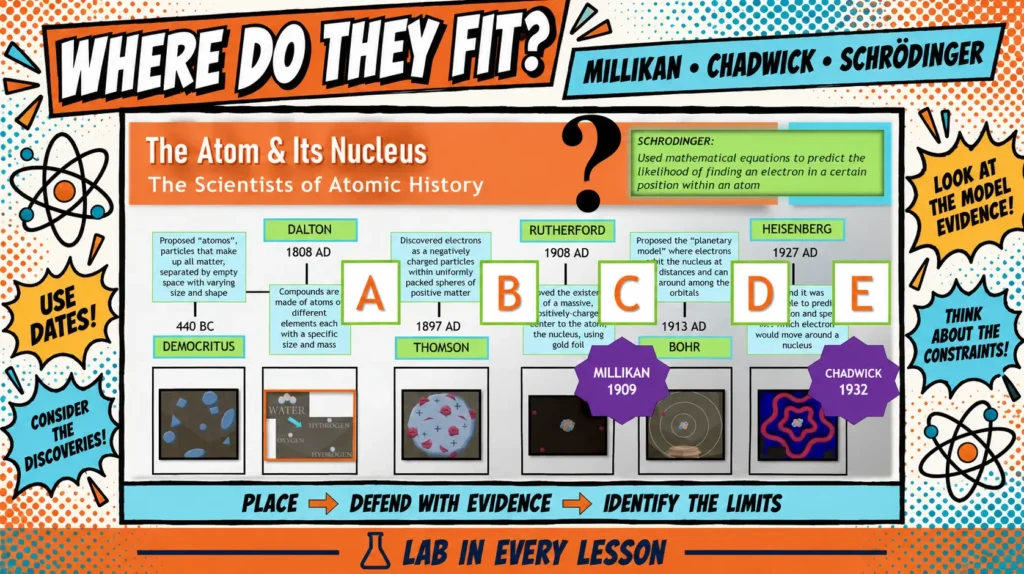
The selected video gave students a strong core timeline, but it didn’t include all the most influential scientists we would encounter in a high school chemistry course. Millikan, Chadwick, and Schrödinger were missing. Instead of treating that limitation as a reason to abandon the resource, I turned the missing scientists into the most rigorous part of the lesson.
By design, I provided the details of each scientist’s contribution or discovery so that I could probe students for evidence that would support where on the established timeline that scientist could logically fit. They don’t have enough information to know the exact date … which is exactly the point! Students must use evidence to propose a time period.
Place Millikan, Chadwick, and Schrödinger by Arguing From Evidence
Students reason through three additions:
- Robert Millikan measured the electron’s charge. His work had to occur after Thomson had established the electron’s existence. Students can eliminate every position on the timeline prior to Thomson.
- James Chadwick discovered the neutron. That discovery had to follow Rutherford’s discovery of the nucleus. Notably, the exact date was 1932, more than two decades after the nuclear model emerged.
- Erwin Schrödinger developed a mathematical description of electron behavior. Students can reason that his work belongs after the timeline had already progressed beyond discovering the electron (Thomson) and around or after describing their basic organization around the nucleus (Bohr). His wave equation appeared in 1926.
There is more than one defensible location on the atomic theory timeline for students to reason through these additions. That gives them permission to make a claim without feeling as though they should know more than the evidence allows. They can eliminate impossible positions, choose reasonable ones, and explain why.
“Students don’t need the exact answer before they can make a scientifically defensible argument.”
Use the Timeline to Reveal the true [sometimes slow] nature of science
Once students make their placements, we reveal can the actual dates.
- Millikan’s work came more than a decade after Thomson’s 1897 electron experiments.
- Chadwick’s neutron discovery came decades after Rutherford’s work established the nucleus.
- Schrödinger’s mathematical model followed Bohr’s model rather than appearing immediately after the electron was discovered.
Those gaps matter, especially at the start of a new school year!
Scientific models don’t change the instant one person proposes a new idea. Evidence accumulates and it takes time for the scientific community to embrace the new evidence as truth.
Other scientists test, refine, and sometimes reject what came before. The scale of the timeline helps students see the nature of science.
Use Atomic Models to Practice Modeling and CER
I kept the candy analogies from my original attempt at making this lesson more student-centered. They’re memorable and genuinely useful! However, they serve a completely different function for me, now.
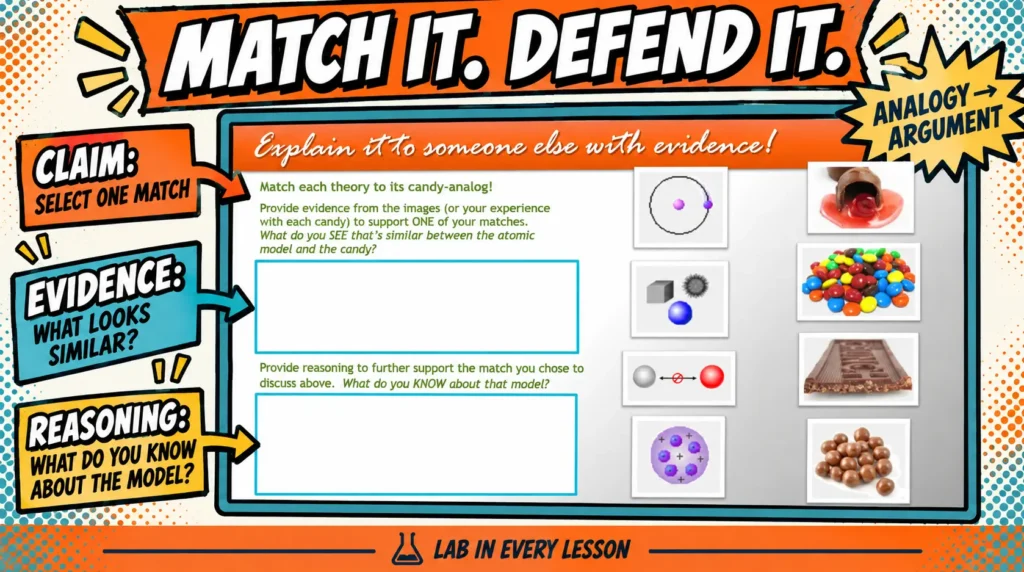
After students have constructed the timeline and encountered the atomic models, the candy comparisons become a model-evaluation task. Students can make a claim about which candy best represents a particular atomic model, support the match with visible features, and explain how those features correspond.
In this way, it’s more of a highly-rigorous transfer task!
We can even generate and assign a structured CER challenge that reveals whether students understand the models well enough to reason with them.
An Atomic Theory Timeline Project Might Still Be the Right Choice
If you arrived here looking for an atomic theory timeline project in which students research one scientist and report back to the class, you may have gotten more in this blog post than you bargained for!
But, seriously — if you choose to still deliver this lesson project-style, your students will still be obtaining and communicating information, working collaboratively, and taking responsibility for knowledge you might have otherwise delivered.
I’d simply ask two questions before you commit those precious several instructional days:
- Where is the reasoning? Will students gain exposure to the cross-cutting concepts that emerge when they compare models, trace how one discovery made another possible, or explain how the evidence changed atomic theory?
- Is the time investment serving your most important goal? Could a shorter timeline task create room for a deeper investigation of the experiments and data behind the models?
A research project may be exactly right if research, source evaluation, or scientific communication is the primary goal. If the goal is understanding how the atomic model changed, students need a task that makes the sequence and relationships impossible to ignore.
Give Students Something to Do With the History of Atomic Theory
I didn’t need several days of independent research and presentations to make the atomic theory timeline student-centered. I needed a strong information source and a student artifact that transformed watching into constructing, matching, comparing, and defending.
The next time a lesson seems destined to become a list of scientists, dates, or discoveries, ask yourself:
- What could students build with this information?
- What sequence could they reconstruct?
- What model could they examine?
- What conclusion could they defend with evidence?
If you teach chemistry and want to use this complete atomic theory timeline activity instead of your atomic theory timeline project, download it here.
If you want to apply the same design process to another information-heavy lesson, learn more about my inquiry-based, student-centered instructional design approach, Discovery by Design, and see how purposeful student action can always come before explanation if we’re intentional in our planning and prep.