An inquiry-based lesson example that helps students discover what each part of CER actually does
Students may know the words claim, evidence, and reasoning without understanding what each part actually does. In this article, you’ll get the director’s cut on an inquiry-based claim, evidence, and reasoning example lesson for your middle or high school science class. Using it, students will discover the CER structure through relatable professional conversations so they understand not only how to write a CER response, but why clear claims, convincing evidence, and scientific reasoning matter.
Claim, Evidence, and Reasoning in Science Begin With Everyday Thinking
Science teachers often introduce CER as a science-writing strategy. But people use claims, evidence, and reasoning every day even though they most assuredly don’t know what CER even is!
Anytime someone asks, “How do you know?” they’re asking for evidence. Usually, they also need the reasoning that explains why that evidence supports the claim:
- Lawyers ask juries to believe their claims.
- Doctors support diagnoses.
- Mechanics explain what’s wrong with a car.
- Architects justify design decisions.
- Meteorologists tell us what the weather will be and why they expect it.
The context changes, but the communication problem remains the same: make a decision or recommendation, support it with something observable, and explain the logic connecting the two.
“Maybe the secret to teaching CER is helping students see that it isn’t just for science. It’s how people communicate clearly every day.”
Why Students Struggle With Claim, Evidence, and Reasoning in Science
My school began using a standardized claim-evidence-reasoning structure for open-ended responses around 2020 or 2021. Because the rubric was used across the high school, I had the opportunity to watch several cohorts develop their understanding of CER in multiple subjects.
Students generally understood the claim first: the claim is the answer. Evidence improved more slowly because evidence looks different across disciplines. In an English class, a student may cite a passage or quote a line from a text. In science, evidence is just different. It constitutes a measurement, observation, image, pattern, test result, or other information gathered through a sensory observation.
Reasoning has remained the most difficult part to teach for me.
Students may repeat the evidence, add another fact, or write a sentence beginning with “because” without actually explaining why the evidence makes the claim credible. I’ve experimented with teaching CER in different orders—even working backward from the logic—but students still needed a clearer understanding of what reasoning does.
“Reasoning is the part that answers the question I write most often on student work: But why?”
Students Need to Understand What Each Part of CER Does
I don’t want students to leave my classroom simply knowing how to satisfy a CER rubric. I want them to become informed decision-makers who ask stronger questions, recognize whether someone has supported a claim, and communicate ideas so people other than the science teacher can understand them.
That’s why defining claim, evidence, and reasoning isn’t enough. Students need to experience the work each component performs. If they understand why the structure creates a convincing explanation, they’re in a much stronger position to construct one themselves.
“Science skills are life skills—and clear communication may be one of the most transferable skills we teach.”
How I Used to Introduce Claim, Evidence, and Reasoning in Science
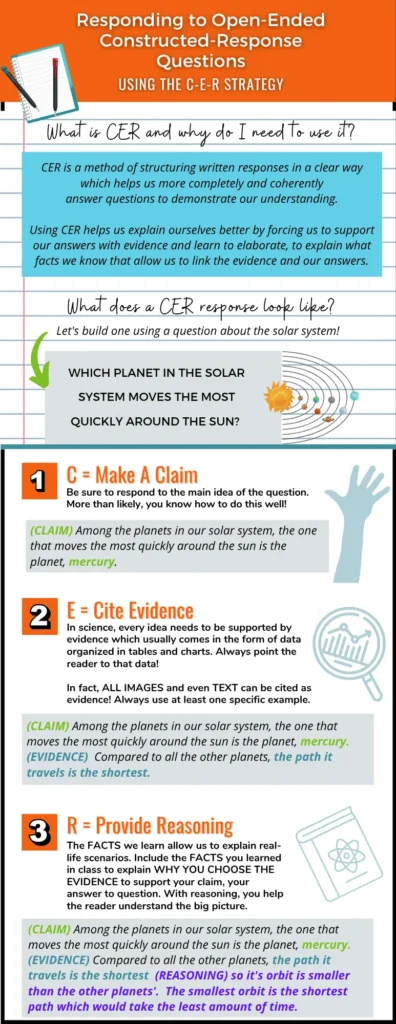
My previous CER introduction looked solid. It used a familiar science question: Which planet moves most quickly around the sun? Students may have memorized the answer, but CER asks them to prove it.
I broke the response into three parts, defined each one, showed students what it should include, and explained why they needed it. I also gave them a colorful reference they could revisit whenever they wrote a CER response. Teachers might provide the same support as a laminated handout, bookmark, anchor chart, or classroom poster.
Then we practiced — again and again. Students wrote responses, received individual feedback, and reviewed examples as a class. That repeated practice and feedback are still necessary because students develop at different rates.
But even as an introduction, the lesson was just too quick:
- here’s the definition
- here’s an example
- here’s why it matters
Everything arrived wrapped in a bow before students had a reason to wonder about any of it.
An Inquiry-Based CER Lesson Begins With Discovery
The core of inquiry-based lesson design is identifying what students need to understand … and then resisting the urge to explain that idea first!
In this case, students need to understand what CER is and why people use it. If I answer those questions for them at the beginning, I’ve removed the central discovery from the lesson.
The redesigned lesson therefore shifts from definitions followed by practice to experience followed by interpretation. Students encounter complete arguments in familiar situations, separate the parts, compare what they notice, and construct their own understanding of the structure.
Begin the Claim, Evidence, and Reasoning Lesson With Clear Communication
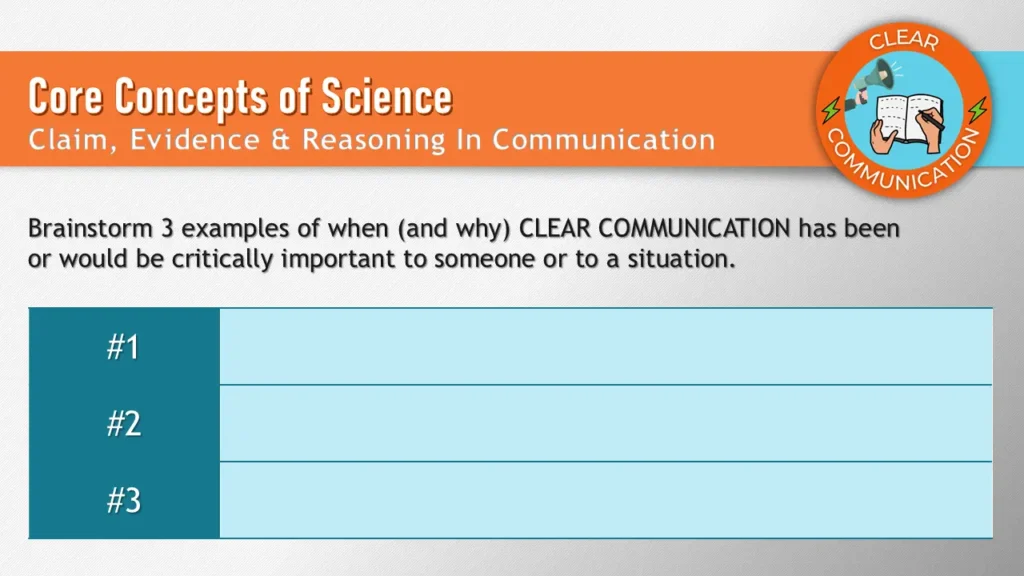
The redesigned lesson begins with a review-and-preview warm-up. Students already know something about communicating clearly, and the prompt asks them to reach toward the larger idea: Brainstorm three situations in which clear communication has been — or could be — critically important.
A courtroom is an obvious example. A lawyer makes a claim about guilt or innocence, presents evidence, and relies on rules, expert knowledge, or testimony to explain why the evidence matters. A sports referee makes a call, reviews replay evidence, and applies the rules of the game. Students can find examples in medicine, news, relationships, school, work, and ordinary decisions.
This warm-up moves the lesson beyond a writing formula before CER is formally introduced. It gives students a reason to care about the structure: communication can affect what people believe, what they decide, and what happens next.
Connect CER Writing to Arguing From Evidence
The learning intention still names claim, evidence, and reasoning, but the purpose is larger: students are learning to write like scientists because clear communication is part of doing science.
One of the science and engineering practices is engaging in argument from evidence. That practice may happen in writing, speaking, debating, modeling, or collaborative discussion. CER gives students a structure for making an idea understandable and defensible across those forms.
The success criteria ask students to read professional conversations, identify the claim, evidence, and reasoning in each one, analyze similarities across examples, and use those observations to explain how each component should be constructed. Instead of copying definitions, students use evidence from the conversations to argue for their own definitions and writing tips.
Use Professional Conversations as Claim, Evidence, and Reasoning Examples
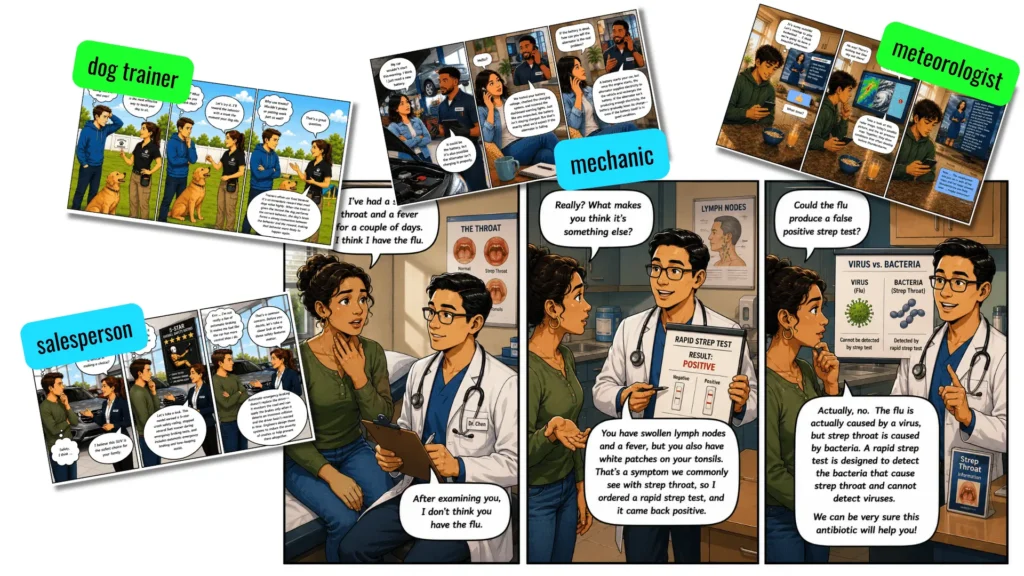
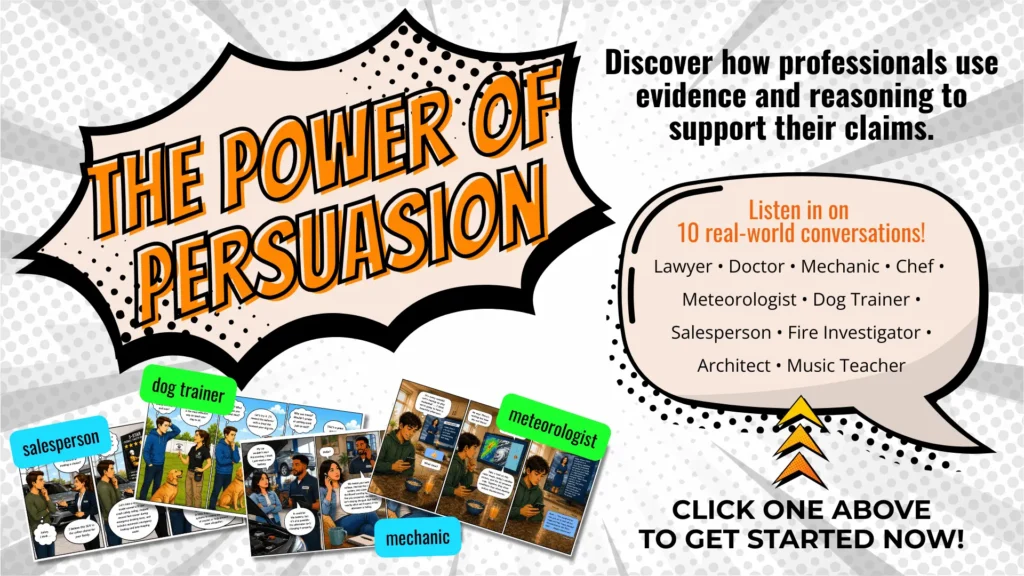
To create that experience in my cyber classroom, I built an interactive Genially called The Power of Persuasion. Students choose from ten professionals and listen in on a conversation each might have. The examples include professions students readily associate with expertise, such as lawyers and doctors, along with more familiar possibilities such as chefs, salespeople, and dog trainers.
Students choose three conversations rather than following one required path. That choice builds agency and makes the activity useful for getting to know students near the beginning of the year. Their selections may reveal a career interest, a hobby, or simple curiosity about an unexpected profession.
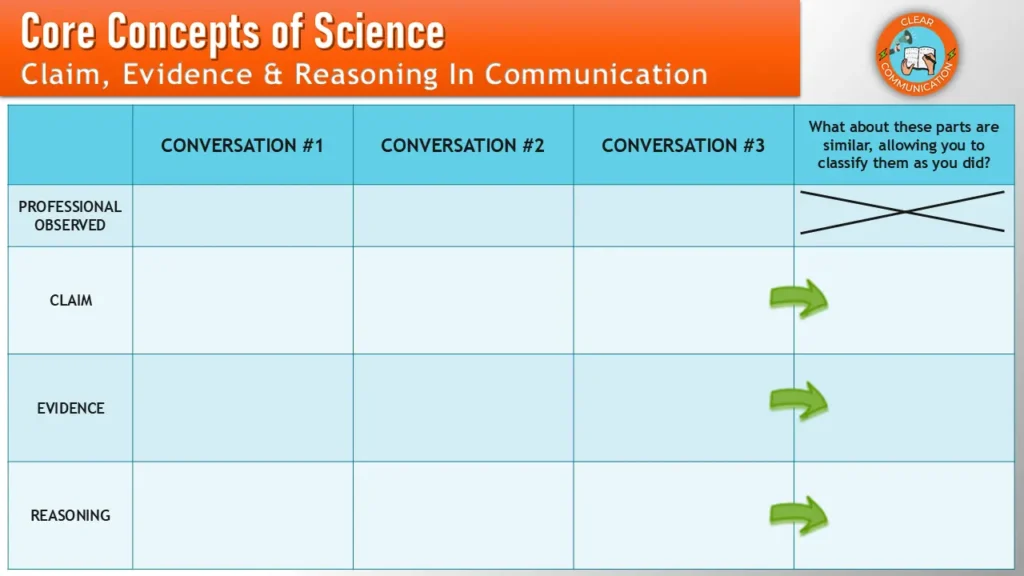
For each conversation, students identify what they believe is the claim, which information functions as evidence, and what reasoning connects the two. They record their thinking in a Seesaw activity, though the same structure could work in another learning platform or on paper.
communication belongs to many professions and everyday situations
Use Technology to Make CER Examples Interactive
As a cyber school teacher, I rely on technology to create an experience that doesn’t otherwise exist. In this lesson, Genially allowed me to create each conversation so that it unfolded in short comic-style frames. Students reveal dialogue, open visual evidence, compare outcomes, and continue when they’re ready.
The tool isn’t the instructional goal. Its job is to immerse students in the pattern so they have something meaningful to observe and analyze. Minimal directions are enough:
- choose a conversation
- explore it
- record information as you gather it
High school students can click, evaluate what appears, and determine where to go next. Finding their way through the experience is part of the inquiry.
Preserve Student Thinking in a CER Learning Artifact
The accompanying Seesaw page becomes the student’s thinking space. For each selected profession, students record the claim, evidence, and reasoning they identified and explain why they classified each statement that way.
Because Seesaw creates an ongoing catalog of student work, the completed page also becomes a useful artifact. Students can revisit the lesson, reopen the interactive tool, reconsider their original thinking, and compare their early understanding with the stronger CER responses they produce later in the year.
A Science-Based Claim, Evidence, and Reasoning Example: Pie Crust
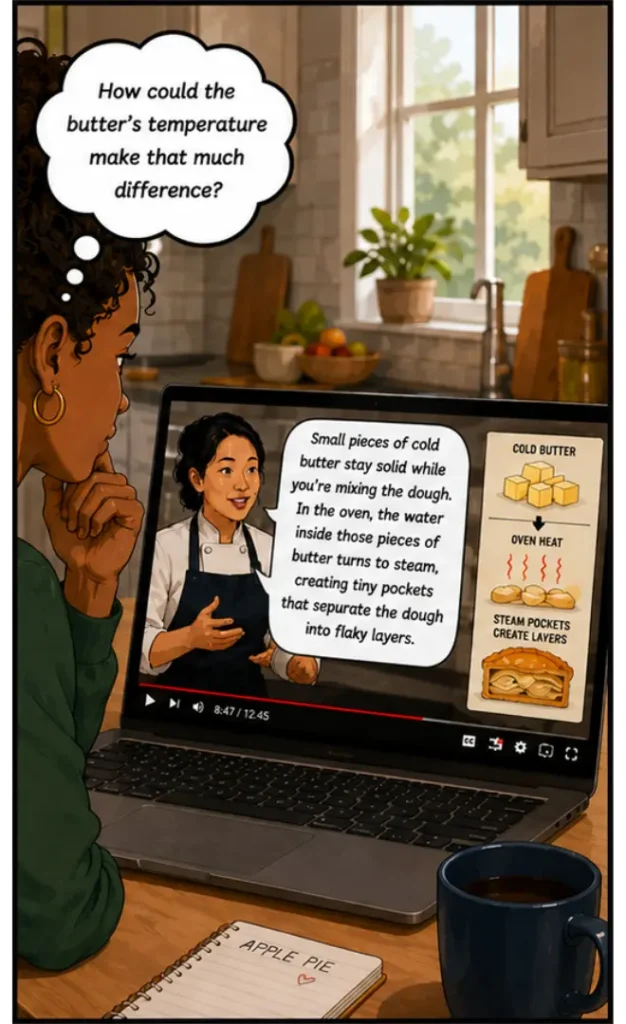
One of my favorite conversations features a chef explaining how to make a flaky pie crust. The example is relatable, but it still requires the same reasoning structure students use in science.
The chef’s claim is simple: If you want the flakiest pie crust, keep the butter as cold as possible. The claim doesn’t appear in exactly the same position as it does in every other conversation, which helps students realize that CER is a thinking structure—not a rigid paragraph template whose parts always arrive in one order.
convincing until the remaining pieces support it
In CER Writing, Evidence Shows What Happened
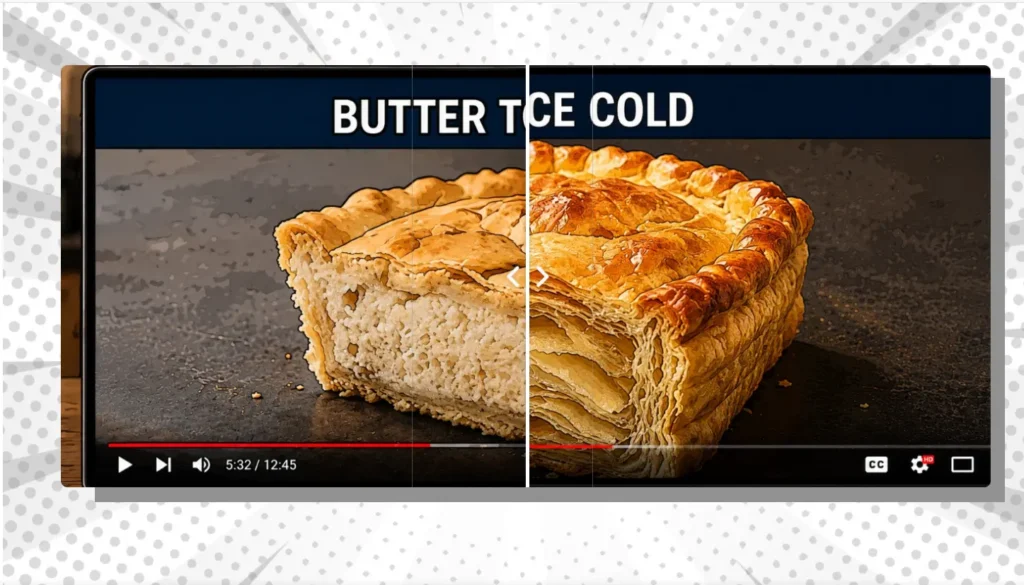
Students then reveal visual evidence comparing crust made with butter that was too warm with crust made using ice-cold butter. A slider makes the difference visible: the cold-butter crust forms flakier layers.
This distinction matters because scientific evidence isn’t automatically the same as textual evidence. In science, evidence often describes something students can observe, measure, experience, or derive from data. Here, students can see the outcome that supports the chef’s claim.
In CER Writing, Reasoning Connects the Evidence to the Claim
The visual evidence proves that something happened, but it doesn’t explain why. That’s where reasoning enters. When cold butter reaches the oven, its water content generates steam. The steam creates pockets that separate and lift the layers of dough, producing the flaky texture.
That scientific idea connects the observed result to the recommendation. The reasoning is not a repetition of the evidence; it’s the relevant content knowledge that makes the evidence meaningful.
“Evidence shows that it happened. Reasoning explains why that evidence should make us believe the claim.”
Other conversations include multiple pieces of evidence, which opens the door to a question students will revisit throughout the year: Which evidence is most convincing? A lawyer may have fingerprints, security footage, and a receipt, but not every piece necessarily connects to the same reasoning. Learning to select relevant evidence is part of constructing a strong argument.
Students Build Their Own Claim, Evidence, and Reasoning Definitions
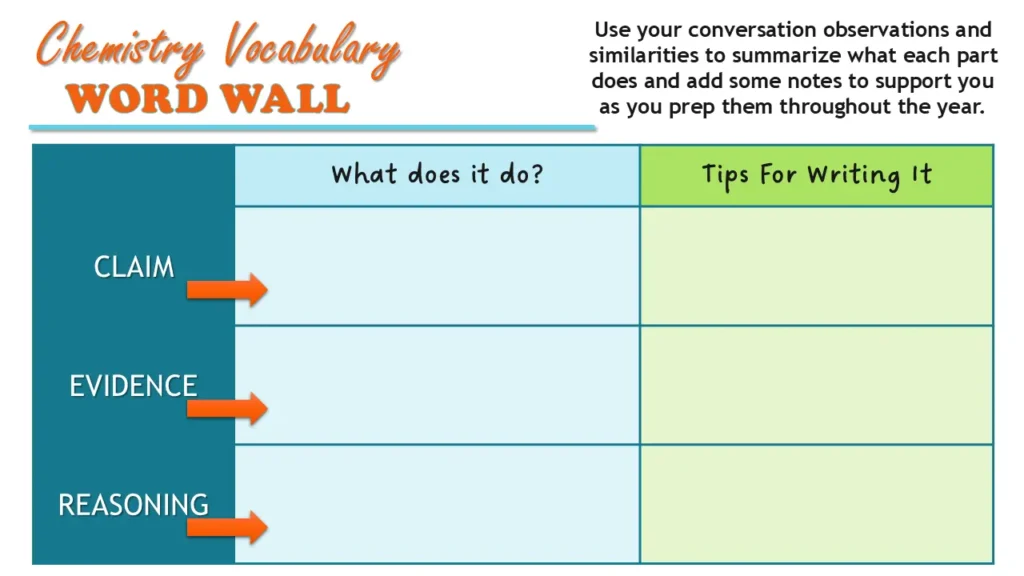
After students investigate three conversations, the lesson returns to the terms claim, evidence, and reasoning. The words appeared at the beginning without complete definitions; now students have examples they can compare.
They look for patterns:
- Claims tend to be short, direct answers or positions that another person could challenge.
- Evidence describes something observable or otherwise documented.
- Reasoning is often longer and more detailed because it supplies the facts, rules, principles, or expert knowledge that explain the connection.
Students use those similarities to determine the job of each component and develop tips for writing their own responses. A class might conclude that the claim answers the question, evidence describes what someone observed, and reasoning provides the detailed scientific facts that explain why the evidence supports the answer.
The teacher still guides the discussion, confirms what students have discovered, and clears up misconceptions. Students may take notes, but they’re taking notes from knowledge the class constructed together—not copying knowledge the teacher delivered before they had a reason to understand it.
“Students are still taking notes—but they’re taking notes from knowledge they constructed together.”
Let Students Create Their Own CER Example
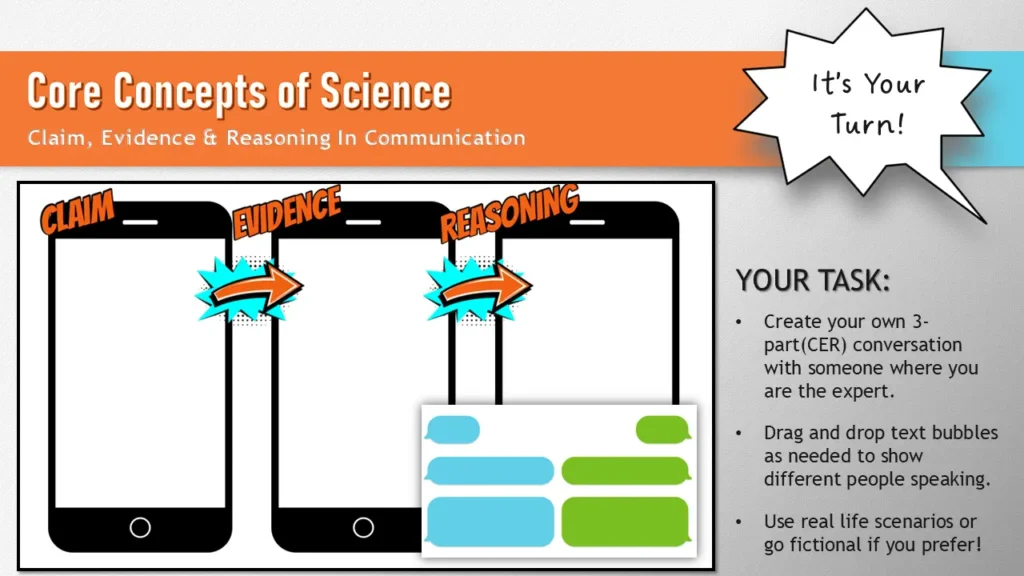
Once students understand the pattern, they create a fictitious conversation in which they’re the expert. They may write from the perspective of a dancer, gamer, athlete, small-engine repairer, artist, musician, baker, or another role rooted in their own experience.
A text-message format keeps the final task familiar and gives students a natural way to show the exchange between a claim, a request for evidence, and an explanation. More importantly, the task communicates that every student already knows something worth explaining.
At the beginning of the school year, those conversations also give the teacher a window into students’ interests and strengths. CER becomes both a science practice and a way to begin knowing the people who will do that science together.
Teach Claim, Evidence, and Reasoning as a Science and Life Skill
Ultimately, this lesson is so much more impactful and far-reaching than CER writing strategy
It helps students understand that evidence matters, why reasoning matters, and how clear communication allows people to evaluate one another’s ideas.
Students will, of course, still need repeated practice, feedback, models, and opportunities to revise. An inquiry-based introduction doesn’t eliminate explicit instruction. It gives the instruction somewhere meaningful to land. When students have already discovered what each component contributes, the rubric and reference materials clarify an experience instead of replacing one.
If you’d like to use this experience with your own students, download The Power of Persuasion lesson and interactive tool.
Then explore Discovery by Design to see how inquiry, purposeful student action, and technology can work together to transform more than one lesson.