Make discovery

your destination!

Discovery By Design

Purposeful Planning Principles That Make Inquiry-Based Science Lessons Possible

Person standing at door waving hello to seated group in a living room or office lounge area.

It was just another day in science class when …

Person using a laptop, with a finger tapping a highlighted area on the screen

you launch an inquiry-based lesson for learning and…

Person with glasses leans over a laptop, anxious expression, in a bright office with a plant nearby.

…your students nearly shut down!

Office scene: a coworker at a desk looks surprised while another, standing nearby, smiles and holds a cup.

Without giving up all the answers, you swoop in with just enough support.

Cartoon of a surprised person with hands over their mouth, facing another person who is handing a green mug.

Soon students realize they simply needed to slow down and say what they see.

Person sitting at a desk with a blue laptop, holding a mug and looking upward in a bright room.

Before long, the learning goals are mastered and confidence is restored!

We Need To L.E.A.D., Not Lecture

Meaningful learning doesn’t happen when teachers do all the thinking for students.

It happens when we intentionally design opportunities for learners to engage with ideas, navigate productive struggle, and discover patterns for themselves.

Large stylized number 1 with orange polka dots and a bold orange shadow on a black background

Lessons

structure that creates flow and sustains focus

Stylized letter E with orange 3D edges and a white dotted surface on a black background.

Engagement

productive struggle that keeps students thinking

Stylized orange-outlined letter A with white fill and orange polka dots on a dark background.

Active Discovery

moments when students begin making meaning for themselves

Decorative letter D with an orange outline and white fill dotted with orange polka dots on a dark background.

Differentiation

strategic support that helps every learner move forward

for

through

with

Pop-art style sunglasses over a lime-green starburst background rendered in halftone dots.

What L.E.A.D. looks like in a lesson

Keep the flow and focus on students’ observations for outstanding outcomes!

Large stylized number 1 with orange polka dots and a bold orange shadow on a black background

Link To Prior Knowledge

Students use what they already know to make inferences that link to learning goals.

Stylized letter E with orange 3D edges and a white dotted surface on a black background.

Engage With An Experience

Students investigate a phenomena, model, or source of data.

Stylized orange-outlined letter A with white fill and orange polka dots on a dark background.

Analyze & Argue Evidence

Students look for patterns and construct explanations.

Decorative letter D with an orange outline and white fill dotted with orange polka dots on a dark background.

Develop Understanding

Students apply, refine, and transfer their learning.

A 3D DECODER KEY FOR L.E.A.D. DISCOVERY

Blue stylized key with a circular head and branching circuit-like arms ending in orange, green, and teal dots.
SEP’s:
What Students DO
CCC’s:
What Students THINK ABOUT
DCI’s:
What Students LEARN

In the Lab In Every Lesson store, badges are used on the product covers to identify the three dimensions of learning embedded in the experience.

Explore the tabs to see:

→  what students do

→  what students think about

→  what students learn

Science isn’t something students memorize—it’s something they practice.

Our SEP badges highlight the primary thinking work students engage in during a lesson:

developing and using models Orange badge with a network of connected dots and the text 'MODELS REVEAL MEANING!'
analyzing and interpreting data Magnifying glass over a rising bar chart inside an orange circle, symbolizing data-driven discovery with the text 'DATA DRIVES DISCOVERY!' below.
obtaining and evaluating information Orange badge featuring stacked documents with a magnifying glass and pencil, and the caption 'RESEARCH LEADS TO REASONING'.
mathematical and computational thinking Logo for Math Meets Matter with an orange circle containing a hand-drawn calculator above the bold text 'MATH MEETS MATTER' on a rounded orange badge.
constructing explanations Silhouette of a researcher with a magnifying glass examining footprints inside an orange circle; a rounded orange banner below reads 'EVIDENCE BUILDS EXPLANATIONS!'
engaging in argument from evidence Orange badge-style graphic with a black gavel silhouette inside a circle and the slogan 'Evidence becomes Explanation!'


Crosscutting Concepts help students identify themes that transfer across all areas of science.

Our CCC badges highlight the lens students use while making sense of their observations.

The most common cross cutting concepts embedded include:

patterns Neon-green badge with a black zigzag lightning bolt and the bold text 'PACKED WITH PATTERN POWER!' (promotional graphic)
cause and effect Neon green circular badge with a person tipping domino blocks, and a green rounded speech banner reading “WHY' CREATES WHAT!”
structure and function Bright green badge saying 'FORM EXPLAINS FUNCTION!' with a circle of interlocking gears and curved arrows behind it, symbolizing mechanism and meaning behind form.
scale, proportion, and quantity Bright green infographic icon with a ruler and bidirectional arrows and the bold caption 'SIZE SAYS IT ALL' highlighting size importance.
systems and system models Logo featuring a green circular icon with a network diagram and a hand pointing to the center, above a green badge reading 'SYSTEMS MAKE SENSE!'
energy and matter Neon green badge featuring a circular icon with left and right arrows and the CTA 'TRACK THE TRANSFERS!'
stability and change Green badge featuring a scales icon and the slogan 'Sort out what shifts & what stays' in bold black text on a neon green background.


The DCI badge identifies the content understanding students develop through the lesson experience.

These are the scientific concepts and explanations students are working toward—not the starting point of the lesson.

Unlike the SEP’s and CCC’s of which there are a set number defined by the NGSS, these badges will be unique for each lesson product listing.

Some examples include:

states of matter Three cups arranged in a circular, cyclical process with orange beads moving between them, connected by blue arrows to show transfer around the loop.
the mole quantity Magnifying glass over a colorful circular data visualization, symbolizing data analysis and investigation.
atomic theory timeline Timeline of scientific illustrations arranged along a curved orange arrow, with five framed diagrams.
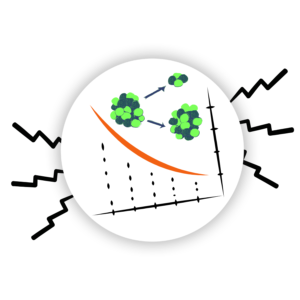
half-life of radioactive decay Abstract biology diagram: three green cell clusters with an orange downward-curving line on a coordinate plane showing decline over time.
combustion reactions and equations Fire/flame icon inside a white circle, indicating heat or danger status

How Will You

Do Discovery?

DESIGN IT YOURSELF

Learn the L.E.A.D. framework and build inquiry-based lessons that move students from observation to explanation.

Get the

Active Learning Action Plan

Join the

Digital Instructional Design Studio

DELIVER IT TOMORROW

Get access to ready-to-teach chemistry lessons with discovery design already done for you.

Shop The Store

On TpT

Explore The Complete Curriculum

In Beyond The Beaker