
An inquiry-based way to introduce the science and engineering practices at the beginning of the year
Students can’t learn to do science by hearing us explain how science works. In this article, you’ll learn why the traditional scientific-method review remains teacher-centered even when it is active, how to flip the sequence so students encounter the science and engineering practices before we name them, and how one of my favorite science and engineering practices examples—a standards-sorting activity—can reveal what doing science will actually look like all year.
Learning Science Is Like Learning to Ride a Bike
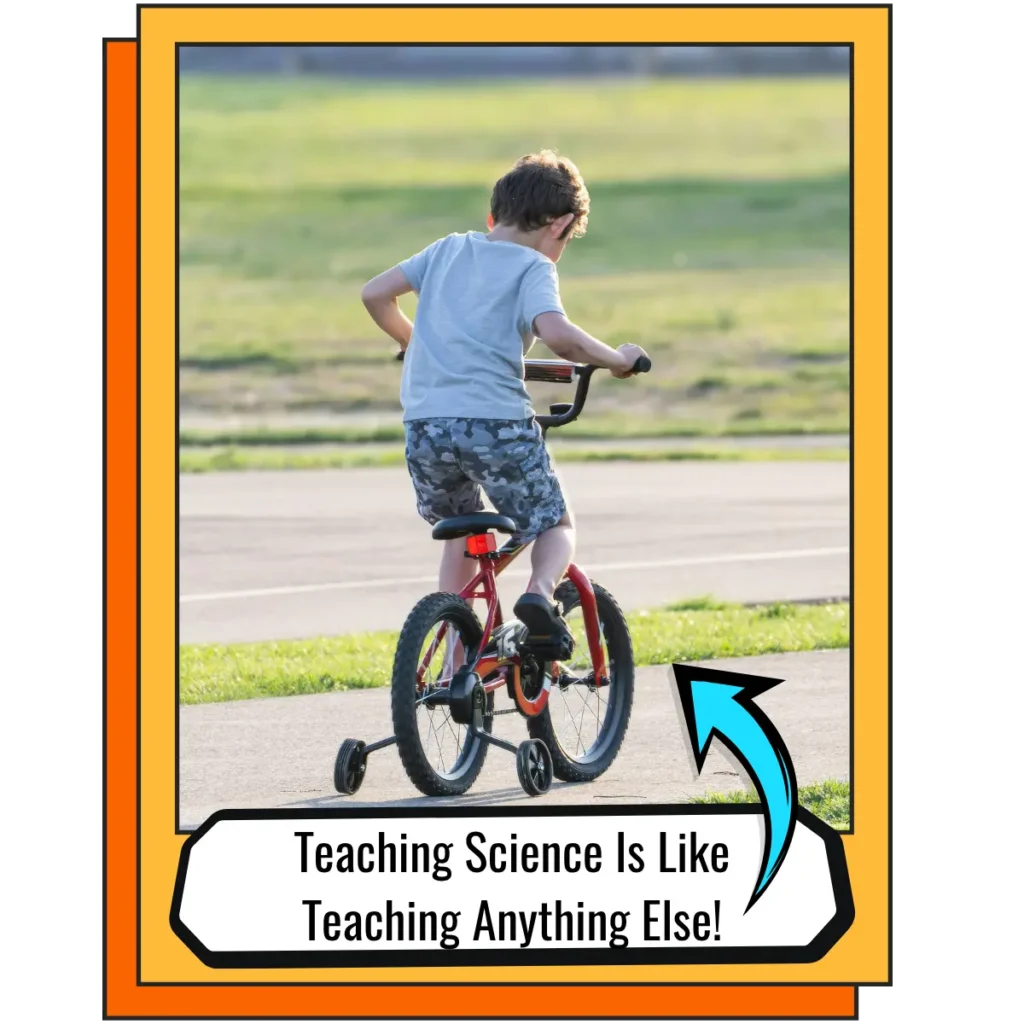
Think for a moment about something most of us have learned—or helped a child learn—to do: ride a bike!
We might begin with feet on the ground or training wheels. We can explain what the pedals do, where to place their hands, and how to steer. We can show pictures and videos, and children have probably watched other people ride. All of that gives them the right general idea.
But we don’t expect them to ride well because we told them how. At some point, they have to climb onto the bike and begin finding their balance.
Show and tell has merit. The problem is what we expect it to accomplish—and where we place it in the learning sequence.
“We cannot teach students to do science through explanation any more than we can teach a child to balance on a bike by describing it.”
Why Show and Tell Belongs Later in an Inquiry Lesson
At the beginning of the school year, many secondary science teachers review the scientific method:
- observation
- questioning
- hypothesizing
- testing
- analyzing
- communicating findings
We might use a clever ordering activity or invite students to discuss the steps, but we’re still telling them the structure up front.
In inquiry-based, discovery-based, three-dimensional science instruction, that show-and-tell is displaced.
It belongs closer to the end—after students have encountered the process, tried to use it, and developed some ideas of their own. Then direct instruction can clarify misconceptions, assign disciplinary language, and help students go deeper.
If our goal is for students to practice science, the first activity of the year should prove that we mean it.
My Original Scientific-Method Lesson Was Active—but Not Fully Inquiry-Based
The lesson I used to use to accomplish this was a good one. It began with clear learning intentions and success criteria, then gave students an accessible real-life scenario in which they could practice the scientific method. It was active and collaborative. But it still began by giving students the framework they were supposed to use.
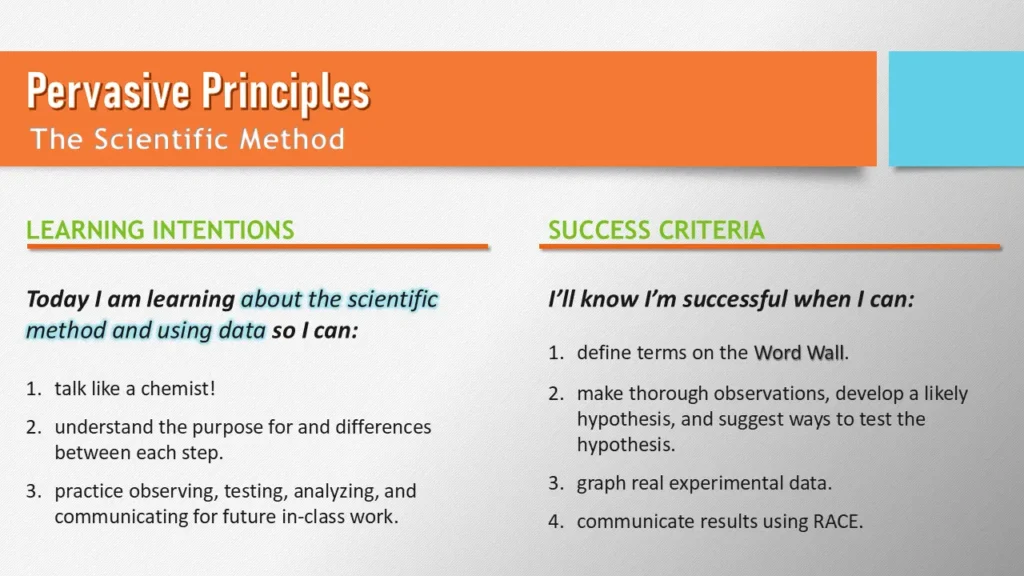
How Learning Intentions Support Active Science Learning
Learning intentions separate the purpose from the task. It should answer the question, “Why are we spending a precious 50 minutes on this?”.
In this lesson example, the answer was not merely that students’ brains had been on vacation for three months and needed a refresher. I wanted them to understand the purpose of the scientific process and begin practicing it again.
The success criteria identified what students would do:
- make observations
- develop a hypothesis
- suggest ways to test it
- present data
- communicate their thinking
An Approachable Scientific Method Lesson Example
The remainder of the lesson asked students to apply the process to a crying baby. The context mattered. Students weren’t accountable for unfamiliar or technically difficult content; they already knew that babies need food, comfort, sleep, or a clean diaper.
That familiarity opened the door to good discussion. Students could make observations, propose explanations, suggest tests, and work through the process together without being distracted by complex scientific knowledge.
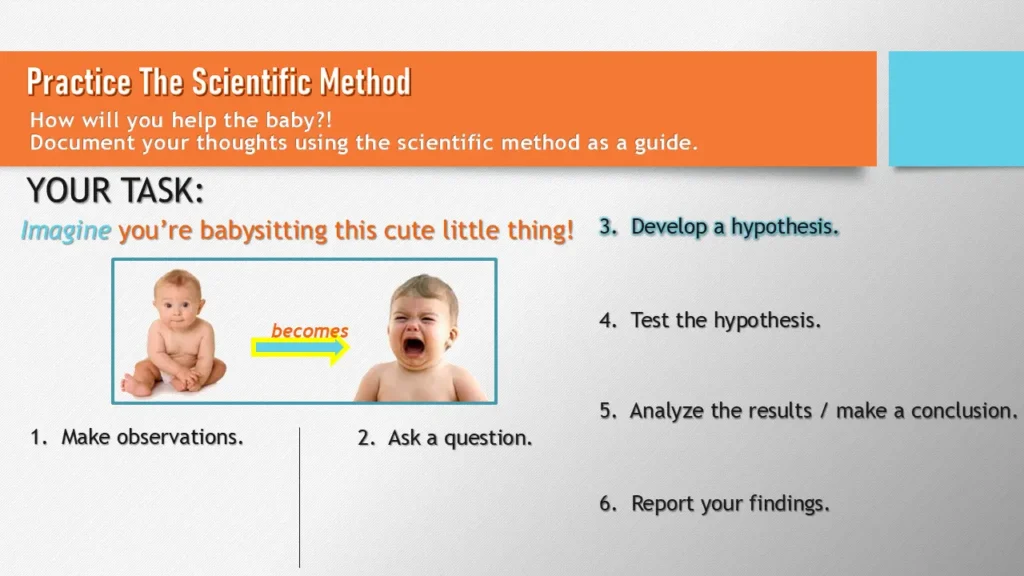
This lesson worked!
But, around here, even if it’s not BROKEN, I fix it!
It was not deeply inquiry-based. It was far better than reading definitions from a slide.
I had to determine how to move the discovery even earlier in the sequence of learning.
Where Vocabulary Belongs in an Inquiry-Based Science Lesson
Moving discovery earlier raises a reasonable concern: If we don’t explain the scientific process and introduce its terminology first, how will students learn the vocabulary they need? Inquiry-based instruction doesn’t mean removing vocabulary or direct teaching from the lesson. It means reconsidering where they belong in the learning sequence.
Chemistry students still need to distinguish a polyatomic ion from a monatomic ion, a reactant from a product, and ionic bonding from covalent bonding. Biology students need the names of cell structures, macromolecules, and reproductive processes.
Disciplinary literacy is part of our job. We need to give students precise words for the concepts they uncover.
The key question is when.
“Let students encounter the idea, think about it, and begin to describe it. Then give them the language that makes their thinking more precise.”
Instead of saying, “Here is meiosis; now learn what it means,” we can let students observe a process, notice what changes, identify patterns, and propose an explanation. Then we can confirm: “Yes—you’ve got it. That process is called meiosis.”
Inquiry flips the sequence from name, explain, and practice to encounter, think, and name.
That sequence—encounter, think, and then name—became the design principle behind my new beginning-of-the-year activity. Instead of introducing the science and engineering practices through definitions, I wanted students to discover what those practices would look like across the course.
A Science and Engineering Practices Example: Standards Sorting
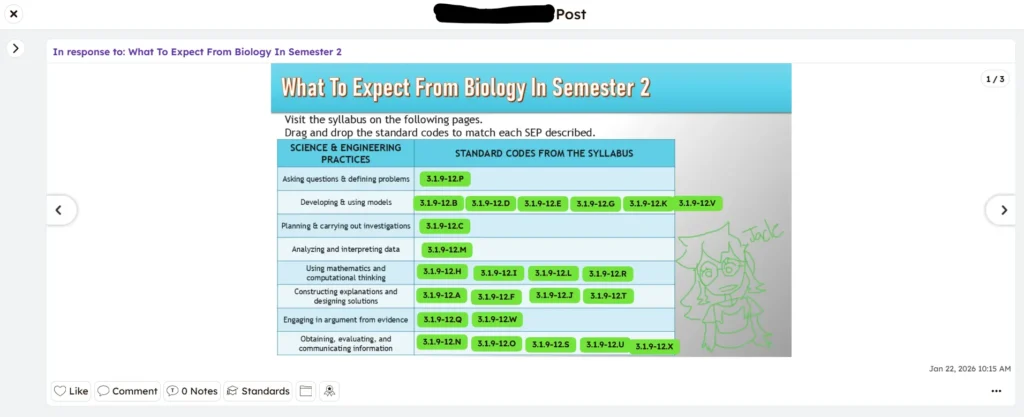
To introduce the science and engineering practices at the beginning of the year, I created a drag-and-drop activity in Seesaw. The platform is marketed heavily toward elementary classrooms, but it is an exceptionally flexible tool for interactive secondary learning.
The activity can be recreated in another technology tool if needed. The essential design is not the platform; it is what students are asked to notice and do.
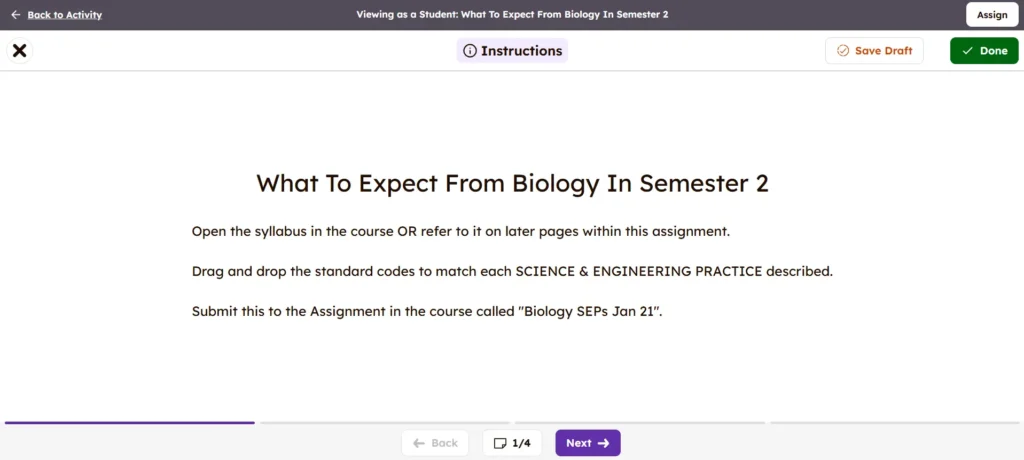
Turn Your Science Syllabus Into an Active Learning Tool
The directions ask students to open the syllabus and drag each standard code into the science and engineering practice it best represents.
The final pages of the syllabus contain the standards, their codes, and the full standard language. In the previous article in this series, I explained why a syllabus should avoid overwhelming students with too much technical language. At first glance, including standards and codes may seem to violate that principle.
The difference is that the standards are not there simply to be read. They are raw material for an activity.
Students also learn something important about the teacher’s role: I have requirements too! I don’t arrive each day and choose an activity simply because I feel like teaching that way. The standards shape what I’m responsible for designing—and, therefore, what students will be expected to learn and do.
Use SEP Action Words to Make Science Standards Student-Friendly
Pennsylvania’s STEELS standards are derived from the Next Generation Science Standards, and the biology standards include a great deal of content. To make the task approachable, I bolded the action phrase within every standard.
A standard might contain intimidating language about cellular division, differentiation, complex organisms, cycling matter, or energy flow. But the bold phrase tells students what they will actually do: construct an explanation based on evidence, use a model, develop a model, or use mathematical representations.
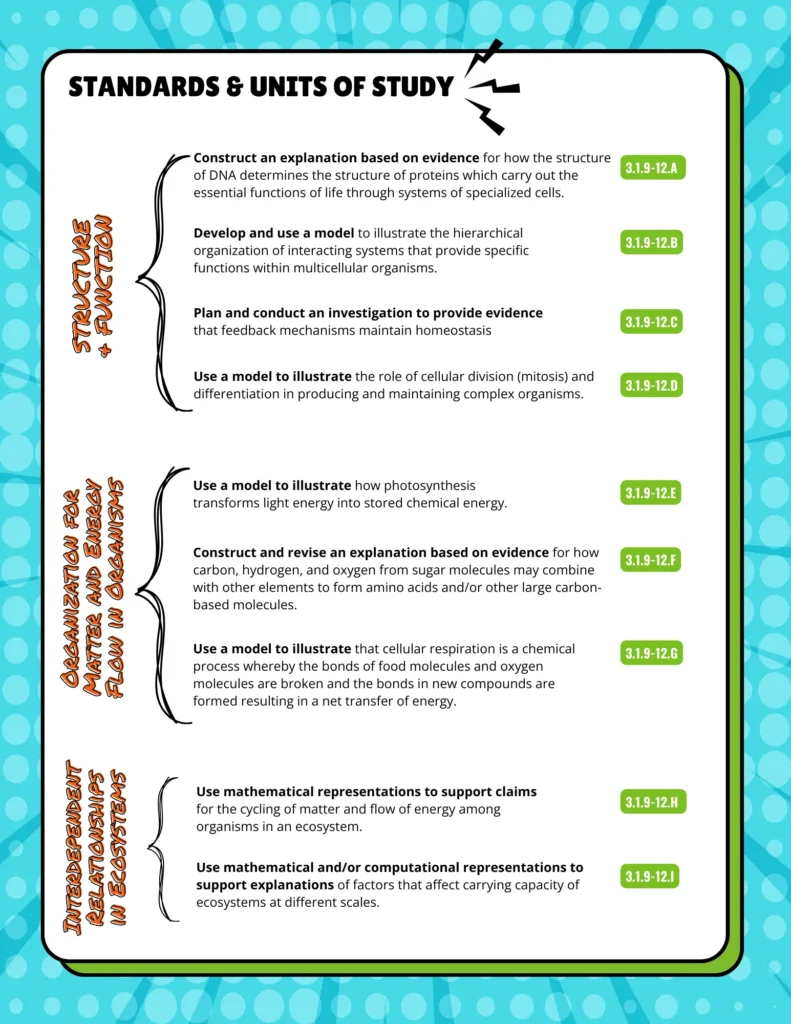
Students can begin with a practice and look for standards that match it, or begin with a standard and determine which practice its action language represents. Either way, they must read, interpret, compare, and make a defensible choice.
A Science and Engineering Practices Sorting Activity
For example, “use a model to illustrate the role of cellular division, mitosis, and differentiation in producing and maintaining complex organisms” contains a great deal of unfamiliar content. A student may not yet understand mitosis or differentiation. But the student can identify the central expectation: use a model to show how something works.
That distinction changes how students understand both learning and assessment. They won’t be asked only to answer multiple-choice questions about mitosis. They will use and create models to demonstrate understanding.
A standard that asks students to use mathematical representations to support claims belongs with using mathematics and computational thinking. A standard that asks students to construct an explanation belongs with constructing explanations and designing solutions.
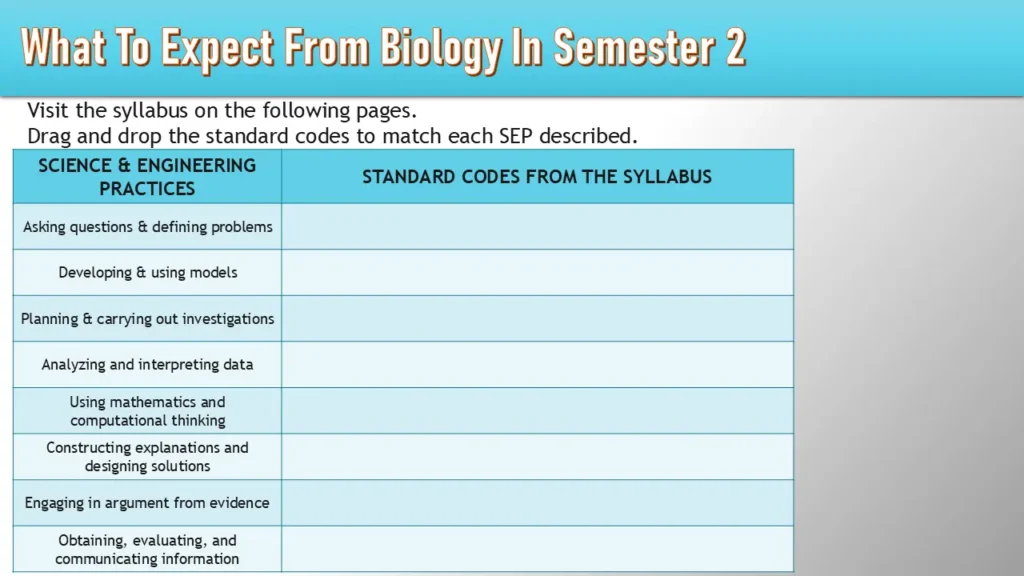
The Completed Sort Reveals How Students Will Do Science
Once students finish, the collection of sorted standards becomes data they can analyze. They are no longer looking at isolated codes and technical phrases. They can identify patterns in what the course will repeatedly ask them to do.
Developing and Using Models Becomes a Coursewide Practice
In the completed biology example, developing and using models immediately stands out. Several standards require students to use or develop a model for different content.
Students can see that they will draw, interpret, evaluate, and use models again and again. Modeling isn’t an occasional project or decorative diagram. It’s a recurring way of learning and demonstrating understanding.
Mathematics and Computational Thinking in Biology
Using mathematics and computational thinking also appears repeatedly. That observation can surprise students who don’t expect much mathematics in biology. They don’t yet know that genetics will involve probability or that matter and energy can be represented quantitatively, but the pattern prepares them for what is coming.
What the Science and Engineering Practices Reveal to Teachers
The completed sort can reveal which practices appear less frequently in the formal standards. In this biology set, planning and carrying out investigations and analyzing and interpreting numerical or graphical data appear less often than modeling or communicating information.
That doesn’t mean students will rarely analyze observations. A well-designed inquiry lesson can ask students to observe, compare, and interpret every day. But the standards pattern helps the teacher see where the formal emphasis lies—and where intentional lesson design may need to add balance.
Science Is Bigger Than the Traditional Lab Station
Some teachers may look at this activity and think, “That isn’t science. Science happens at a lab station with specialized instruments, chemicals, and equipment.”
Hands-on investigation is valuable, but it is not the entire definition of science.
“Science is observing and thinking, doing and thinking again, then sharing the idea so someone else can question it and begin the process again.”
Models, evidence, explanations, mathematical reasoning, communication, and pattern recognition are not substitutes for science.
They are science.
When inquiry-based lessons immerse students in those practices, lab thinking can happen far more often than traditional lab day.
This Framework Worked Even When the Content Was New to Me
For almost everything I had shared publicly, chemistry was my expertise. I had taught it for 15 or 16 years and developed my Discovery by Design framework within that content.
Then my school changed my assignment in December 2025. Funding changes led to significant staff layoffs, students had to be redistributed, and I was assigned biology classes in the middle of the year. I didn’t even realize I was legally qualified to teach biology, and I had not taken a biology course since college!
The existing biology teachers generously shared their materials. Most were lecture notes—and because I did not know the content well, the temptation to project those notes and conduct “science story time” was strong.
But I knew that reading information to students was not the best learning experience I could provide. Once I worked through my own panic, I applied the same lesson-design framework to unfamiliar content.
Use Observation to Begin an Inquiry-Based Science Lesson
The science and engineering practice I lean on first is observation: What do you see?
Most students can observe something and interpret what they see on some level. Their willingness to share may vary, but observation gives nearly everyone an entry point. Students don’t have to identify themselves as “science people” before they can begin.
“When the first question is simply “What do you see?” students can enter the science before deciding whether or not they believe they are good at it.
Why Inquiry-Based Science Produces Meaningful Engagement
The biology students did become engaged, although some resisted because the approach was unfamiliar. Engagement wasn’t created by adding entertainment to lecture notes. It emerged because students had something meaningful to observe, interpret, model, discuss, and explain.
That experience confirmed that Discovery by Design wasn’t limited to chemistry content and chemistry teachers!
If the framework could help me transform unfamiliar biology content in the middle of the year, it could help another teacher redesign one familiar lesson at the beginning of the year.
The Question That Starts it all
If you want to make a lesson more discovery-based, begin with one question:
“What can students do to see what I want them to see?”
Don’t begin by asking how you’ll explain the concept(s) more clearly.
Identify the pattern, relationship, distinction, or idea students need to notice. Then design something they can observe, sort, model, compare, test, or interpret.
Once you identify the something students will do, the lesson often begins to write itself.
This is the thinking behind Discovery by Design, my approach to creating science lessons in which students encounter important ideas through purposeful action before the teacher explains and names them.
If this example has you reconsidering where explanation belongs in your own lessons, explore the complete framework and see how inquiry, action, and technology work together.