How to redesign your syllabus for inquiry-based learning and a student-centered classroom culture
Your syllabus does more than list course policies. It gives students and families their first clues about who holds the knowledge, what learning will look like, and what kind of participation your classroom values. In this article, you will learn how to redesign a traditional science syllabus so it introduces inquiry-based learning, communicates a student-centered culture, and becomes an experience students can actively think with instead of another document they endure.
Your Syllabus Is Already Teaching
If I were beginning to implement inquiry-based learning consistently in my science classroom this year, I would start by rethinking the course syllabus.
That may sound like a strange place to begin. A syllabus is usually treated as a course document: a place for the description, grading policy, materials list, rules, deadlines, and contact information. But in an inquiry-based classroom, it can be much more than that. It can be the first expression of the classroom culture you intend to create.
Before students complete a single assignment, before families arrive for back-to-school night, and before an administrator walks through your classroom, anyone who reads your syllabus has already formed an impression of what learning will look like there.
“Your syllabus can be the first expression of the classroom culture you intend to create.”
Teaching through inquiry is a very different experience from delivering lectures and notes every day. If curiosity, student action, productive struggle, collaboration, and technology will be central to the course, the syllabus should begin communicating those priorities immediately.
A Better-Looking Syllabus Is Not Necessarily More Engaging
For several years, I used what I believed was a more fun and engaging chemistry syllabus. I created it in Piktochart as a colorful, science-themed infographic and kept it on my course website. Because I teach in a cyber school, it did not need to be printed, so I could make it long, visual, and interactive.
It welcomed students to our “learning laboratory,” introduced me, shared a few personal details, and even included conversation starters. I wanted students to ask why I liked certain hobbies or what I thought about particular topics. In a virtual classroom, where two-way interaction can be difficult to establish, those details had a genuine purpose.
Then came the course description, graded assignments, homework, weekly practice, learning experiences, unit tests, grading policies, and academic honesty policies. In other words: read, read, read, read, read.
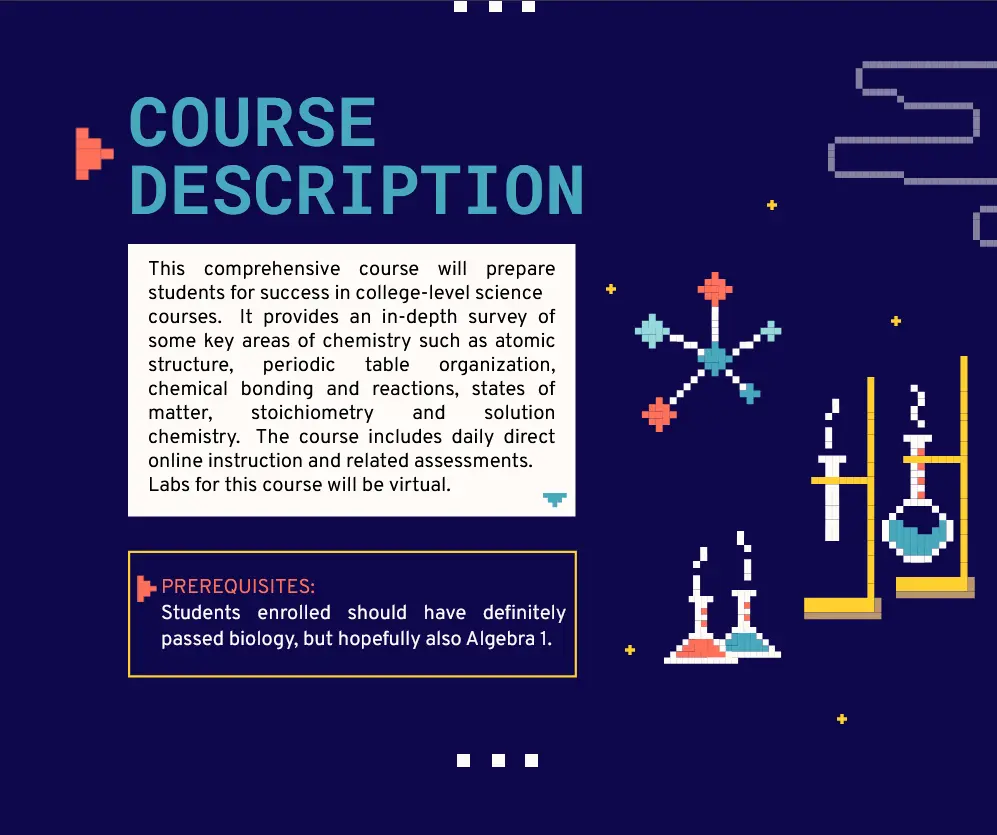
The design looked playful and scientific, but the students’ role had not changed. They were still receiving information from me. The document looked engaging without actually asking them to engage.
“Looking the part does not actually make a syllabus engaging.”
What Canva Templates Reveal
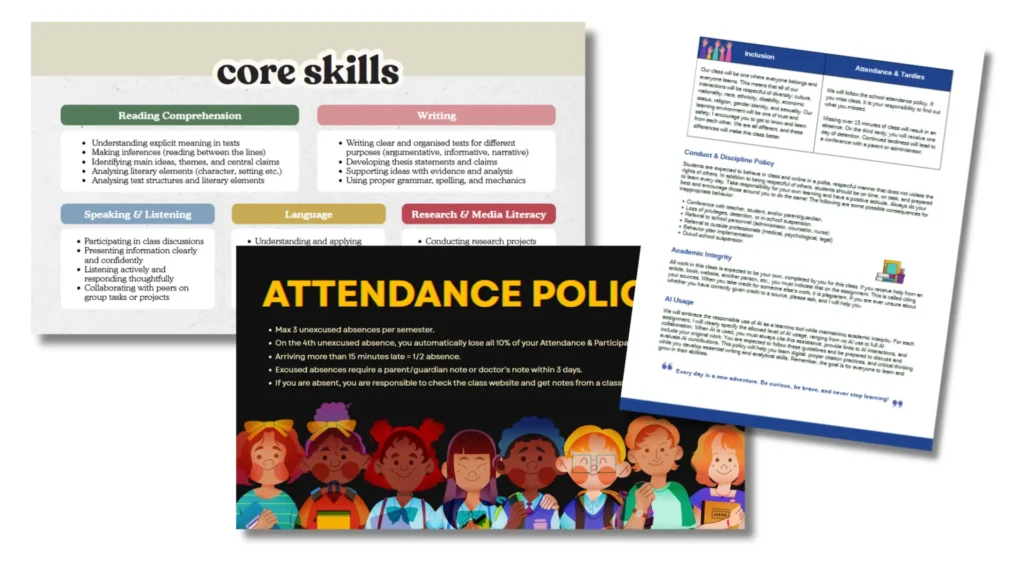
Today, many teachers would begin a syllabus redesign by searching Canva. That is a reasonable place to look: the templates are attractive, editable, and full of useful layout ideas. But when I examined several syllabus templates, I noticed that most of them followed the same underlying pattern.
They began with the teacher: who I am, what this course is about, what you need, what you will do, and how I will grade you. Then came pages of expectations, materials, procedures, and rules. Even presentation-style templates designed to be delivered as a lesson often positioned the teacher as the expert who would tell students all the things.
Some templates included genuinely useful elements, such as brief explanations of why the course matters, a support network, important dates, or encouraging statements. But classroom culture was often reduced to one small section buried beneath the information every other teacher was also sharing.
Three Shifts That Make a Syllabus More Student-Centered
1. Move Most Rules Somewhere Else
Rules have a place. Students need clear boundaries, and teachers need workable procedures. But a syllabus does not have to become a wall of prohibitions.
Display the rules where students will use them. Practice important procedures. Invite students to help discuss or develop classroom agreements where that makes sense. If the syllabus is meant to establish culture and help students think, pages of rules can turn them off before they encounter anything that makes the class feel inviting or different.
Imagine being in seventh period and reading your seventh syllabus of the day. Another dense page of policies is not likely to communicate curiosity or possibility.
2. Replace Word Walls With Bite-Sized Meaning
Science teachers may love a good vocabulary wall, but a syllabus can become a different kind of word wall: one students hit and immediately decide they cannot climb.
Students do not need an entire pacing guide, a college-style catalog of learning outcomes, or every technical standard on the first page. They are usually looking for a few practical answers: What will this class be like? What will I have to do? How will I be evaluated? Can I succeed here?
Keep the most useful information short, clear, and easy to scan. When possible, use small sections that communicate meaning without overwhelming students with everything they will encounter all year.
3. Stop Making the Teacher the Center of the Story
An “About Me” section can help humanize the teacher, especially in a virtual classroom. But when the entire document begins and continues with what the teacher knows, expects, requires, and will explain, it quietly reinforces a teacher-centered model.
An inquiry-based syllabus should turn toward the learner quickly. What will students explore? How will they participate? What habits will help them succeed? What will they be trusted to figure out?
Anatomy of an Inquiry-Based Science Syllabus
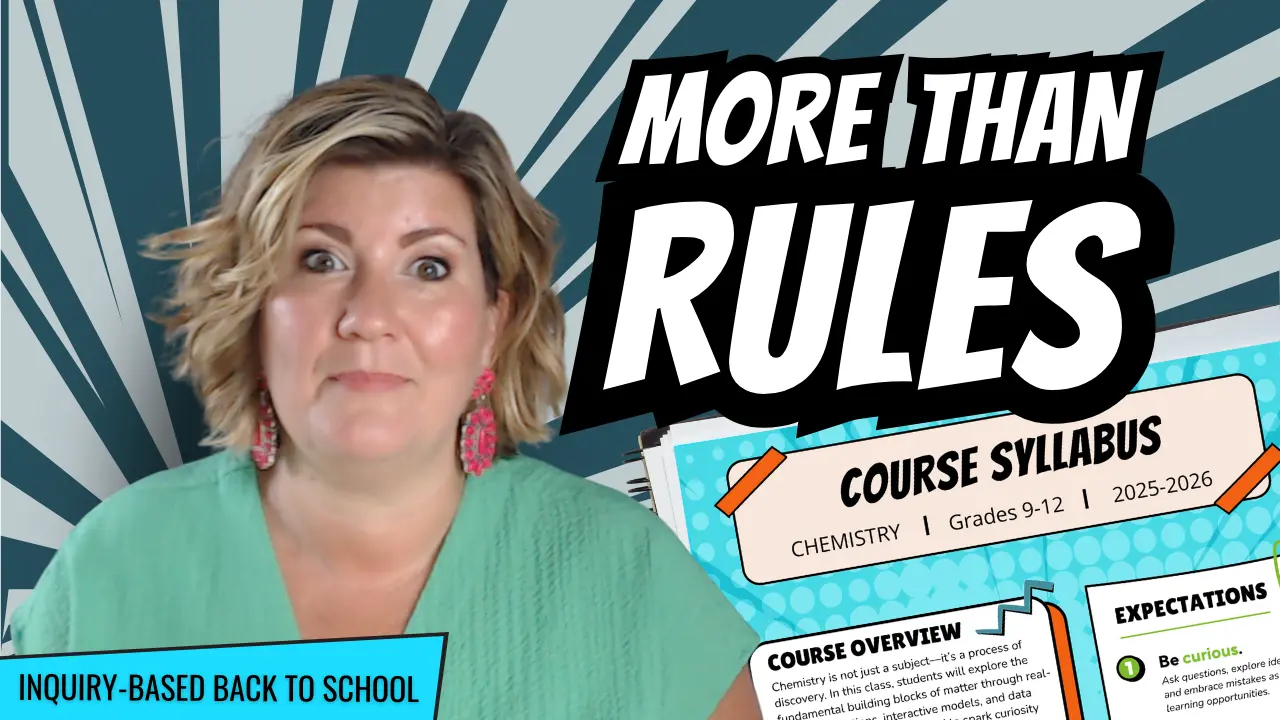
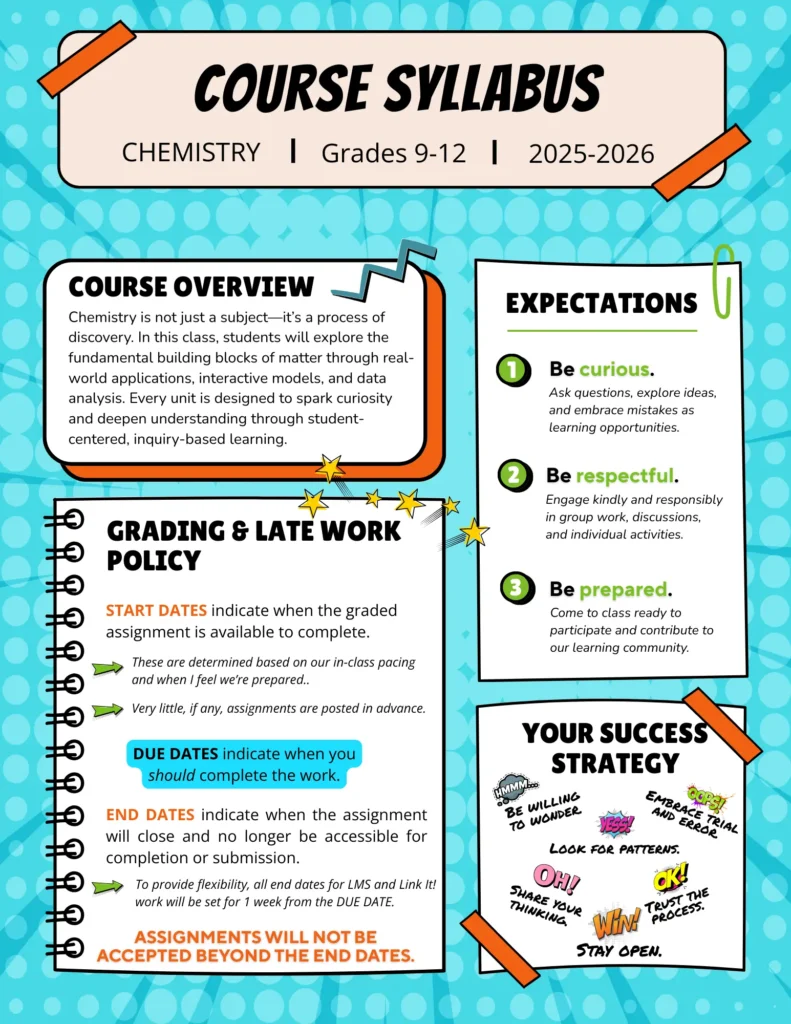
When I redesigned my chemistry syllabus, I began with a Canva template that placed expectations near the top instead of burying them at the end. I borrowed the layout cues, then changed the content to reflect the kind of learning students would actually experience.
The Course Overview Explains How Learning Will Happen
The course overview is intentionally short. It does not list reactions, stoichiometry, atomic models, bonding, or every other chemistry topic. Students do not need a detailed content inventory on the first day.
Instead, the overview explains that students will explore the fundamental building blocks of matter through real-world applications, interactive models, and data analysis. It tells them that every unit is designed to spark curiosity and deepen understanding through student-centered, inquiry-based learning.
That language communicates content and expectations at the same time. Students immediately learn that they will use models, analyze data, investigate real-world situations, and take an active role in learning.
“Our goal is not simply to deliver the content. Our goal is to allow students to uncover it.”
Expectations Focus on Habits, Not Compliance
After the overview, the syllabus answers the next logical question: What do I need to be and do to succeed in this kind of class?
Students are asked to be curious: ask questions, explore ideas, and embrace mistakes as learning opportunities. They are asked to be respectful because inquiry often involves collaboration and small-group work. They are asked to be prepared—not merely by bringing a list of materials, but by arriving ready to participate and contribute.
How many syllabi tell students on the first day that mistakes are expected learning opportunities? That one statement signals that they have entered a different kind of classroom.
The Success Strategy Builds Confidence
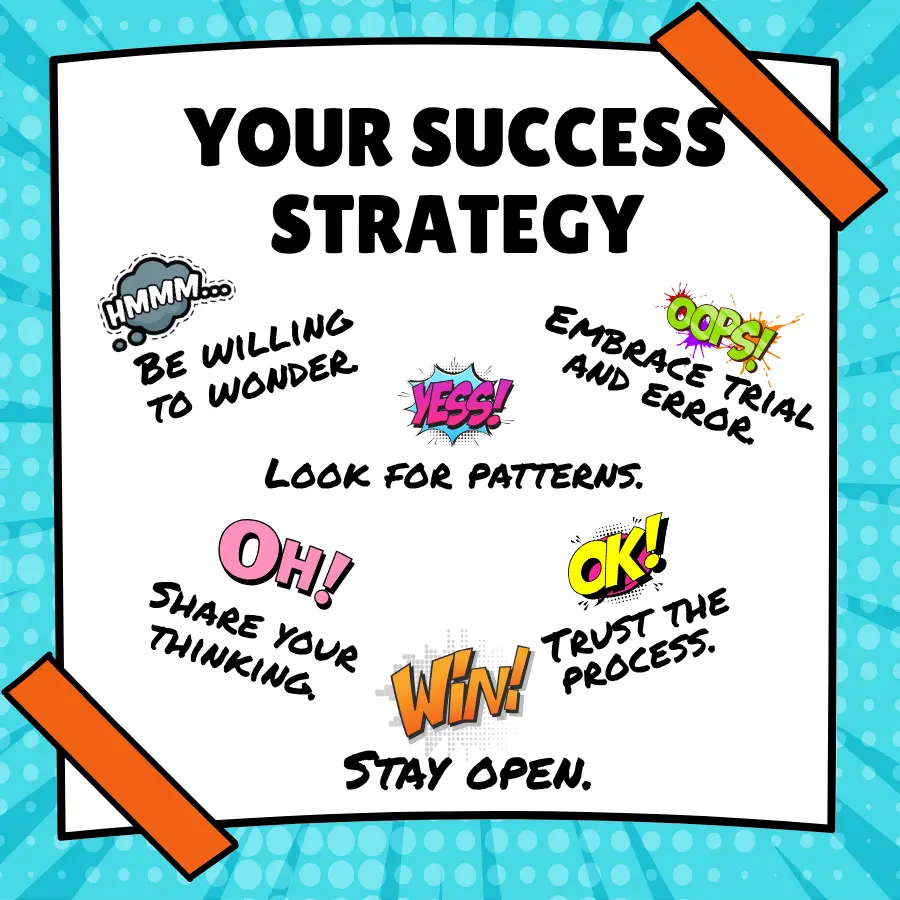
Where the original Canva template listed materials to bring, I created a “Your Success Strategy” section. By the end of page one, students may be thinking: I do not know exactly what I will learn, but I know I will be doing a lot. I will have to participate, investigate, and figure things out. What if I have never learned this way before?
Our job is to answer: You can do it.
The success strategy does not lead with warnings about missing assignments, cell phones, or artificial intelligence. It gives students six actions that build both skill and confidence: be willing to wonder, embrace trial and error, look for patterns, share your thinking, trust the process, and stay open.
These statements connect directly to the inquiry-based experience. Wonder supports curiosity. Trial and error makes exploration possible. Looking for patterns supports data analysis. Sharing thinking reinforces collaboration. Trusting the process and staying open reassure students that unfamiliar learning can still be safe and achievable.
“Inquiry may feel unfamiliar to students. The syllabus should raise the expectations and their confidence at the same time.”
Let the Grading Plan Reinforce What Science Is
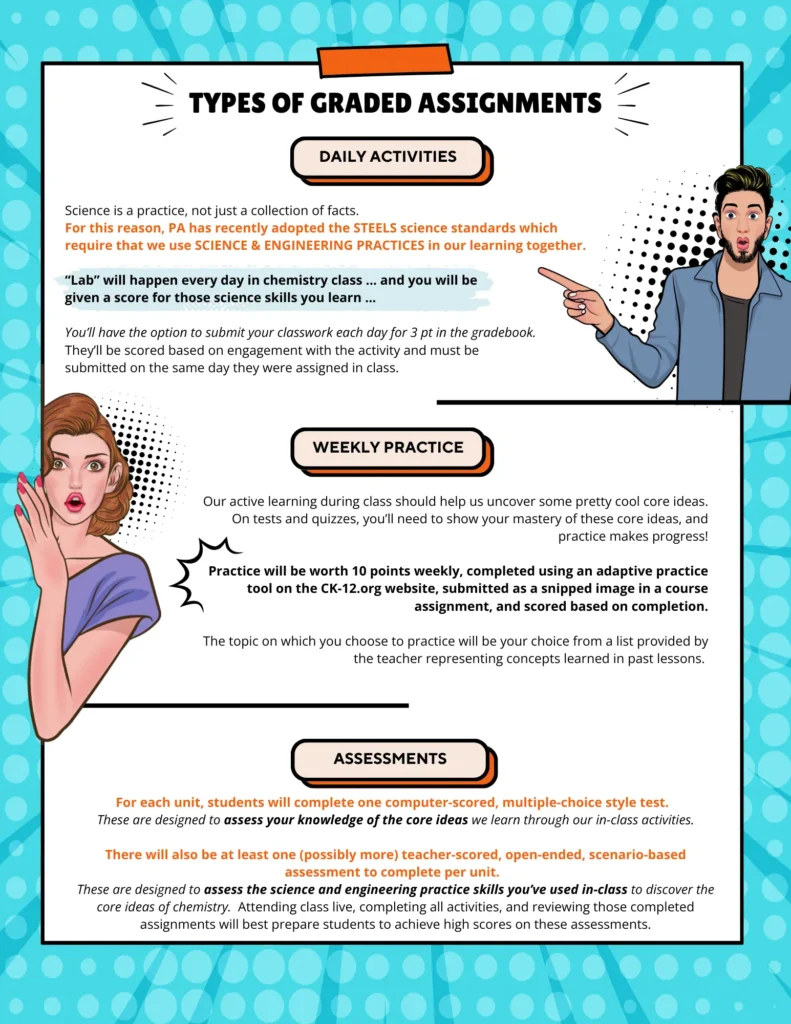
The second page of my syllabus explains grading and the three types of work students will complete. I kept it deliberately simple because the categories themselves help reinforce the course philosophy.
Daily Activities: Science and Engineering Practices
Daily activities emphasize that science is practice, not just facts. Students will use the science and engineering practices to explore, model, analyze, explain, investigate, and communicate.
This is especially important in a cyber classroom, where students often ask how a science course can include labs without everyone having the same physical materials. My answer is that lab thinking can happen every day. Students can engage in the practices of science through thoughtfully designed experiences, even when a traditional hands-on lab is not possible.
“Science is practice, not just facts. Lab thinking can happen every day.”
Weekly Practice: Disciplinary Core Ideas
Inquiry does not eliminate scientific knowledge. Scientists have produced important explanations and core ideas, and students need to understand them.
Weekly practice gives students opportunities to strengthen that content knowledge. The difference is that facts are not treated as the entire purpose of science class. Students learn the ideas while also learning the thinking processes scientists used to develop them.
Assessments: Putting the Dimensions Together
Assessments ask students to demonstrate mastery of the core ideas while also applying science and engineering practices and recognizing crosscutting concepts. Traditional questions may still have a place, but claim-evidence-reasoning responses, models, explanations, and other open-ended tasks reveal more about how students think.
The syllabus does not need to teach the entire Next Generation Science Standards framework. It simply needs to show that what students do, what they know, and how they connect ideas all matter.
Include the Standards—But Give Students Something to Do With Them
The final page of my syllabus includes the science standards. That may sound like a recipe for first-day overwhelm. Standards contain technical language about fission, fusion, radioactive decay, electron states, and other unfamiliar content.
I did not include them so students could read a wall of jargon. I emphasized the action phrases: develop models, use models, construct explanations, plan and conduct investigations, and so on. Those verbs are the science and engineering practices—and they create an opportunity for a first-day inquiry activity.
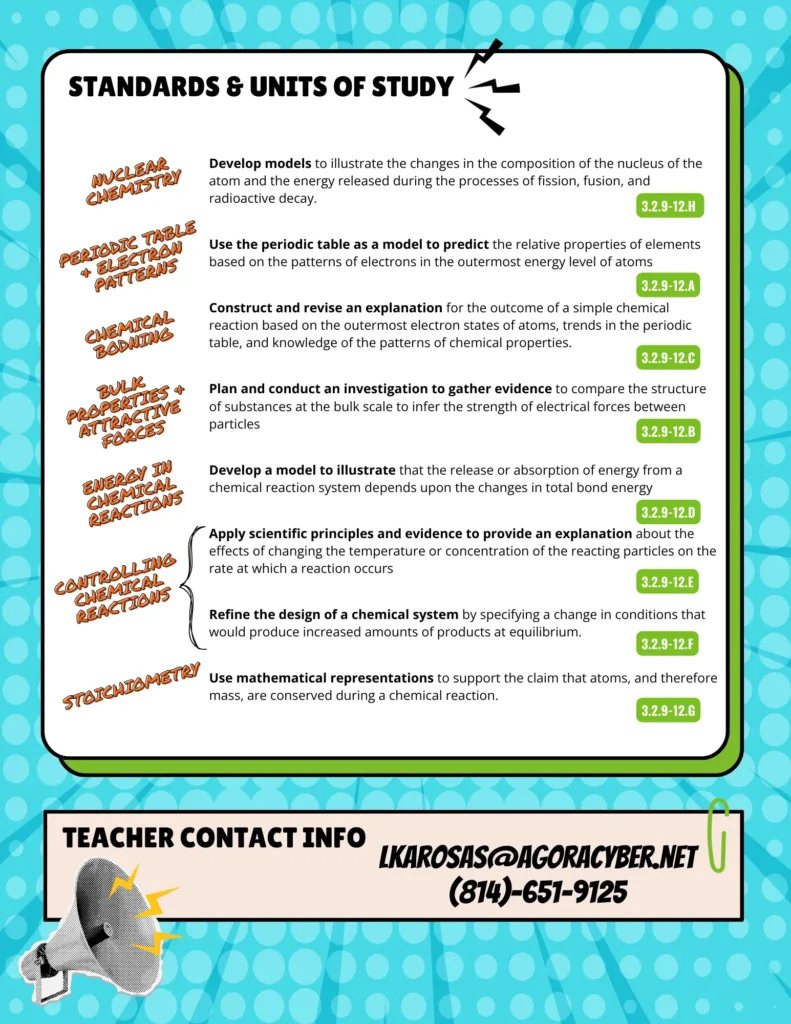
The standards page can become raw material students examine, sort, connect, question, or use to make predictions about the course. Instead of telling students everything they will learn, we can let them begin uncovering the patterns themselves.
To see exactly what that can look like, explore this science and engineering practices example, in which students sort standards by the type of scientific thinking they require—and use the completed sort to predict how they will do science throughout the course.
Do Not Read the Syllabus—Design an Experience Around It
Redesigning the document is only half of the transformation. If I place a student-centered syllabus on the screen and then read every word aloud, students are still receiving information passively.
The first-day experience should match the culture the document promises.
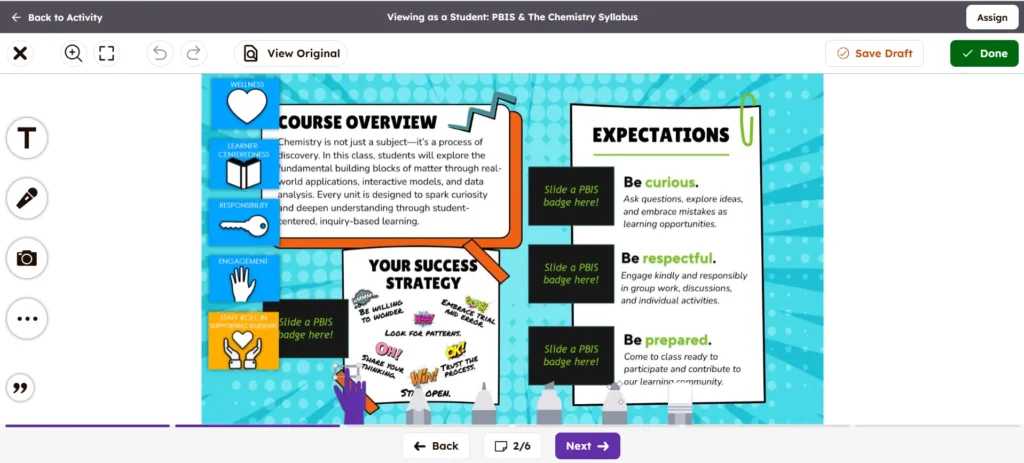
A syllabus scavenger hunt is one possibility. In my classroom, I created a Seesaw activity that asked students to connect sections of the chemistry syllabus to our schoolwide PBIS expectations: wellness, learner-centeredness, responsibility, and engagement.
How the PBIS Connection Activity Works
Students drag and drop PBIS badges onto black boxes placed throughout the syllabus. They may use more than one badge when they believe several expectations apply.
Being respectful and kind during discussions might connect to wellness. Being prepared may initially sound like responsibility, but because the syllabus defines preparedness as being ready to participate and contribute, students may also connect it to engagement. The “Your Success Strategy” section is clearly learner-centered, but it also supports wellness by reassuring students that challenge, mistakes, and uncertainty are manageable.
There is not always one correct answer. Students have to examine the language, interpret its meaning, identify relationships, and justify their choices. That makes the activity a higher-depth-of-knowledge task rather than a decorative scavenger hunt.
“Don’t read the syllabus to students. Give them a reason to think with it.”
Why This Matters Beyond Syllabus Day
The activity helps students understand the course while also connecting chemistry to the expectations they encounter across the school. It prevents the inquiry-based classroom from feeling like one teacher has suddenly gone off the rails and begun asking too much.
Instead, students see that curiosity, participation, responsibility, communication, and wellness belong to a larger learning culture. The chemistry course becomes one place where they will practice those habits in a particularly scientific way.
Begin the Transformation Before the First Lesson
A syllabus cannot create an inquiry-based classroom on its own. But it can establish the promise of one.
When students first encounter your course, the document can tell them that science will be something they do—not merely information they receive. It can communicate that curiosity matters, mistakes are part of learning, collaboration is expected, and the teacher has designed a process students are capable of navigating.
Then the first-day activity can prove that those words are true.
Your next step is to choose one section of your current syllabus and ask what it teaches students about their role. Does it position them as recipients of rules and information, or as active participants in a learning process? Revise that section first.
Then explore the next article in this series to see how I turned the standards page into an inquiry experience that introduces the science and engineering practices from day one.