One simple system for reinforcing science and engineering practices every day
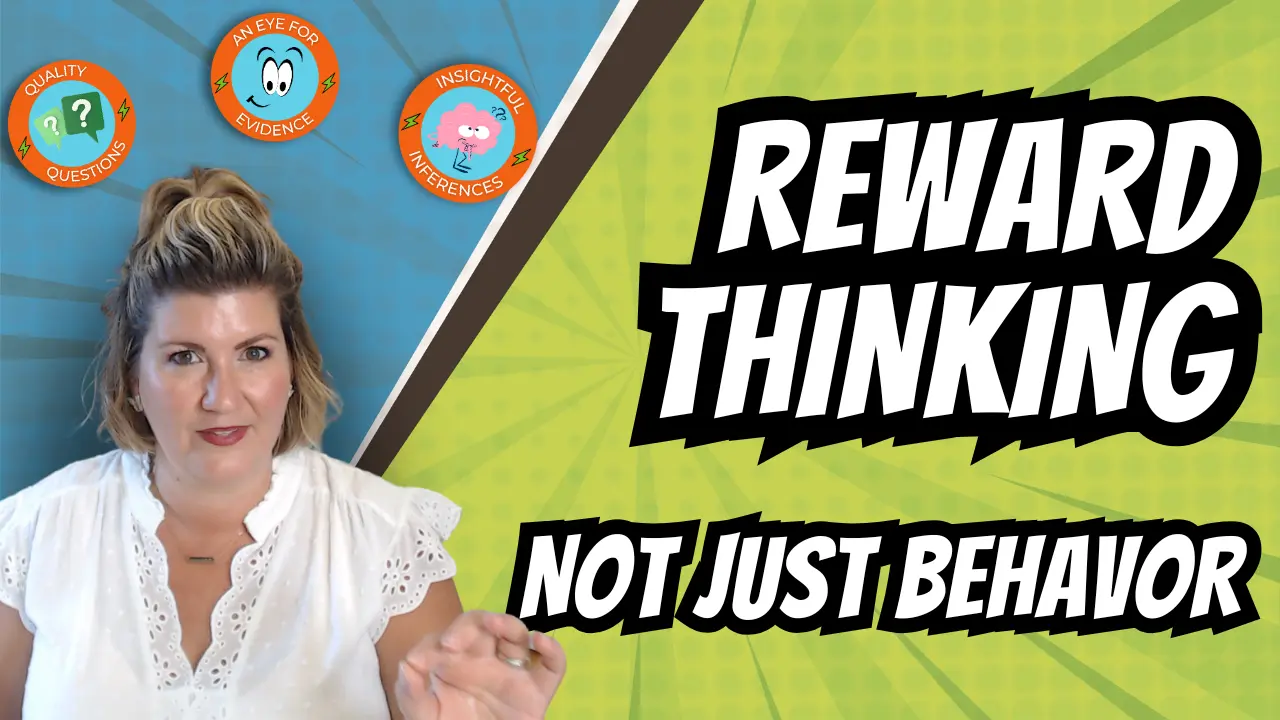
A classroom reward can do more than acknowledge compliance. In this article, you’ll learn how a science-specific badge system can reinforce the science and engineering practices, give students immediate feedback on the actions that matter, help them recognize their own strengths, and keep your inquiry-based classroom message consistent all year.
Most Classroom Rewards Reinforce Compliance
Most educators are familiar with PBIS—Positive Behavioral Interventions and Supports—and the reward systems schools use to reinforce a shared culture. Students may earn pencils, candy, stickers, homework passes, or points for being responsible, showing kindness, following expectations, or demonstrating excellence.
Those rewards can serve a useful purpose. But if you’re building an inquiry-based science classroom, you may also want a system that recognizes the behaviors unique to doing science. Those behaviors are the science and engineering practices: observing, questioning, modeling, investigating, analyzing, explaining, using evidence, and communicating clearly.
When the reward reflects one of those practices, it doesn’t merely say, “Good job.” It tells the student exactly what you noticed—and reinforces what scientific work looks like in your classroom.
“When a reward reinforces inquiry, every reward becomes a mini science lesson.”
Why I Created a Science-Specific Reward System
I’ve taught chemistry in a cyber school for 16 years. In a virtual classroom, tangible rewards are difficult to distribute. I can’t casually hand a student a sticker, pencil, or eraser unless I’m prepared to mail it—and managing classroom mail isn’t central to my work each day.
That limitation forced me to become more intentional. If I wanted a reward system to help students understand that science wasn’t only about content, I needed to identify the exact actions I wanted to reinforce and decide what job the system was supposed to do.
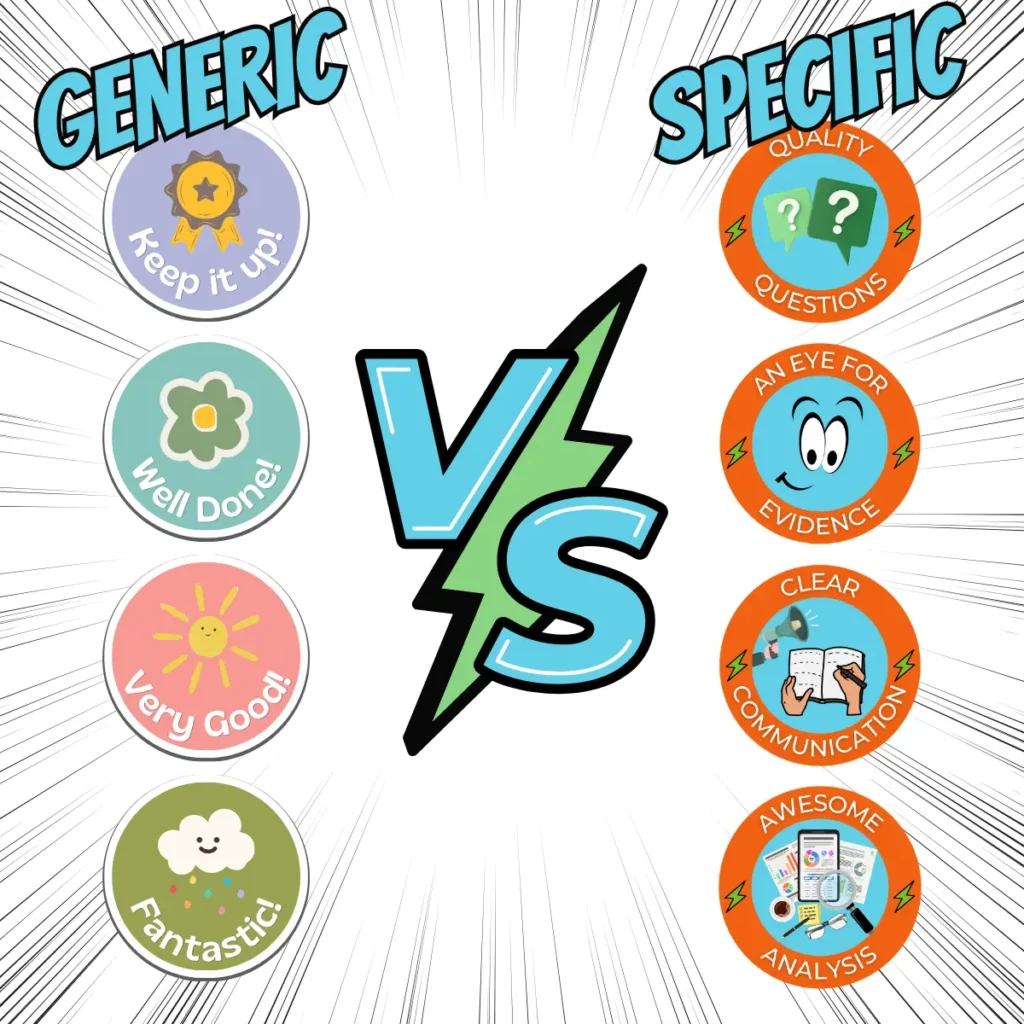
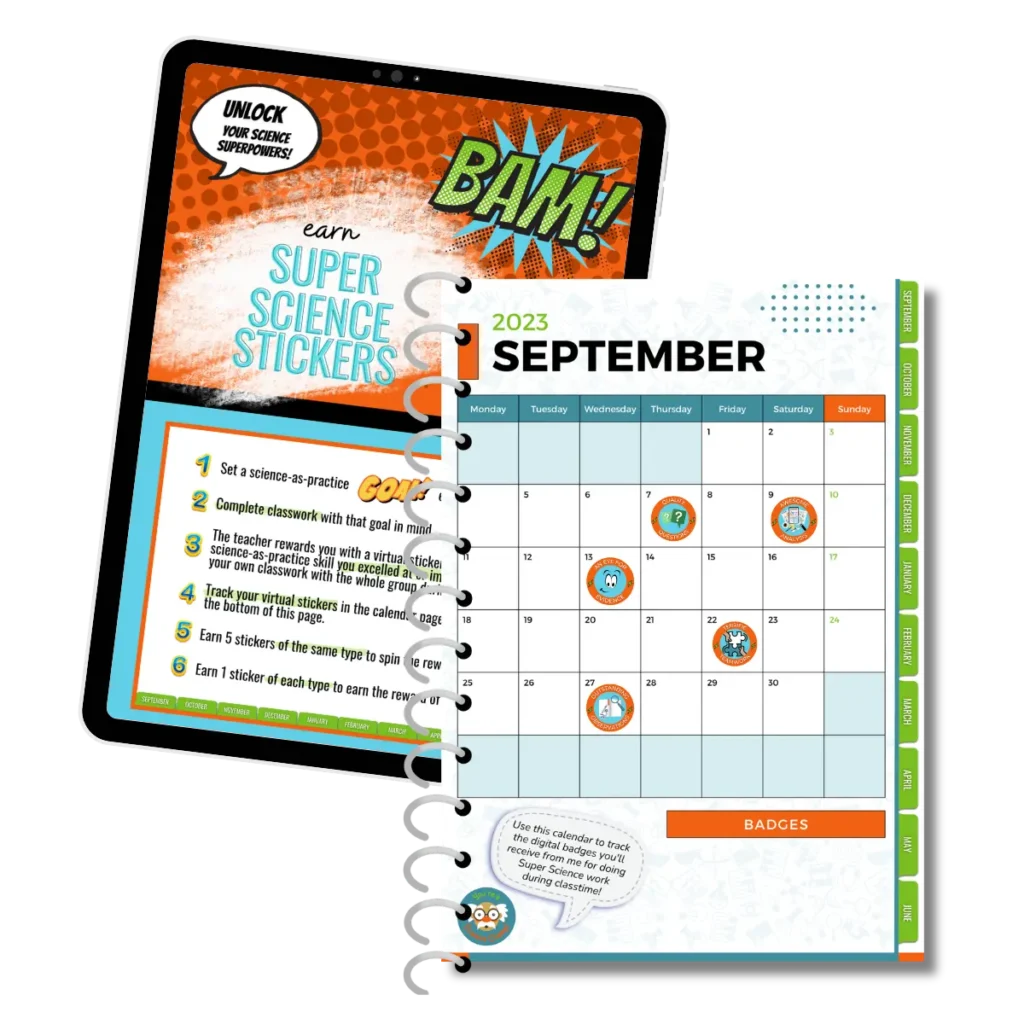
The result was a digital badge system built around scientific thinking and action. A student could be recognized for making outstanding observations, asking quality questions, identifying evidence, designing an experiment, analyzing an outcome, contributing to a team, or communicating clearly.
The same idea can work in a physical classroom with printed stickers, stamps, notebook badges, points, or another reward format. The format isn’t the important part. The important part is that the recognition names the scientific action.
Specific Recognition Helps Students Feel Seen
Students can tell when they’re simply a body in a chair or a name on a screen. They can also tell when a teacher has paid enough attention to notice what they contributed. That feeling of being seen—the human, relational part of teaching—can have an enormous effect on engagement.
A generic reward says, “You were great today.” A science-practice badge says, “I noticed that you kept returning to the evidence when your group was deciding what the results meant.” The second message carries far more information. It tells the student that you noticed a specific contribution, that the contribution mattered, and that the student is capable of doing meaningful scientific work.
“A badge isn’t only a reward. It’s evidence that the teacher noticed what the student could do.”
Science Practice Badges Help Students Discover Their Strengths
Specific recognition can also help students identify gifts they haven’t named for themselves. A student may not want to become a scientist, but that doesn’t make the science and engineering practices irrelevant. The student who repeatedly earns Clear Communication may be an excellent writer or speaker. The student with an Eye for Evidence may be drawn to journalism, law, research, or another field that depends on evaluating claims.
I still remember a high school teacher watching me organize student council materials and telling me that I should consider becoming a teacher. I laughed because teaching wasn’t part of the future I imagined at the time. He saw something in me before I understood where those strengths might lead.
Teachers often underestimate how influential they can be in helping students identify their gifts. We don’t need to choose a career for them. We can simply name what we see: You notice details other people miss. You ask questions that move the group forward. You explain complicated ideas clearly. Those observations give students evidence they can use as they build a picture of themselves.
A Badge Collection Makes Growth Visible
Over a semester or school year, the badges create a record. A student may notice an abundance in one or two categories: “I keep earning badges for observations and communication. Those must be strengths.” The student may also notice a category represented only once and decide it’s an area to develop.
That’s growth mindset without stopping to deliver a separate growth-mindset lesson. The collection gives students concrete evidence of what they’ve practiced, where they’re strong, and where they can improve. You can use that evidence to help them set a goal for the next lesson or choose one scientific action to practice more intentionally.
Keep the Inquiry-Based Classroom Message Consistent
A science-specific reward system also reinforces everything you’ve told students about learning during the first days of school. If your syllabus promises curiosity, student action, productive struggle, and inquiry, the lessons and feedback that follow need to prove that you meant it.
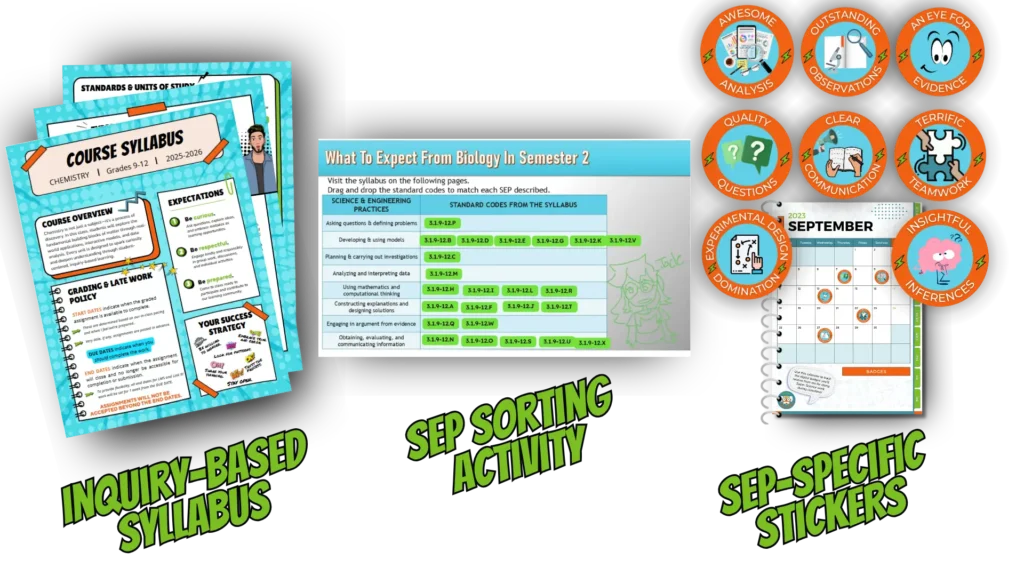
Perhaps students first encounter an inquiry-based science syllabus. Next, they complete an activity that introduces the science and engineering practices by asking them to sort standards and predict what they’ll do throughout the course. They realize they’ll develop models, construct explanations, analyze data, use mathematics, and communicate ideas—not merely remember scientific facts.
Then you introduce a reward system that says, “I’m going to notice and acknowledge you when you do those things.” The message remains consistent: this is what science is, this is what you’ll do here, and this is what your teacher values.
“The syllabus makes the promise. The lessons prove it. The rewards keep the message alive.”
Consistency Turns a First-Week Idea Into Classroom Culture
Students have experienced initiatives that disappear after the opening weeks of school. They may initially assume that inquiry, student action, or a new reward system will eventually fizzle out too.
When the language and badges continue showing up across lessons, students begin to take the expectations seriously. Developing models isn’t something they did once during an introduction. Looking for evidence isn’t reserved for formal labs. Clear communication isn’t a poster on the wall. These practices become recurring features of how the class works.
Use Rewards as Formative Feedback — Not Daily Grades
Science standards ask students to learn both content and action. They include the scientific ideas students need to understand and the practices they’ll use to investigate, model, explain, and communicate those ideas. Our assessments should reflect that balance.
But that doesn’t mean assigning a grade to every developing skill every day. We aren’t going to give one student an A for observations and another a C for questions during an early learning experience. Scientists improve by doing the work repeatedly, and students need room to practice before every action becomes a formal measurement.
A badge creates a softer system for immediate formative feedback. It acknowledges a strong action in real time without converting every learning moment into points.
Introduce the Reward System by Letting Students Do Science
If the system is meant to reinforce inquiry, its introduction shouldn’t interrupt inquiry. You don’t need to spend an entire class explaining what every badge means while students listen. Introduce the badges while students use the practices they represent.
I bring my badges into a beginning-of-the-year lesson sometimes labeled “the scientific method.” The lesson doesn’t ask students to memorize a sequence of steps. It gives them a simple phenomenon to observe and uses that experience to clarify what each badge will recognize.
“If the badges represent doing science, teach the badges while students are doing science.”
Make the Science Practices Visible in the Success Criteria
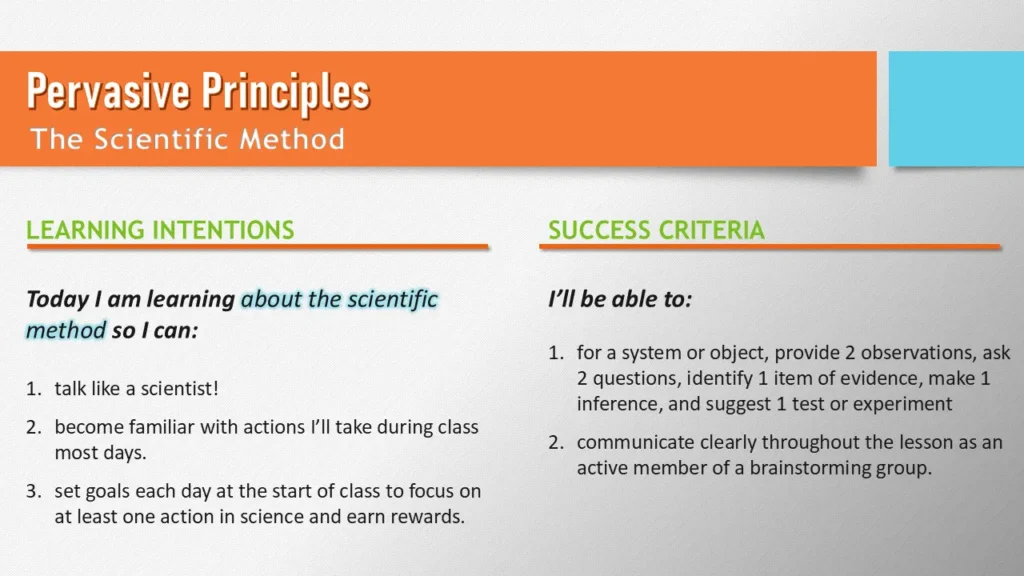
The lesson begins with learning intentions and success criteria that name the actions students will practice. By the end of class, students should be able to make two observations, ask two questions, identify one piece of evidence, make one inference, and suggest one test or experiment. They should also communicate clearly as active members of a brainstorming group.
Those criteria make the purpose of the badge system visible. Students aren’t trying to collect arbitrary rewards. They’re learning to recognize and improve the actions that allow scientific thinking to move forward.
Ask Students What Each Science Badge Looks and Sounds Like
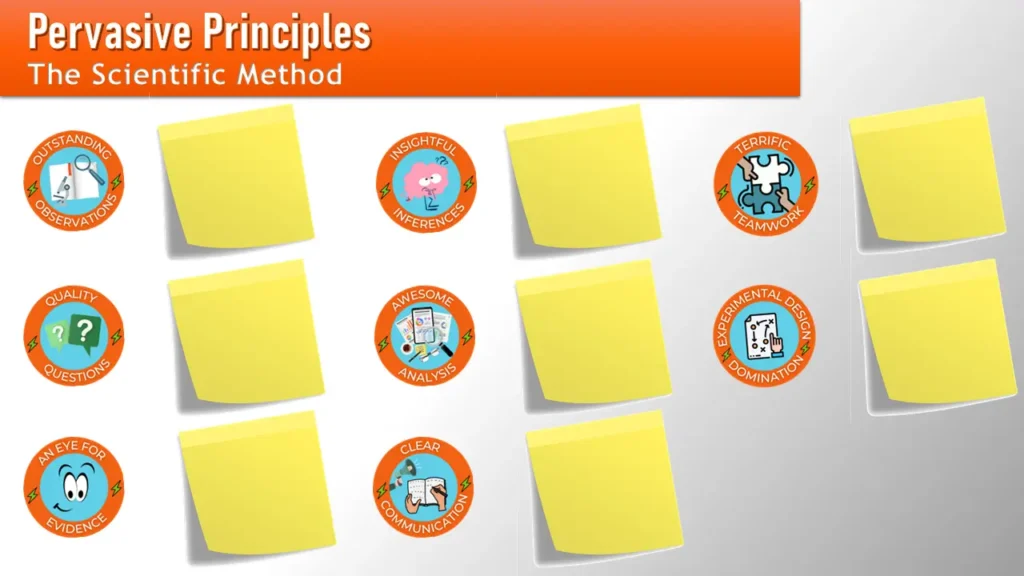
Before I begin awarding the badges, students help define them. What does it look like to make outstanding observations? What does a quality question sound like? What would someone do to demonstrate an eye for evidence or contribute to awesome analysis?
Students can jot down a few ideas in Seesaw, Google Classroom, Nearpod, on a digital sticky note, or on paper. They don’t need to write essays. The goal is to give them an opportunity to interpret the badge language and establish shared expectations before the system begins.
This is another small act of consistency. We don’t deliver a system to students and hope they’ll act on it. We ask, as always: What can students do with this?
A Simple Phenomenon Can Bring Every Badge to Life
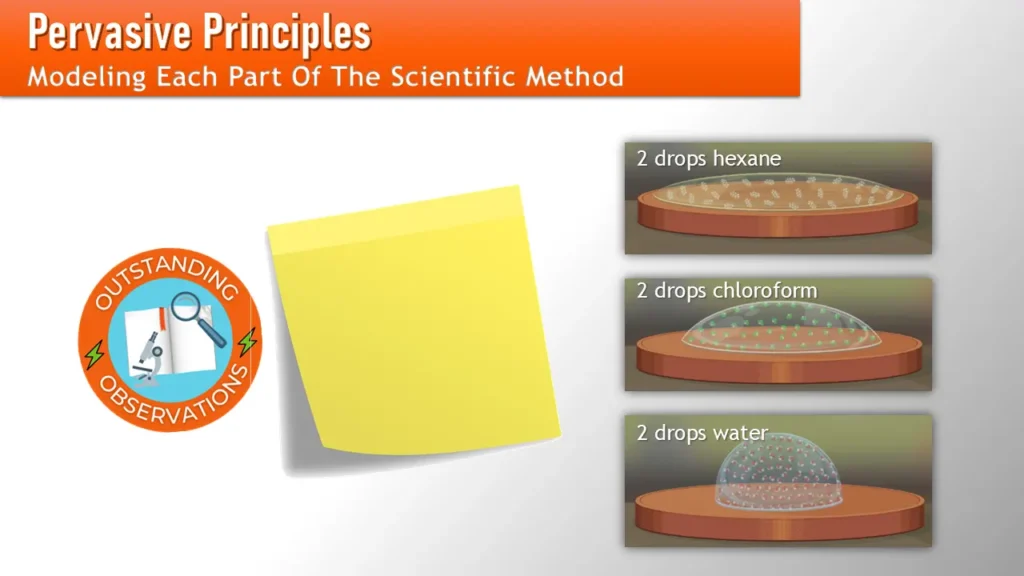
To model the badges, I use an everyday phenomenon involving drops of water and surface tension. Surface tension eventually becomes serious chemistry content, but students have already encountered droplets, puddles, and water resting on different surfaces. That familiarity lets them concentrate on the scientific actions instead of struggling with unfamiliar content.
You could substitute any simple, relatable phenomenon. A beginning-of-the-year measurement activity, a low-risk hands-on investigation, or an experience designed to introduce classroom tools could work just as well. The phenomenon only needs to give students something worth noticing, questioning, testing, and discussing.
Move From Observations to Questions, Inferences, and Evidence
Students begin with outstanding observations: What do you notice about the three drops? What similarities, differences, shapes, or patterns can you describe? Teachers who prefer “notice and wonder” language can use it here; I tend to emphasize observation with my secondary science students.
Next come quality questions: What could we ask about this phenomenon to learn more? Because scientific questions lead toward investigation, students then consider insightful inferences. What do we already know? What might explain what we see? What tentative answer or hypothesis could we propose?
The Eye for Evidence badge requires an important distinction. An observation describes what a student notices. Evidence is the specific observation or result the student selects to support a claim or inference. Helping students separate the two prepares them for stronger explanations later.
Connect Experimental Design to Meaningful Analysis
Quality questions naturally create an opening for experimental design: What could we do to answer one of these questions? Students might identify what to change, what to observe or measure, and what outcome they expect.
If students complete the investigation, they can analyze the results directly. In my cyber classroom, I may provide the outcome through a series of images and ask students to connect the pieces. Either format works because analysis doesn’t always require a table of numbers. Students can analyze patterns and relationships in qualitative observations too.
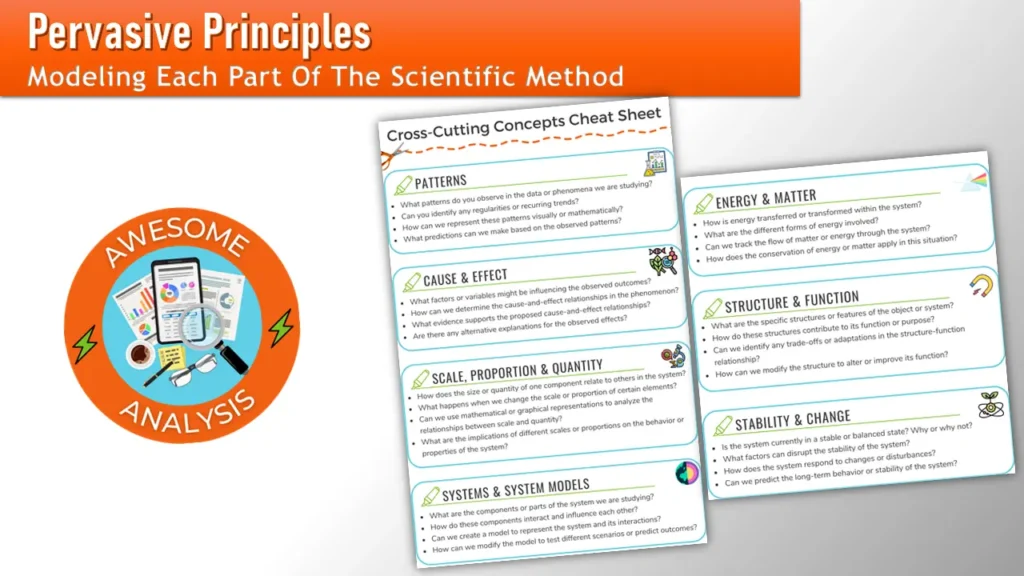
This is where the crosscutting concepts become especially useful. Analysis often asks students to identify a relationship: How does one factor affect another? What pattern appears? What changed, and what remained stable? The crosscutting concepts give students thinking tools for moving from individual observations toward a larger explanation.
Clear Communication Creates a Natural Bridge to CER
At the end of the experience, students reflect on teamwork and clear communication. What allowed the group to work productively? Who helped clarify the group’s thinking? What made an explanation easy to follow?
Clear Communication is broader than a single response format. Students may communicate by speaking, writing, drawing, modeling, or presenting on behalf of a group. But effective scientific communication still depends on answering a question, selecting evidence, and connecting that evidence to relevant scientific knowledge.
That makes the badge activity a natural bridge to claim-evidence-reasoning. In the next video in this series, I’ll share an inquiry-based way to introduce CER and show students why the structure matters before asking them to produce a formal response.
By the End of the Year, the Badges Become Evidence
Now imagine that it’s May. Students are cleaning out lockers, closing digital notebooks, or looking back through the work they’ve collected. Among the lessons and assignments is a record of badges earned over ten months.
That collection is evidence. It shows that students learned and practiced far more than earth science, biology, agriculture, chemistry, or physics content. They observed, questioned, designed, modeled, analyzed, communicated, and collaborated. They did the work of science.
“It’s not only a record of what students learned. It’s evidence of what they did.”
A report-card grade summarizes performance, but it can’t tell the entire story. A yearlong collection of specific recognition helps students understand why they earned that grade, which skills became strengths, and how much scientific work they completed along the way.
Reward the Actions You Want Students to Repeat
You don’t need to recreate my exact badge system to apply this idea. Begin by identifying the scientific actions you want students to recognize and repeat. Choose a small set of practices, give each one student-friendly language, and decide how you’ll acknowledge those actions consistently.
Then introduce the system through a simple experience that lets students observe, question, infer, design, analyze, and communicate. The reward system will make more sense because students will already have experienced the work it recognizes.
If you’d like to understand the larger instructional philosophy behind this approach, explore Discovery by Design to see how inquiry, purposeful student action, and technology work together across a lesson.