An inquiry-based makeover for introducing chemistry on the first day of real content
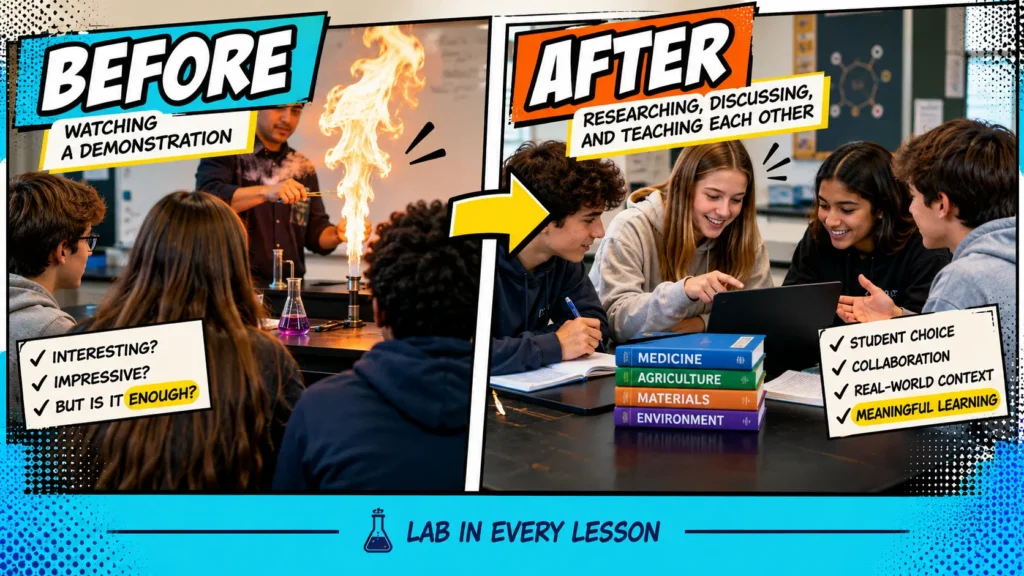
Science demonstrations are fun. They can capture attention, create surprise, and make chemistry feel alive. If you’re interested in inquiry-based science instruction, three-dimensional learning, or the NGSS, it can be tempting to assume that an engaging phenomenon automatically creates an inquiry lesson.
But adding phenomena to 3D best practices wasn’t intended merely to entertain students for a few minutes. Its real power is in connecting science to reality and creating a through line students can investigate. When we’re introducing chemistry, we don’t want students to leave only thinking, “That was cool.” We want them to begin doing the work of learning chemistry.
In this article, I’ll show you the before and after of my own introduction to chemistry lesson: what the original version did well and how I rebuilt it around choice, collaboration, communication, and purposeful student action.
Why an Introduction to Chemistry Matters in an Inquiry-Based Course
For many of my 16 years teaching high school chemistry, I didn’t include an introductory chemistry lesson at all. I started the course with atomic structure and moved forward from there.
That changed when I redesigned the entire course for inquiry. I realized students needed a shared foundation—a core concepts unit that leveled the playing field and provided the background reasoning they’d need to make sense of later investigations. Once that unit existed, it made sense to begin by introducing chemistry as a discipline: its scope, its language, and its influence on the world students already inhabit.
My first attempt was called Why Study Chemistry? Like most first attempts, it wasn’t a disaster. It contained several genuinely useful decisions. It simply missed the mark in the places that mattered most.
The question isn’t whether students encounter something interesting. It’s whether the lesson gives them something meaningful to do with it.
Why Interesting Chemistry Demonstrations Aren’t Enough
The Learning Goals Were Too Vague to Guide Students
The objectives asked students to identify the potential for reactions in everyday life and “appreciate” the potential chemistry provides for solving complex problems.
Appreciation may be a worthwhile outcome, but it isn’t an observable action. Students couldn’t use those goals to determine what they were expected to learn, and I couldn’t use them to determine what evidence would show that learning had happened. The objectives sounded nice but didn’t reveal the actual intellectual work of the lesson.
Why Open-Ended Chemistry Questions Still Need Structure
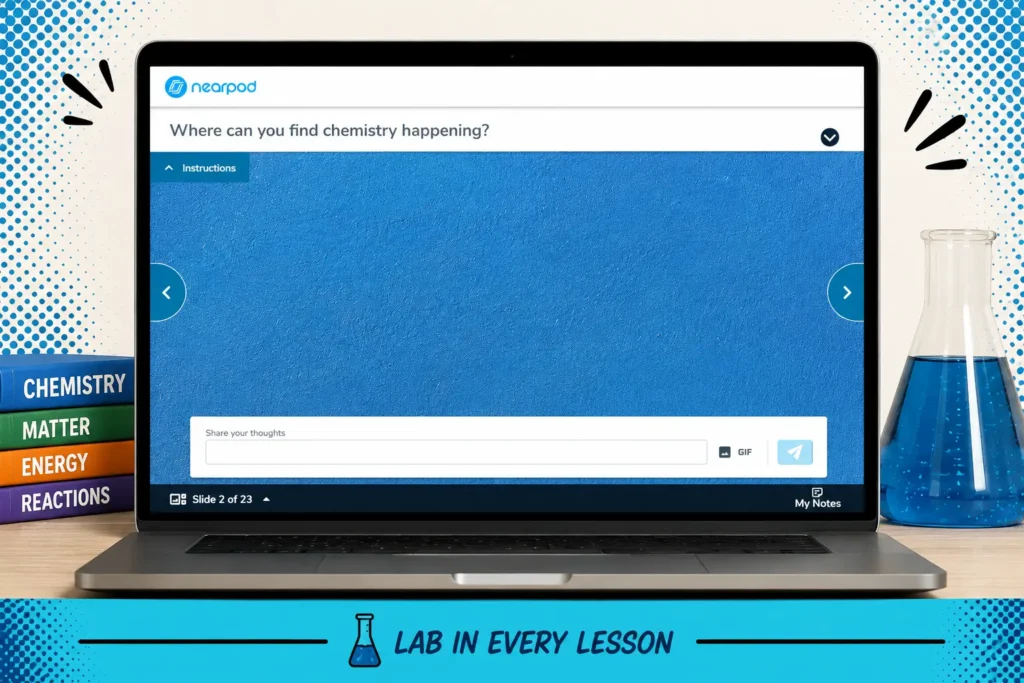
Students opened the lesson and immediately encountered the question, “Where can you find chemistry happening?” That was my early version of what I now call Review & Preview: pull from what you know, connect to your life experience, and begin thinking about the day’s topic.
The intention was good. The screen, however, was almost completely blank. Students were asked to produce ideas from a wide-open blue background with no image, example, category, or contrast to help activate their thinking! For students who already believed chemistry happened in laboratories and nowhere else, the question gave them very little leverage.
Why Real-World Chemistry Examples Didn’t Create a Complete Inquiry Experience
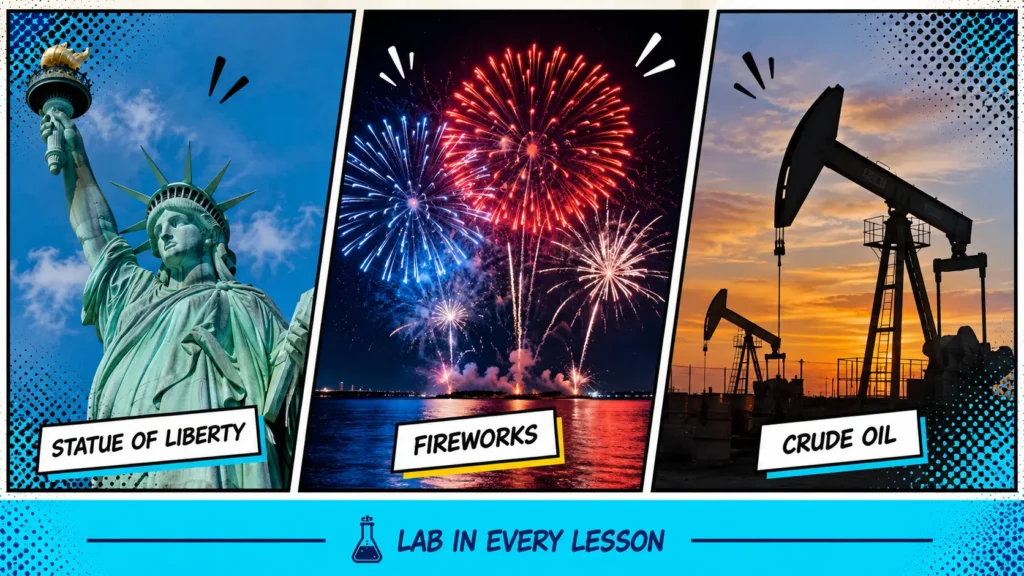
From there, students explored three strong real-world contexts:
- the green patina on the Statue of Liberty
- the chemistry of fireworks
- the processing and use of crude oil
Each one had clear potential for introducing chemistry in the world.
In the Statue of Liberty example, students used a Nearpod virtual-reality view to examine the monument. They were then asked where chemistry was happening and which reactants had combined with the copper statue.
I knew what I wanted them to notice: the sunlight hitting the statue, the gases surrounding it, the salty air, and the many substances that affect matter even when we can’t see them. Chemistry commonly asks students to reason about particles and gases that are present but invisible.
The problem was that students hadn’t yet learned the language of reactants and products. The prompt required knowledge the lesson hadn’t helped them build. After a brief exploration, I supplied a video with the explanation. The fireworks and crude-oil examples followed essentially the same pattern:
- encounter an interesting context
- answer a few questions
- receive the answer
- move on to the next phenomenon
What Worked in My First Introduction to Chemistry Lesson
It’s easy to look back at an old lesson and focus only on what we’d change. That misses useful evidence. Version 1.0 already contained three design choices worth preserving.
Real-World Phenomena Came Before Formal Explanation
Students met chemistry through recognizable, consequential scenarios rather than through a definition copied from a textbook. The Statue of Liberty, fireworks, and crude oil placed chemistry at center stage in public monuments, celebrations, industry, energy, and environmental decision-making.
Questions Activated Students Before the Content Arrived
Students were asked to think before they watched the explanation. Even though the prompts needed more structure, the sequence respected an important principle: what students notice and predict before instruction affects what they’re prepared to see during it.
The Exploration Led Somewhere
The lesson didn’t leave students indefinitely poking around. Each investigation eventually returned to an explanation and a core idea. Inquiry isn’t a refusal to teach. Students need opportunities to compare their thinking with scientific knowledge, revise it, and name what they’ve uncovered.
Those strengths became the foundation for the redesign. I didn’t need to throw away the real-world connections or the student-first sequence. I needed to make the action more purposeful and connect it to clearer evidence of learning.
Introducing Chemistry Through Purposeful Student Action
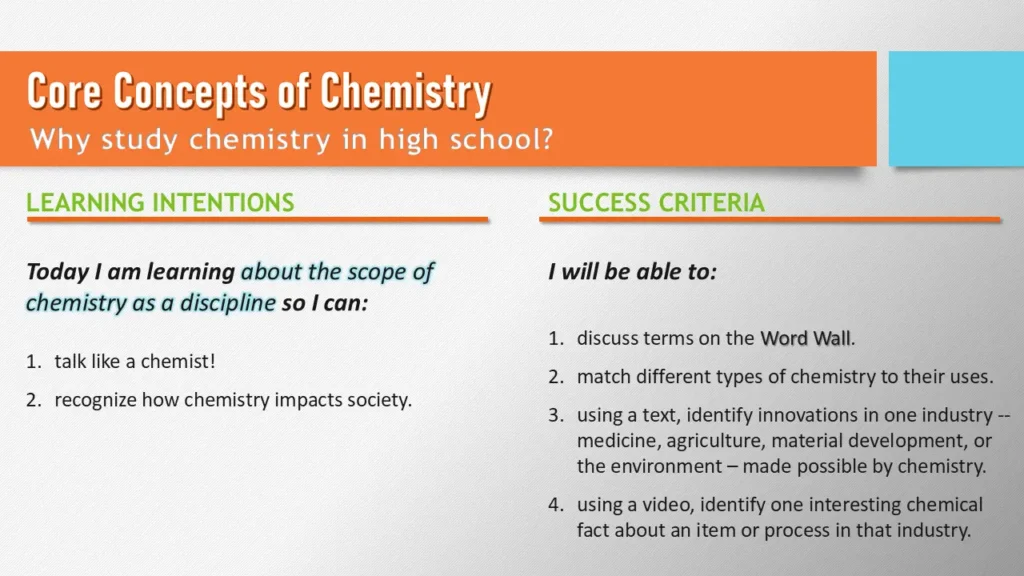
The revised lesson begins with a more precise goal: students are learning about the scope of chemistry as a discipline so they can talk like chemists and recognize how chemistry affects society.
More importantly, the success criteria name the students’ actions.
They will:
- encounter key terms
- match branches of chemistry to possible applications
- identify innovations made possible by chemistry, investigate one specific chemical process, and communicate what they learned
That change matters because the verbs establish the lesson. Instead of hoping students will appreciate chemistry, I can design opportunities for them to match, identify, investigate, explain, and teach.
It’s what’s happening as a verb that matters. What are the students doing with the content?
Use a Low-Stakes Sort to Introduce the Branches of Chemistry
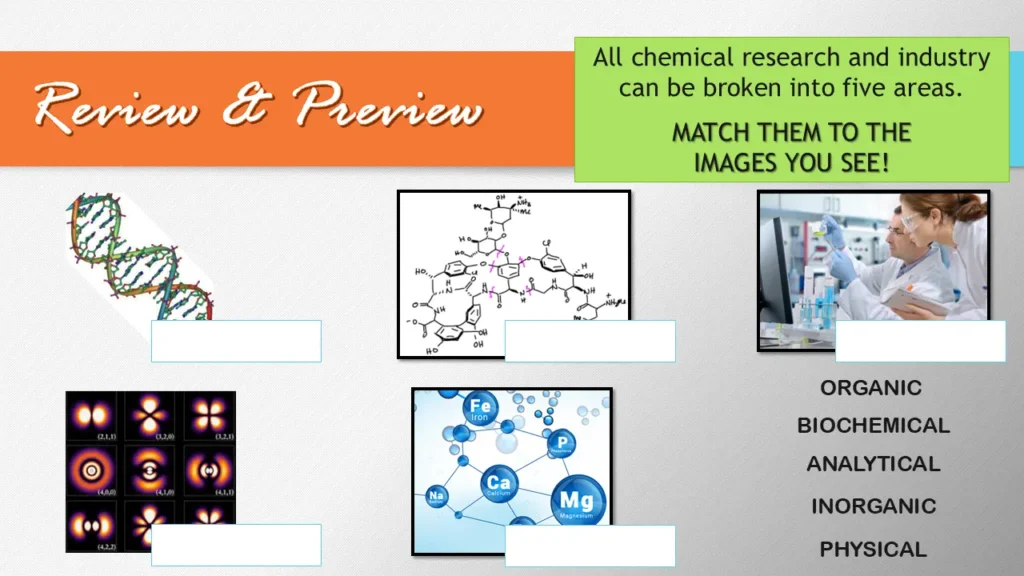
The new version begins with images and unfamiliar labels representing branches of chemistry. Students look closely and try to match the images with words such as biochemistry, analytical chemistry, organic chemistry, inorganic chemistry, and physical chemistry.
- They aren’t expected to know every answer.
- They may recognize DNA and connect biology with biochemistry.
- They may infer analytical chemistry from an image of people studying and recording something carefully.
- Few students will correctly match an electron photograph with physical chemistry on the first attempt.
The value of the activity is in the observation and conversation. Students explain what they see, compare the reasoning behind different matches, and discover that a first interpretation can be reasonable even when it isn’t the accepted classification. The reveal gives them new language after they’ve already built a reason to need it.
Treat the Warm-Up as a Preview of the Learning
This isn’t an isolated icebreaker. The branches of chemistry become a preview of the larger investigation. Students first encounter the discipline broadly, then examine how chemistry makes innovations possible across medicine, agriculture, materials development, and the environment.
The warm-up prepares their attention. By the time students reach the main task, they already understand that chemistry isn’t one narrow study of chemical reactions. It’s a collection of overlapping ways to study matter and use that understanding to solve problems.
An Inquiry-Based Introduction to Chemistry Through Real-World Applications
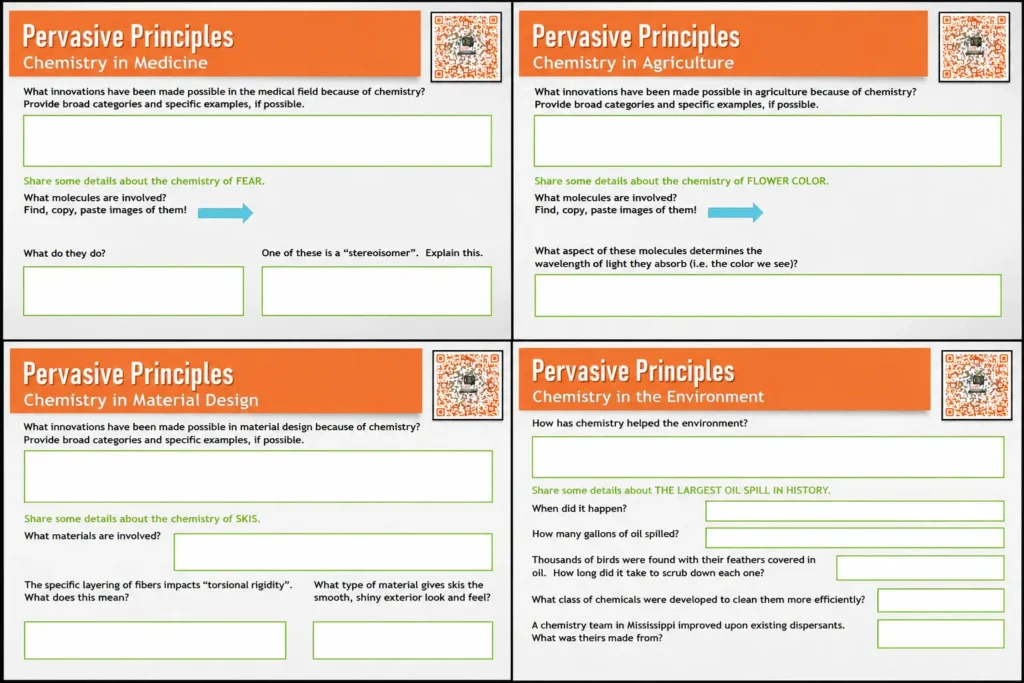
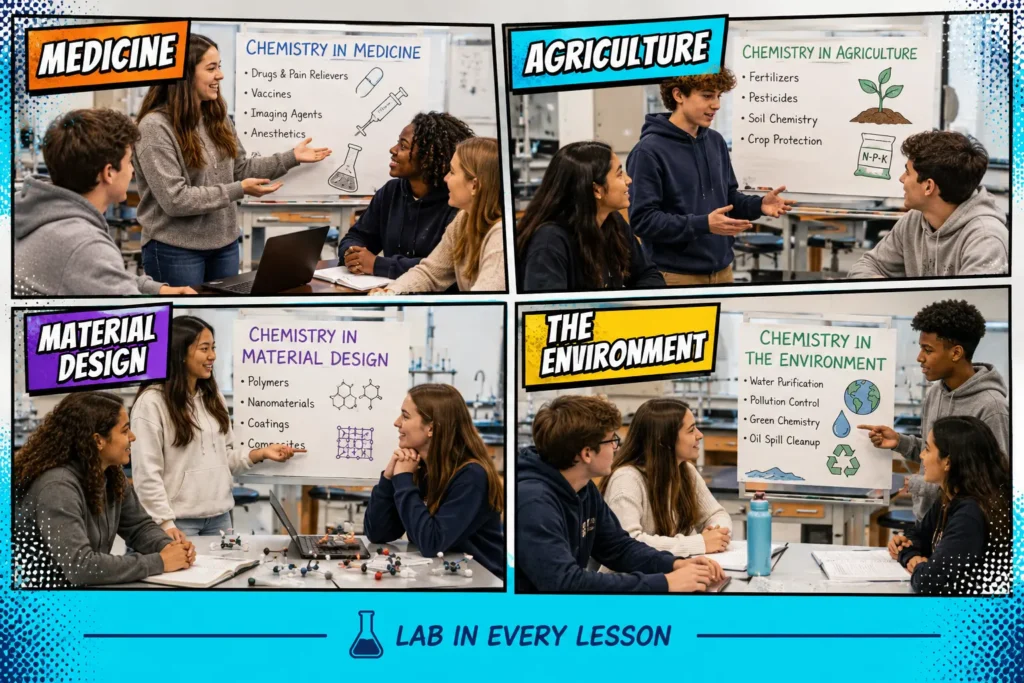
The central learning experience is organized around four industries: medicine, agriculture, material design, and the environment. Instead of requiring every student to complete every page independently, the class can divide and conquer!
One group investigates chemistry in medicine. Another takes agriculture. A third explores material development, and a fourth examines environmental chemistry. Each group uses a shared structure, but the context and chemical story differ.
Give Every Group a Shared Question and a Distinct Context
At the top of each student artifact is the same broad prompt: What innovations in this industry have been made possible by chemistry? That consistent question helps the class compare across industries later.
The second part narrows the investigation to a particular story:
- Medicine: the chemistry of fear, including the molecules involved and what they do
- Agriculture: the chemistry of flower color and the molecular features that produce color
- Material design: the chemistry of skis, including torsional rigidity and the materials that create a smooth exterior
- The environment: a major oil spill and the chemical and environmental information students can extract from a closely examined video
Students aren’t merely hunting for a definition of chemistry. They’re obtaining information and using it to explain what chemistry makes possible within a context that matters.
Use Existing Digital Resources as Raw Material for Inquiry
For this lesson, I sent students to mine information from a customized CK-12 FlexBook. Because the digital text can be edited, I could organize the reading and embed the videos connected to each group’s artifact.
But, make no mistake: the technology isn’t the inquiry. Its job is to make the right evidence quickly accessible. A virtual textbook, video, interactive slide, or curated webpage becomes useful when students must do something intellectually meaningful with what it contains.
Let Students Teach the Chemistry They Investigated
On the second day, groups communicate their findings to the class. Students become accountable not only for completing their own work, but also for helping classmates understand an application of chemistry they didn’t investigate themselves.
This changes the social impact and intent of the lesson. Choice is one form of student-centered learning. Collaboration is another. Students teaching students goes further still: the information they gather has a purpose and an audience.
The lesson now emphasizes obtaining, evaluating, and communicating information—one of the science and engineering practices. What might look on the surface like a WebQuest becomes a genuine scientific practice when students must gather relevant information, make sense of it, and communicate it clearly enough for others to learn.
Why Educational Technology Doesn’t Automatically Create Inquiry
The original Nearpod lesson placed the device in students’ hands. They could click, drag, and move through a virtual-reality scene. But control over a screen isn’t the same as control over the thinking.
In the revised lesson, students make decisions, interpret images, choose a context, divide responsibility, obtain information, and teach one another. The technology supports those actions without becoming the point of the lesson.
This distinction matters when introducing chemistry because the first day of real content establishes a classroom contract. If we’ve told students that this science class will feel different — that they’ll investigate, reason, communicate, and carry responsibility for learning — then the first lesson should let them experience that promise.
If we can create a student-centered learning experience from introductory information, we can do it with anything.
How To Make Any Secondary Science Lesson Inquiry-Based
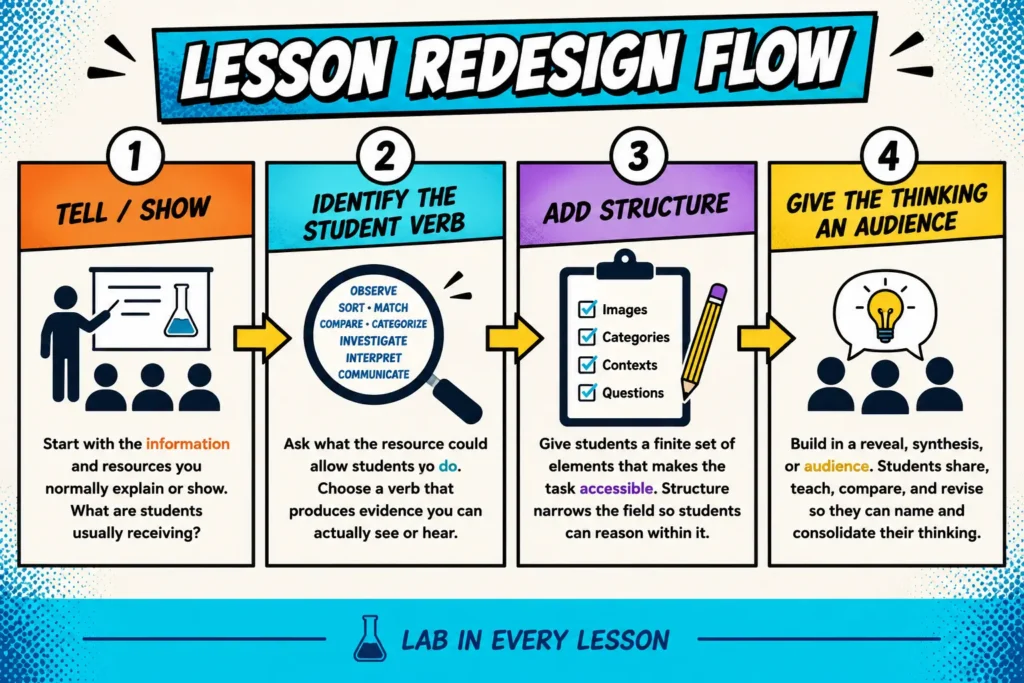
You don’t need to copy this exact lesson or use the same technology. The redesign process is transferable to almost any topic that initially feels too informational for inquiry.
Start With What You Usually Tell or Show Students
Open the lesson, slide deck, textbook page, pacing guide, or demonstration you already use and identify the information you normally explain and the resources you normally show.
Identify the Student Action Hidden Inside the Resource
Ask what the resource could allow students to observe, sort, match, compare, categorize, investigate, interpret, or communicate. Choose a verb that produces evidence you can actually see or hear.
- A photograph can become evidence for an inference. A set of definitions can become a sort. Four readings can become a collaborative jigsaw. A video can become a close investigation when students must extract and explain specific information from it.
Add Structure Without Removing Discovery
Students don’t need a blank screen to think independently. Give them a finite set of images, categories, contexts, or questions that makes the task accessible. Structure narrows the intellectual field so students can reason within it; it doesn’t eliminate their agency.
Build in a Reveal, Synthesis, or Audience
Inquiry needs somewhere to go. Students might compare their sort with accepted terminology, combine findings from four groups, revise an early idea after viewing new evidence, or teach classmates what they discovered. The ending should help them name and consolidate what the experience allowed them to see.
Use Your First Chemistry Lesson to Establish How Students Will Learn
The first day of real chemistry content doesn’t need to cover a major disciplinary core idea. Instead of intending to reveal big core ideas, it could reveal what learning will look like in your classroom.
Students can leave an introductory lesson with evidence that they’ve observed closely, connected chemistry to society, gathered information, collaborated, and communicated what they learned. They’ve begun developing the habits they’ll need when the content becomes more complex.
The next time you open your pacing guide and think, “There is nothing here for students to discover,” pause before searching for a brand-new activity. Look at what you already tell them, show them, or ask them to read.
What could students do with these resources to figure it out for themselves?
That’s the question at the center of Discovery by Design — and it can change far more than an introduction to chemistry.
No matter what secondary science you teach (!), if you’re ready to apply it to one of your own lessons, the Active Learning Action Plan will help you identify the intellectual work in an existing activity and deliberately place more of that work in students’ hands.