How core concepts and prior knowledge create the foundation for an inquiry-based science curriculum
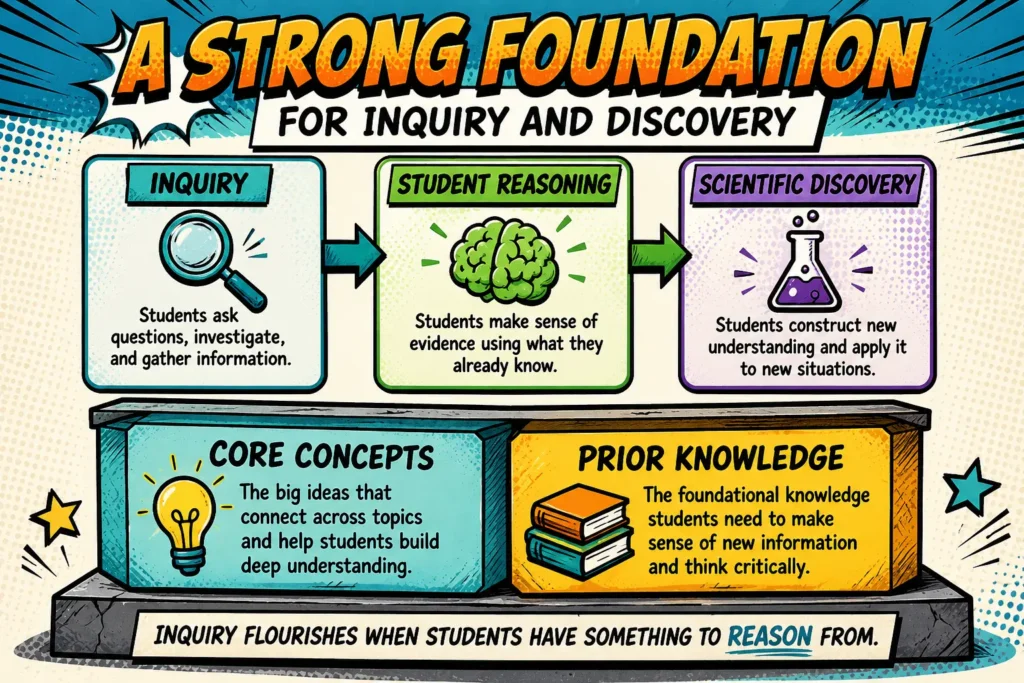
An inquiry-based science curriculum asks students to observe, question, recognize patterns, and construct meaning — but they can’t reason from knowledge they don’t have. In this article, you’ll see why I brought an introductory unit back into my chemistry curriculum, how I identified the core concepts students needed before deeper discovery could begin, and how you can uncover the foundational ideas that support inquiry-based science instruction in your own course.
An Inquiry-Based Science Curriculum Can’t Ask Students to Reason From Nothing
When I got completely sick and tired of talking at the wall … of being the person who owned all the learning in my high school science classroom … I decided to go all in on active learning, visible learning, discovery-centered experiences, and inquiry-based science instruction.
But when I sat down to redesign my chemistry curriculum, I ran into a problem: digging for answers and doing science require some foundational knowledge first! Scientists investigate very specific questions with a deep background of facts, principles, models, and prior experiences available to them. They have a bank of reasoning to pull from when they’re trying to make sense of what they observe during their investigations.
So how could I ask every student to make observations, find patterns, and construct explanations if they didn’t share the core reasoning those discoveries required? That question led me back to something I’d previously removed from my course: an introductory chemistry unit. This time, however, I rebuilt it with a much clearer purpose.
“Inquiry asks students to do the thinking – but they still need something to think with.”
Why I Removed the Traditional Introduction to Chemistry Unit
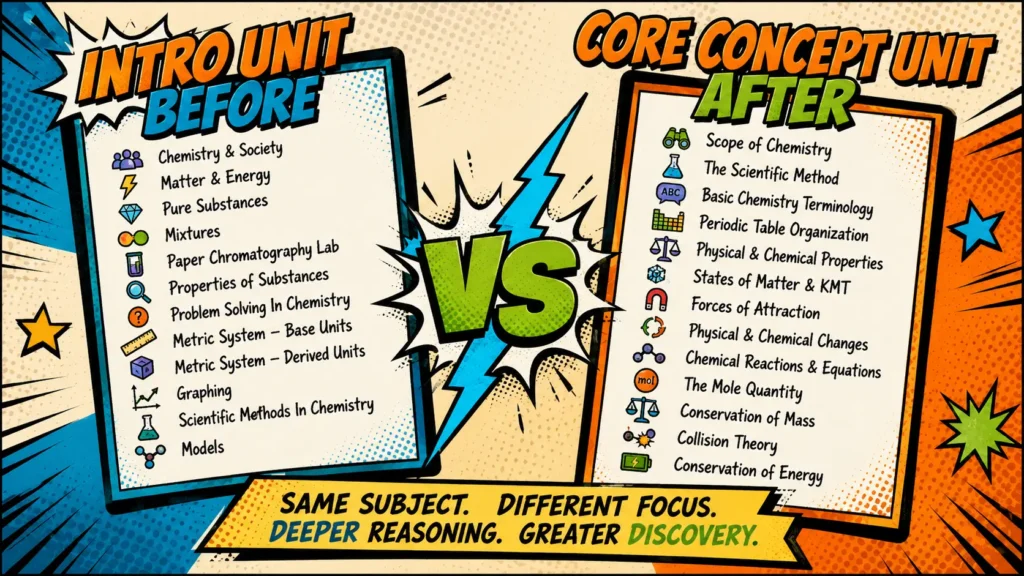
When I began teaching in 2010, I inherited a well-established sequence that largely followed the textbook. Like many chemistry courses, it began with an introduction to chemistry unit. That unit moved from questions like “What is an atom?” and “What is matter?” through the basics of dimensional analysis, touching briefly on much of what we planned to teach during the year.
Within a few years, I stopped teaching it. I found myself reteaching the same ideas later when they emerged more naturally in the science curriculum. The original lesson might have technically covered a concept, but that didn’t mean students could retrieve and use it months later.
Coverage Didn’t Create Usable Prior Knowledge in Science
At that point, I was still doing a great deal of lecturing. Even when students paid attention, much of the material went in one ear and out the other. I couldn’t confidently say, “Remember when we learned this? Take out your notes and apply it here,” because the earlier exposure hadn’t necessarily become durable, usable knowledge.
My cyber charter school also serves students coming from schools across the state. New students join throughout the year, with especially noticeable movement near the beginning. I couldn’t assume everyone had completed the same introductory lessons or arrived with the same science background.
The traditional unit felt like a broad preview without enough purpose. It consumed valuable instructional time, so I eliminated it and began the course with atomic structure instead.
“Teaching something once isn’t the same as giving students knowledge they can reason from later.”
Why Inquiry-Based Science Instruction Made Me Bring It Back
Six or seven years later, I was ready to quit teaching because I couldn’t stand lecturing anymore. I tended toward blaming the lack of engagement and achievement on my students, even though I was the teacher leader in the room. After some careful reflection, I realized I had the power to change the experience … for them and for me!
As I redesigned the course around students doing the critical thinking work, I discovered that an introductory unit wasn’t inherently pointless. I had declared my former introductory unit worthless because it contained two to three mini units that didn’t even have a natural transition or connect.
The new question wasn’t, “What do chemistry teachers usually cover first?” It was, “What must students know or experience now so they can do more of the thinking later?” That shift transformed an Introduction to Chemistry unit into my Core Concepts of Chemistry unit.
Forces of Attraction Revealed a Gap in Prior Knowledge
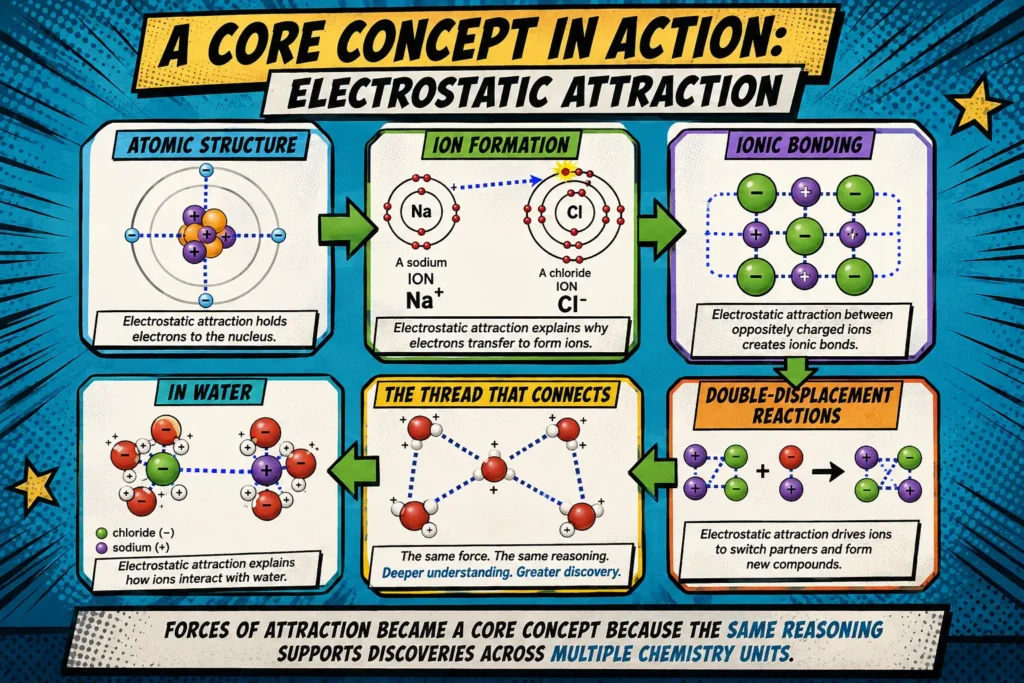
The first concept I started with during that redesign was deceptively simple: opposites attract. Positive and negative charges attract one another. But where, exactly, had all my students learned that?
I searched the curriculum available to me and spoke with teachers whose courses fed into chemistry. The answer was surprisingly consistent: they weren’t explicitly teaching it. Students may have carried a general sense that plus and minus attract from their work with everyday objects and situations (like batteries!). Some may have recalled the idea from their work with hydrogen bonding in biology class the year before. But we were beginning ion formation and ionic bonding in chemistry class as though that understanding were already secure. Or, we were trying to teach the foundational principle at the same time students were using it to explain something more complex.
Once I stepped back, I saw electrostatic attraction as an undercurrent throughout the entire chemistry curriculum. It helps explain how protons and electrons hold an atom together. It supports ionic bonding. It’s the basis for dissolution of salts in water and for the hydrogen bonding we observe among and within various polar substances. It reappears when ions separate and find new partners during double-displacement and neutralization reactions.
“A core concept isn’t merely something students encounter early. It’s an idea they’ll use repeatedly to explain what they observe later.”
Core Concepts Help Level the Playing Field
In a classroom where students arrive with different educational histories, intentionally building prior knowledge in science helps level the playing field. We no longer have to assume that every student has learned or remembers the same prerequisite idea. Instead, we’re creating a shared piece of reasoning to return to.
Later, when students investigate atomic structure, ionic bonding, or chemical reactions, I can ask, “What core concept can we apply to what we’re observing?” Instead of supplying the explanation immediately, I can point them toward knowledge they already own and let them use it to construct something new.
Build a Science Curriculum Backward From the Reasoning Students Will Need
Identifying forces of attraction as a core concept led to a broader reflection:
- What else is foundational that students may not know or remember?
- Which ideas will let me say, “We’ve been here before,” when students meet a new phenomenon?
- Where will an inquiry lesson stall because students lack the reasoning needed to interpret what they see?
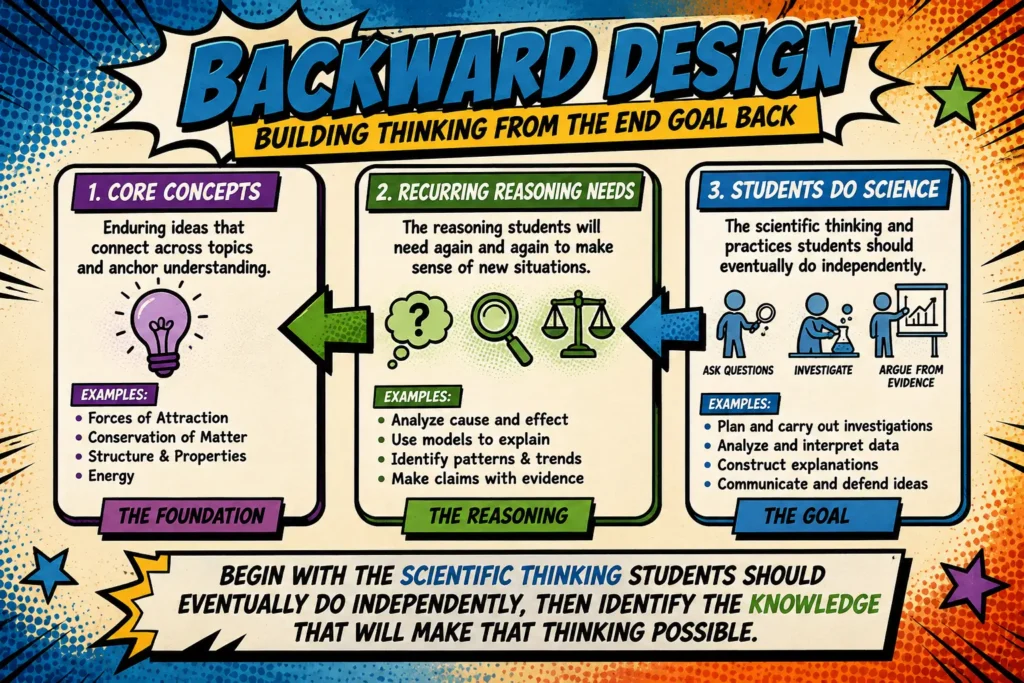
This is essentially Stephen Covey’s second habit: begin with the end in mind.
My end goal wasn’t simply to expose students to chemistry content. I wanted students to observe, ask questions, question their own thinking, look for patterns, construct explanations, and engage in the science and engineering practices every day.
Beginning with that end changed what deserved space at the beginning of the course. A core concept earned its place if it equipped students to do more intellectual work later, not merely because the textbook placed it in Chapter 1.
Start With Why the Science Curriculum Matters
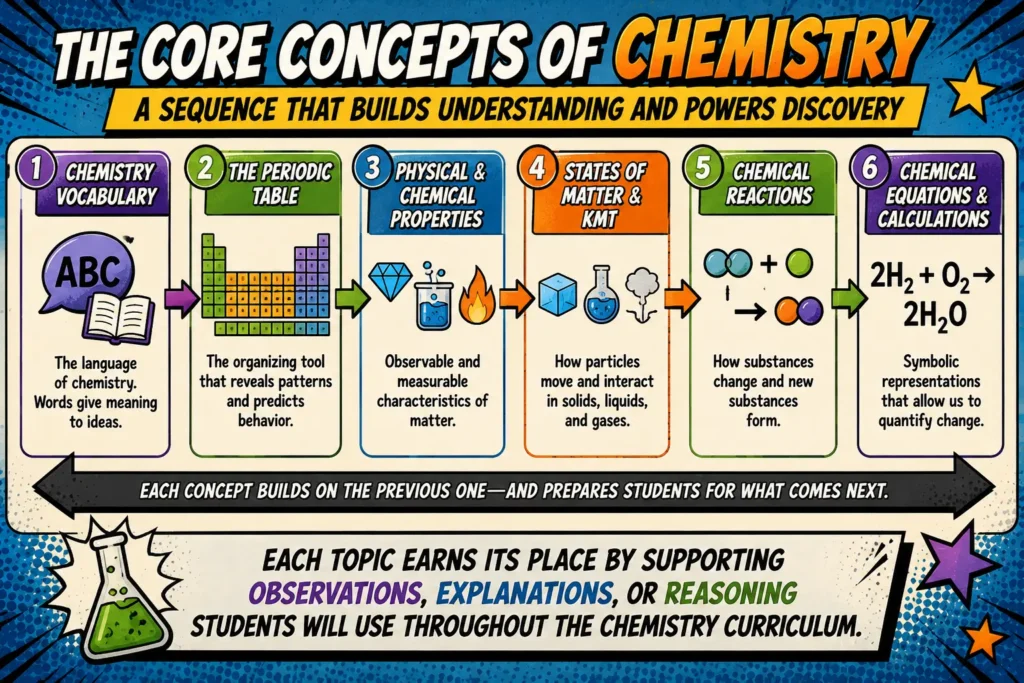
The redesigned unit begins by addressing an objection students may already carry: Why do I have to study chemistry? That question isn’t filler before the “real” content. Students need a framework for understanding that chemistry influences medicine, agriculture, materials, the environment, and countless decisions they encounter beyond school.
Before we dive into the anatomy of an atom, students should see why the course is worth entering. Purpose gives the details somewhere to belong.
Include the Disciplinary Language Students Will Use Every Day
Some foundational needs are less conceptual but equally practical. Students need to distinguish among atoms, elements, compounds, and molecules because those terms will appear every day. They need to know what the periodic table represents and how groups and periods organize it.
This kind of disciplinary literacy isn’t a list of vocabulary words taught for its own sake. It’s the shared language students need to interpret directions, discuss evidence, and communicate scientific ideas once the inquiry work becomes more demanding.
Choose Concepts That Will Explain Future Observations
Physical and chemical properties belong early because they shape the observations students will make and help explain why those observations matter. Physical and chemical changes follow naturally. States of matter are foundational because particle movement affects what substances can do; two solids usually won’t react simply by sitting beside one another because their particles can’t move freely enough to mingle.
Students also need the basic anatomy of a chemical equation: which substances are reactants, which are products, and how atoms are rearranged. Without that foundation, future lessons require me to interrupt the investigation and tell students what’s happening. With it, students are more prepared to extract meaning from their own work.
Use Core Concepts to Introduce the Culture of Inquiry-Based Science Teaching
Content wasn’t the only foundation students needed at the start of a school year.
They were entering a classroom environment where knowledge would no longer be handed to them through a talking-head lecture every day. They would be expected to work for it.
That expectation is unfamiliar for many students. A short core concepts unit gives them space to practice the routines of inquiry-based science teaching with material that may feel more accessible before they dive headlong into chemistry, a subject that makes plenty of adults swallow hard!
Introduce Science as a Verb From Day One
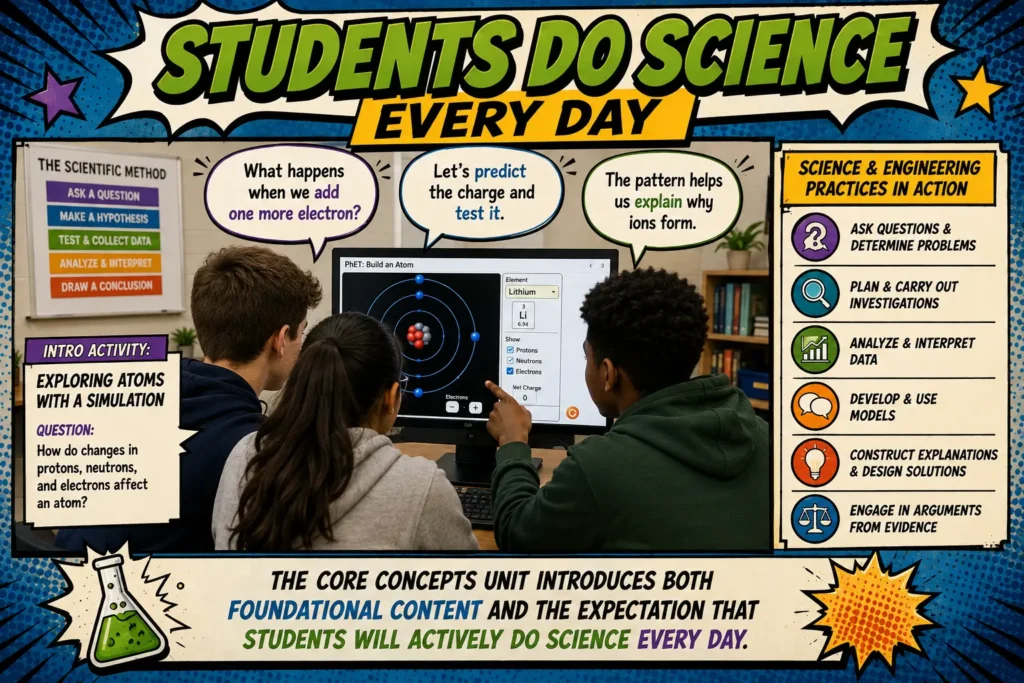
I use the opening unit to establish the science and engineering practices and the culture surrounding them. We aren’t coming to class merely to collect facts and figures. We’re coming to do science so that we can learn something.
Students begin observing, analyzing, modeling, explaining, and arguing from evidence immediately. The content may be introductory, but the critical thinking habits are established here. This is where consistency matters!
If I want students to recognize themselves as people who are capable of making informed decisions, that message and experience must begin on day one and continue all year.
“We’re not coming to class to learn facts and figures. We’re coming to do science so that we can learn something.”
Organize an Inquiry-Based Science Curriculum Around Recurring Themes
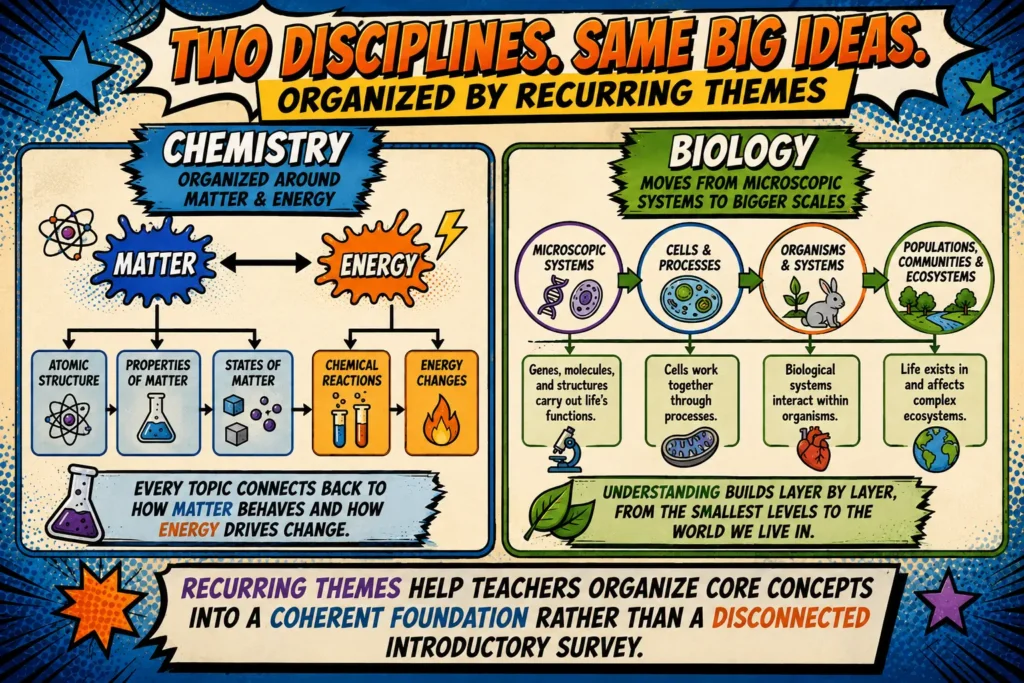
After identifying individual concepts, I pulled back to look for the larger themes running through the course. In chemistry, those themes are matter and energy.
The scope and relevance of chemistry lead into atoms, elements, compounds, the periodic table, properties, states of matter, and forces of attraction, all expressions of matter and how it behaves. Changes in matter become a bridge toward energy. Particle motion, chemical reactions, collision theory, and conservation of both mass and energy connect the two themes.
Organizing core concepts this way keeps the unit from becoming another miscellaneous collection of introductory topics. Students gain a framework they can use to locate new learning within the larger story of the course.
The Same Planning Process Works Beyond Chemistry Curriculum
This process takes time and experience with the complete course. As I move from teaching part of biology last year to teaching the entire course this year, I expect that extra time and experience will help me recognize its recurring ideas and the places where student inquiry depends on knowledge that isn’t yet secure.
Even now, I can see one possible organizing movement: biology often begins with microscopic structures and processes we can’t see, then works toward organisms, populations, habitats, and ecosystems. Genetics may serve as a bridge between the microscopic genes we can’t see and the observable phenotypes they produce. The final themes might be more sophisticated than “micro to macro,” but that lens offers a place to begin.
Every science curriculum has ideas that echo across units. Naming those themes helps teachers distinguish truly foundational reasoning from content that simply appears early in a traditional sequence.
How to Identify Core Concepts for Your Own Science Curriculum
I don’t recommend beginning by inventing a core concepts unit in isolation, especially if the rest of the course doesn’t yet ask students to learn through active, discovery-centered experiences. First, begin transforming individual lessons so students do more of the intellectual work themselves.
That doesn’t mean giving students a website and a worksheet and spontaneously calling the result inquiry. Look closely at what happens in each lesson. Ask yourself:
- What do you explain that students could uncover?
- What demonstration do you perform that students could analyze?
- What patterns, relationships, or core ideas could they extract from purposeful evidence?
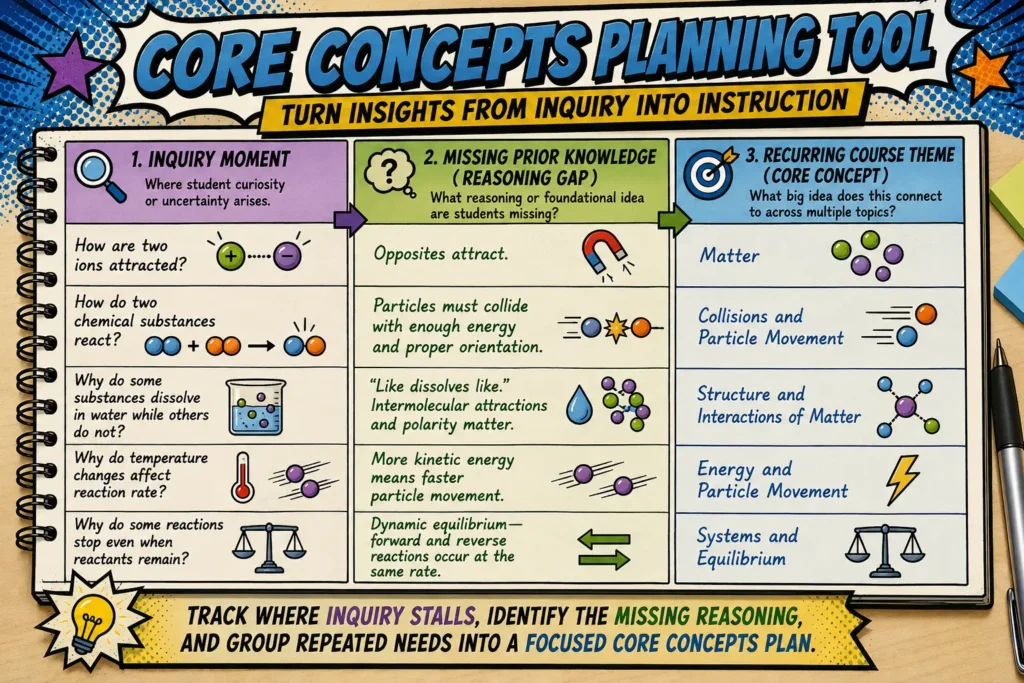
As you build more of those experiences, you’ll notice where inquiry creates productive struggle and where it simply hits a wall because students lack necessary prior knowledge. Those are the moments that reveal potential core concepts for the purposes we’ve described here.
Keep a Running List of Where Inquiry Stalls
As you teach or plan, notice the moments when you think, “There’s no way around this. I’m going to have to reveal the answer because students can’t get there.” Record the missing idea. Some will be narrow facts; others will be more powerful concepts that support reasoning across several units.
Then ask whether that idea belongs in an opening foundation, should be developed immediately before a particular investigation, or can emerge through a redesigned experience. A core concepts unit shouldn’t become a warehouse for everything students might need someday. It should contain the small number of ideas whose early development unlocks repeated discovery.
Group the Core Concepts Into Larger Scientific Themes
Once you have a working list, step back and look for the forest through the trees.
- Which ideas describe the cross-cutting concepts of science: matter, energy, systems, structure and function, cause and effect, scale, or another recurring way of making sense of the discipline?
- Which concepts act as bridges from one portion of the course to another?
Grouping the list into themes will help you refine it, reveal gaps, and create a more coherent opening to the year. More importantly, it gives students a set of mental anchors they can use as the science becomes increasingly complex.
“The goal isn’t to front-load the whole course. It’s to identify the smallest foundation that makes deeper discovery possible.”
Give Students a Foundation—Then Let Them Do the Science
A thoughtfully designed introductory unit doesn’t contradict inquiry-based science instruction. It supports it. When students share essential language, recurring concepts, and experience with the practices of science, teachers can step back more often and ask students to make meaning from what they observe.
If you’re still building toward an inquiry-based science curriculum, don’t begin by trying to redesign the entire course. Start with one lesson. The Active Learning Action Plan will help you turn an existing activity into an experience that puts more of the critical thinking work in students’ hands. As you create more of those experiences, you’ll begin to recognize the prior knowledge and core concepts students need to make deeper discovery possible.
And if you teach chemistry and want to see how these core concepts connect to the complete course, download our Beyond the Beaker Storyline Snapshot. It maps the reasoning behind the yearlong chemistry curriculum so you can see not only what comes next, but why.