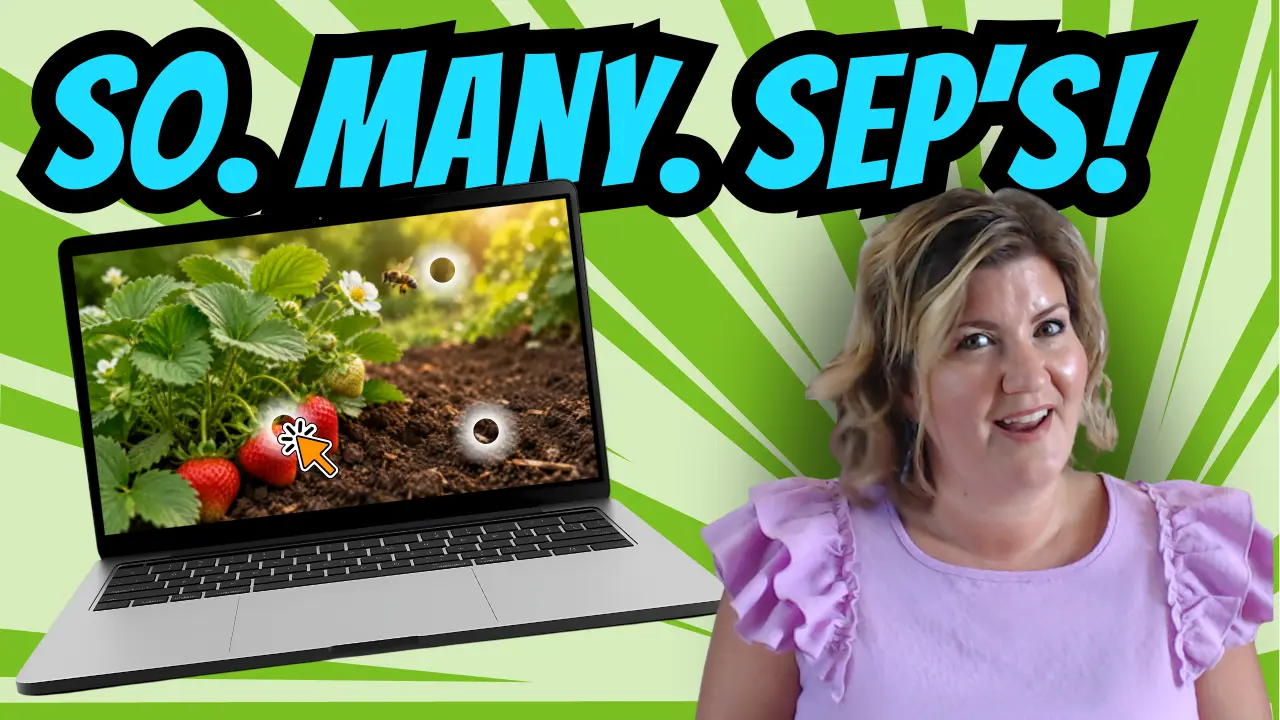
An inquiry-based characteristics of life activity built around evidence, comparison, and patterns
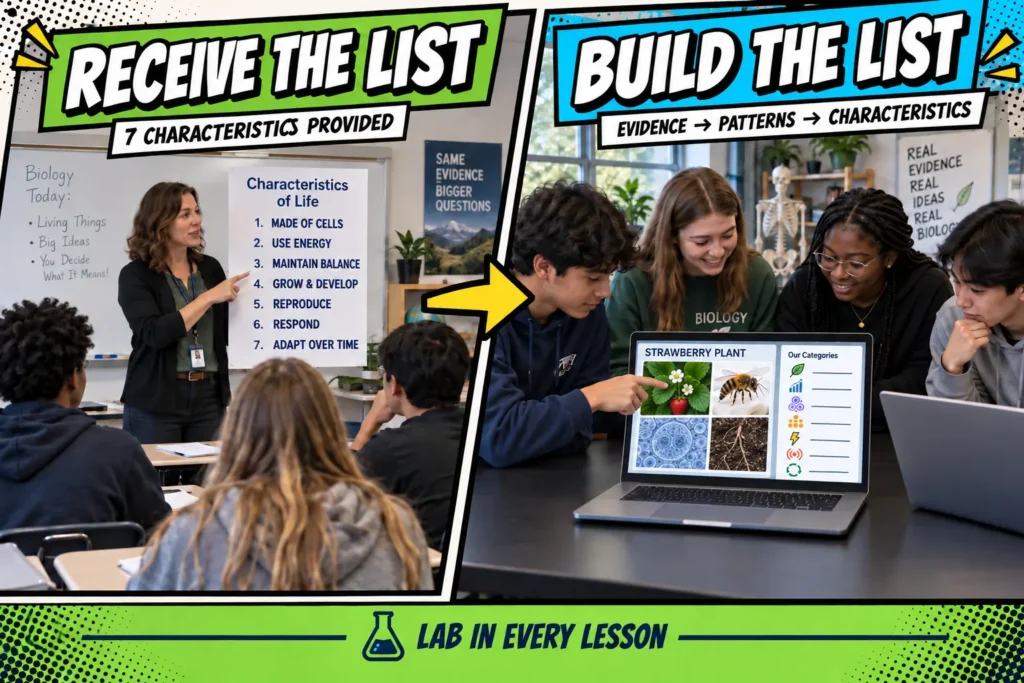
The characteristics of life are easy to teach as a list, but a list gives students almost none of the intellectual work. In this article, you’ll see how I turned this familiar introduction to biology topic into an inquiry-based investigation. Students collect evidence about a strawberry plant, a bee, and soil; compare the patterns they find; and determine the characteristics of living things before I help them by giving those ideas their formal names.
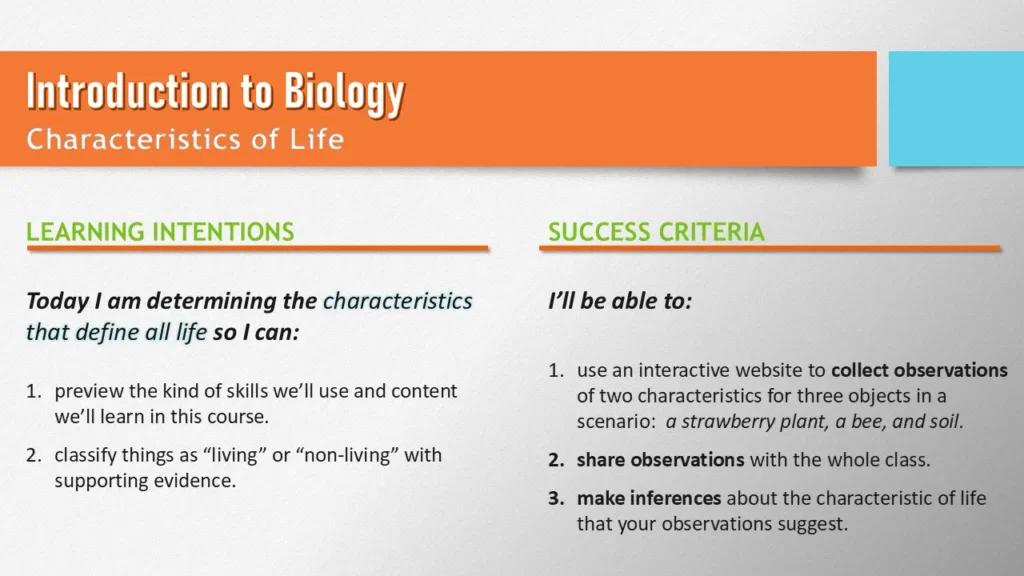
Why the Characteristics of Life Shouldn’t Begin as a List
Growth. Reproduction. Cells. Response to stimuli. Energy use. DNA and heredity. Homeostasis. The characteristics of life are just a list of properties, right? This topic is probably only a pain point for those of us teachers who can’t stand lecturing the list and calling the lesson done!
That was exactly the problem I encountered when I sat down to plan this topic for the beginning of my biology course. I’d never taught the course from the beginning before, and I don’t like to teach by telling. In 2019/2020, before Pennsylvania was held to the 3-dimensional STEELS standards, I was able to prep an inquiry-based plan for every lesson in my high school chemistry course by leveraging technology apps available for free online. At that time I developed a plug-and play framework for creating lessons full of cross-cutting concepts and core ideas that were only revealed when students used science and engineering practices in the activities I designed each day. This would be my first test at applying that framework beyond chemistry content, my own personal area of expertise.
So I gave it a go! This year, my biology students would determine the characteristics of life (and everything that comes after that!) themselves!
The content didn’t need to change. The work did. Instead of asking myself how I could explain seven traits clearly, I asked myself, “What could students observe that would let them recognize those traits and then reveal the pattern over various types of living and nonliving things?”. That question turned a list-heavy topic into a full inquiry-based characteristics of life lesson.
“We didn’t change the content. We changed who did the thinking—and who did the hard work.”
Use Familiar Phenomena to Introduce the Characteristics of Life
For students to collect evidence and extract a pattern, they need something to observe. That’s where I begin when I’m planning an inquiry lesson in any science discipline: every student can make an observation. Two students may look at the same image and notice different things, which immediately creates an opening for questions, collaboration, and discussion.
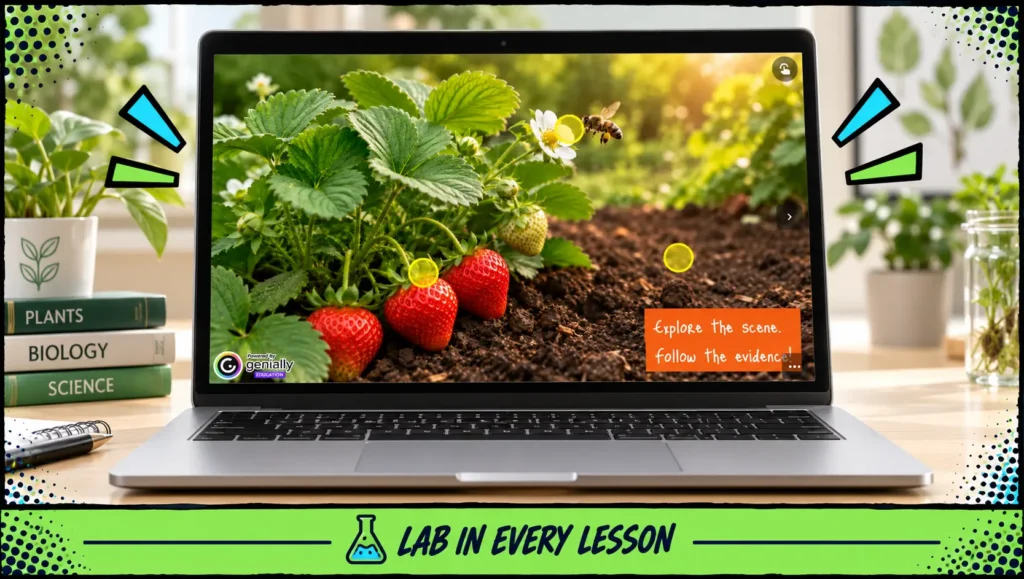
Observation also gives us a natural way to anchor a lesson in phenomena. For ninth- and tenth-grade students who are new to biology, I wanted that phenomenon to feel familiar. The investigation I designed begins with three ordinary parts of a Pennsylvania garden: a strawberry plant, a bee, and soil.
Students probably enter the room with enough prior knowledge to accurately classify the strawberry plant and bee as living and the soil as nonliving. But, the challenge inherent here will be to provide evidence to support those classifications.
“Classification is the starting point in secondary science. Supporing claims with evidence is the skill we need to master.”
Begin With Living and Nonliving Classifications
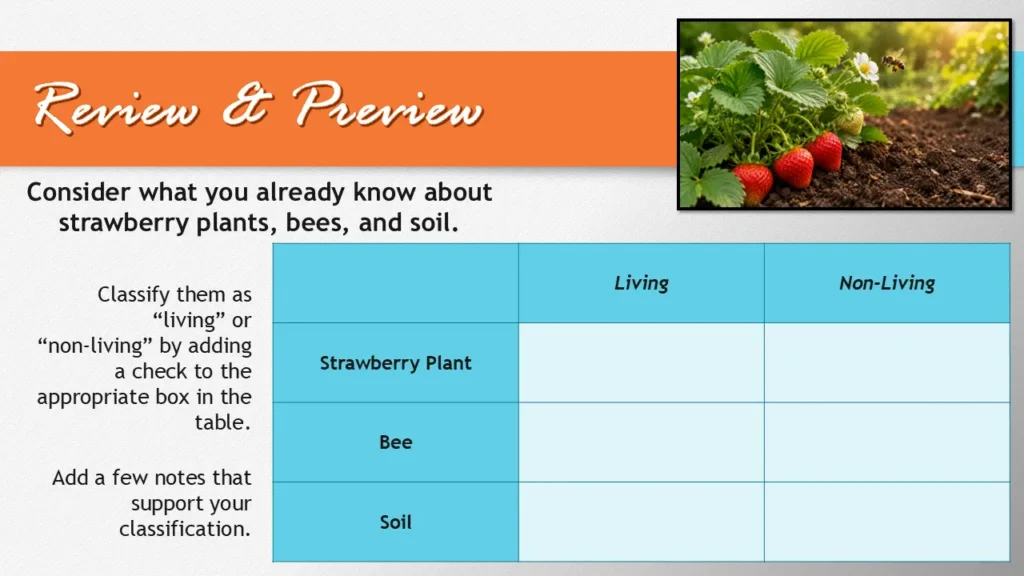
Before students enter the interactive investigation, I ask them to classify the strawberry plant, bee, and soil as living or nonliving and add a few notes explaining their choices. This activates knowledge they already have while previewing the experience they’ll embark upon to discover the seven characteristics.
Also, as a model for the scientific process, their initial classifications become claims they’ll revisit once they’ve collected more precise evidence.
Make Evidence the Goal of the Characteristics of Life Activity
The goal of this activity isn’t simply for students to classify the strawberry plant and bee as living and the soil as nonliving. A younger student could probably do that successfully.
The high school-level challenge is to provide evidence that supports those classifications.
That distinction shaped both the learning intention and the success criteria for the lesson. The learning intention communicates the larger purpose:
Students are determining the characteristics that define all life so they can preview both the course content and the ways of thinking they’ll use throughout biology.
That verb — determining — matters so much here! Students won’t be listening to, reading about, or memorizing the characteristics. They’ll be figuring them out for themselves.
The success criteria then identify the actions that will get them there.
Students will:
- Use an interactive investigation to collect observations.
- Report and compare their evidence with other students.
- Make inferences about the characteristics their evidence suggests.
- Use that evidence to support classifications of living and nonliving things.
Together, those goals keep the activity focused on more than discovering the correct seven terms. Students are practicing how scientific knowledge is built: observe, collect evidence, communicate findings, identify patterns, and use those patterns to support a claim.
A younger student can probably sort many familiar objects into living and nonliving categories. In high school, we want students to move beyond the label and support a classification with evidence. That shift turns a simple review into the beginning of scientific argumentation … one of the eight science and engineering practices!
The success criteria make student learning visible. Students will use an interactive website to collect observations, report their findings to others, and make inferences about the characteristics their evidence suggests.
Divide the 21 Evidence Trails Among Student Groups
The complete interactive tool students will use contains evidence for seven characteristics across three objects. That creates 21 evidence trails which is far too much for every student to investigate deeply during an introductory lesson. Instead, I assign each student or small group two characteristics for each object.
Dividing the work in this way keeps the activity manageable, but it also makes communication necessary. Students have to return to the class and explain what they found so everyone can build the complete evidence set. At the beginning of the year, that gives students a purposeful reason to talk in a small group and then contribute to a larger scientific conversation.
How This Characteristics of Life Activity Uses 21 Evidence Trails
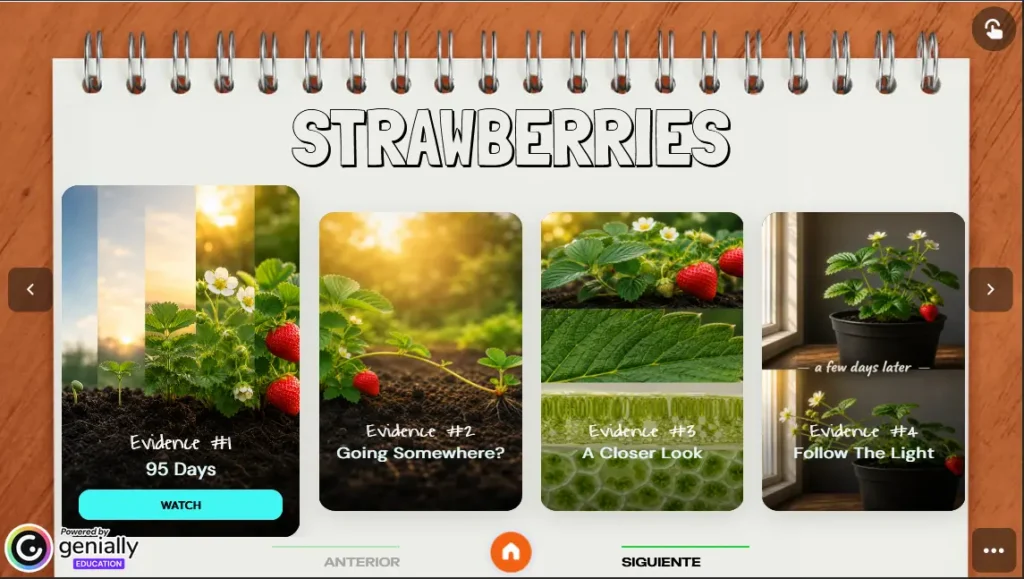
The digital investigation, built in Genially, opens on the garden scene. Students select the strawberry plant, bee, or soil and move through seven numbered evidence cards. The numbers match the spaces in their graphic organizer, so students can concentrate on what they’re observing rather than trying to manage the tool.
Each card gives students a different kind of evidence: a time-lapse video, a sequence of images, an interactive model, experimental results, a microscopic zoom, or an infographic. A repeated prompt brings them back to the same purpose: What does this evidence reveal about the living or nonliving nature of the object?
Use Strawberry Evidence to Introduce the Seven Characteristics of Life
As students systematically work through the interactive tool, they are able to focus on simply recording what they see without already knowing or realizing the characteristic of life each evidence card is depicting:
- Evidence #1 (growth): a time-lapse video documents the development of a mature strawberry plant from a simple seed
- Evidence #2 (reproduction): an interactive model of a strawberry plant complete with runners and daughter plants
- Evidence #3 (cells): modeled magnification enables various perspectives from whole plant to leaf tissue and leaf cells
- Evidence #4 (response to stimuli): the plant grows toward light shining through a window
- Evidence #5 (using energy): a data table with measured daughter-plant production under two light intensities
- Evidence #6 (DNA / heredity): demonstrates a simple way to extract DNA from strawberries
- Evidence #7 (homeostasis / balance): an infographic depicting how stomata inside the strawberry plants help them conserve water on a hot, dry day.
Together, the interactive cards expose students to the evidence behind each of the characteristics of life we’re intending them to discovery and name.
When we use technology with intent, we can create cost-effective, efficient learning experiences that would otherwise be difficult to deliver.
Compare Bee Evidence to Find Shared Characteristics of Living ThingS
The bee matters to this learning experience for students because it prevents them from mistaking a plant-specific behavior for a characteristic shared by all living things. For example, a strawberry uses light to create energy and grow; a bee doesn’t photosynthesize. If both are living, students must look beneath the surface detail for the larger pattern: living things use energy.
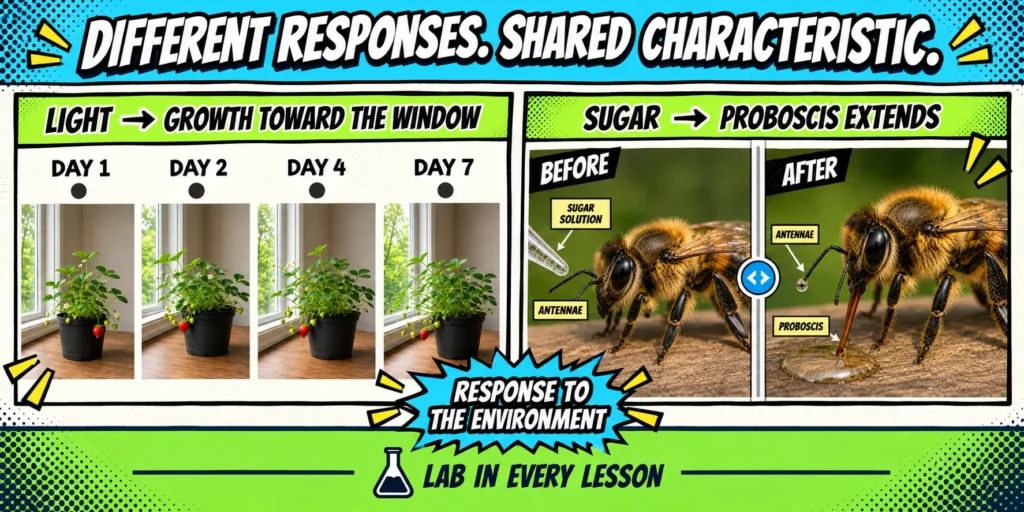
Another contrast that is especially reflective of the level of rigor involved, here, is the evidence representing the characteristic of life relating to response to stimuli. Students watch a strawberry plant bend toward a window over several days. In the bee corresponding evidence for this same characteristic, scientists introduce a sugar solution, the bee senses it with its antennae, and its proboscis extends. The examples appear completely different, but both show an organism changing in response to something in its environment.
Use Soil as a Nonliving Counterexample
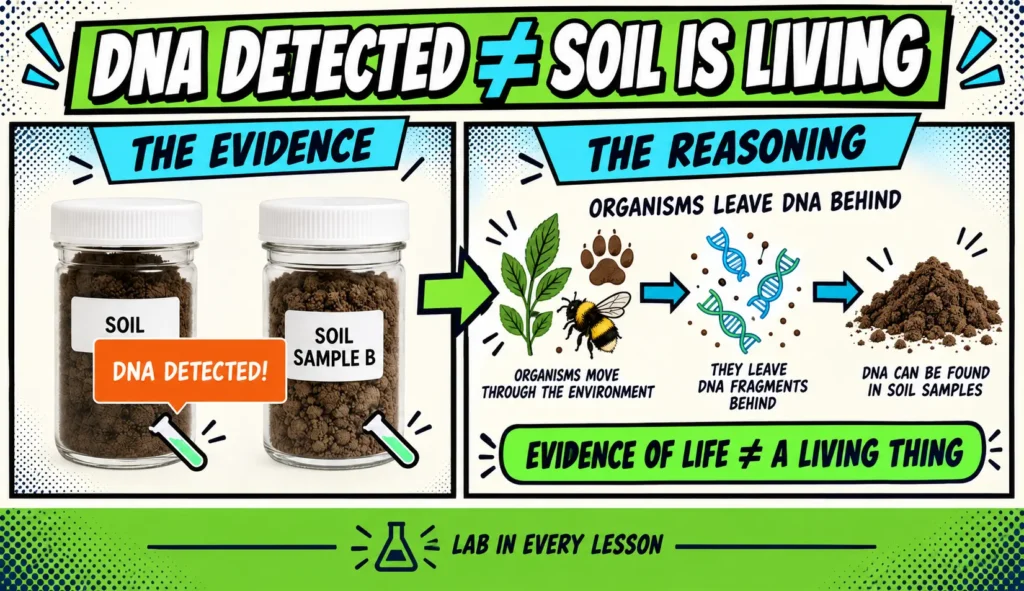
The soil isn’t the token nonliving example in this learning experience. It’s the counterexample that makes the pattern that emerges even more precise. Secondary science students already expect it to be nonliving, but they still have to examine the evidence instead of assuming that every visible change signals life.
Soil can move, erode, dry out, divide into smaller piles, contain environmental DNA, and release carbon dioxide because organisms live within it. Some pieces of evidence provided in the interactive tool may resemble growth, response, energy use, or heredity at first glance. That productive ambiguity pushes students to distinguish what the soil itself does from what living organisms in the soil do.
Without a nonliving comparison, students might simply collect seven interesting facts about plants and animals. Including the soil requires them to test whether the pattern they observe actually defines life or simply describes it.
“A counterexample doesn’t distract from the pattern. It helps students decide where the pattern stops.”
How Students Analyze Evidence to Identify the Characteristics of Life
Although this lesson doesn’t center on calculations, numbers, or measured units, students are still analyzing data. Remember: data can be quantitative or qualitative! Careful observations, model details, before-and-after images, and descriptions of biological responses all become evidence students can organize and compare.
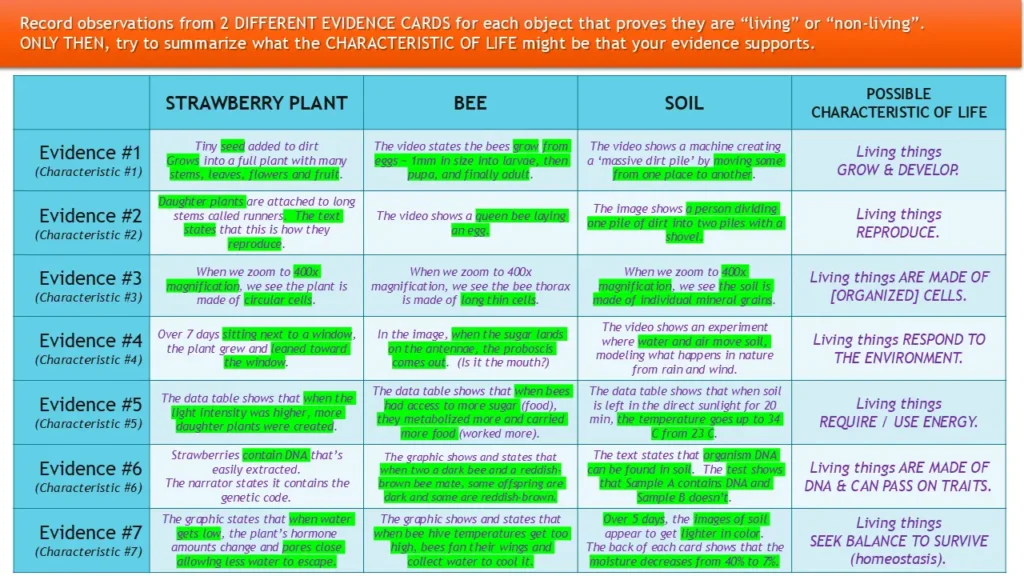
The graphic organizer designed to function as a student artifact for this learning experience lists the three objects across the top and the evidence trails down the side. Students record what they observe in the boxes, then use the final column to state the characteristic that connects the living examples and separates them from the nonliving example.
Connect Seven Evidence Patterns to the Seven Characteristics of Life
Across the investigation, the seven patterns students are working toward are:
- Living things grow and develop.
- Living things reproduce.
- Living things are made of one or more cells.
- Living things respond to stimuli or changes in their environment.
- Living things obtain and use energy.
- Living things contain DNA and pass hereditary information.
- Living things regulate internal conditions to maintain homeostasis.
The important point is that this clean list appears after the cross-cutting concept work of identifying the pattern from the evidence collected. It confirms and formalizes what students have begun to infer; it doesn’t replace the thinking that makes the list meaningful.
Practice Science and Engineering Through Characteristics of Life Evidence
The heaviest intellectual lift in the lesson lives here: finding patterns across the evidence.
To this point in the lesson, students will have practiced so many science and engineering practices!
- They obtain information from videos, models, diagrams, and scientific sources.
- They interpret qualitative and quantitative data.
- They use models, consider experimental outcomes, communicate findings, and support a classification with evidence.
Patterns operate as the bridge between those individual observations and the biological core ideas we want them to extract. They are the crosscutting concept of science that we’re bringing to life!
A time-lapse of a strawberry plant is an interesting observation. A plant growing, a bee developing through a life cycle, and soil failing to show biological development become evidence for a characteristic when students compare them.
“The evidence gives students something to notice. The pattern gives the evidence meaning.”
Guide Students From Evidence to the Characteristics of Life
I expect the observation phase we’ve just discussed at length to take about one class period, even with students investigating only part of the evidence set. As a lesson we’ll deliver at the start of a new school year and as an introduction to biology, students will need time to navigate the interactive, discuss what they see, and decide which details are worth recording. This is a process we can’t rush!
Similarly, the collective sensemaking will take time. Especially if you’re using the collaborative approach I’ve planned for myself, it’s necessary to relax and let each part play out … restrain from rushing it! Each group will report its evidence back to the whole group so the class can populate the strawberry, bee, and soil columns together.
Only after we’re sure that all the students have seen what they need to see or otherwise know what they need to know about the pieces do we turn to that final column and ask what characteristic the evidence suggests.
Scaffold the Most Challenging Evidence Comparisons
Some evidence patterns will be much more difficult for students to identify than others. A strawberry plant growing toward a window and a bee extending its proboscis after sensing sugar appear to have very little in common, especially to students encountering biology content for the first time.
For students who need more support, I can slow down the comparison without revealing the characteristic. We might trace the strawberry plant from its starting condition to its final position near the window, then trace the bee from sensing the sugar solution to extending its mouth parts. From there, I can ask students to identify what changed between the “before” and “after” evidence in each example.
That support doesn’t eliminate inquiry. It directs students’ attention toward the relationship they need to examine while leaving the conclusion in their hands.
Introduce Biology Vocabulary After Students Identify the Pattern
Some characteristics will be easier to name than others. Students may infer growth, reproduction, cells, and energy use fairly quickly. Homeostasis is different. We could never expect students who haven’t learned the term to produce it independently.
Instead, students might articulate that living things keep themselves balanced, adjust to stay safe, or respond in ways that help them survive. Once the class has expressed the correct concept, we can introduce the term “homeostasis” as the precise biological term for the idea they’ve already uncovered.
Do I ultimately want students to know and use the word homeostasis correctly? Of course! But first, I want them to understand the idea the word represents. Precision matters—but it comes after comprehension.
Differentiate Inquiry by Changing the Extent of Discovery and Doing
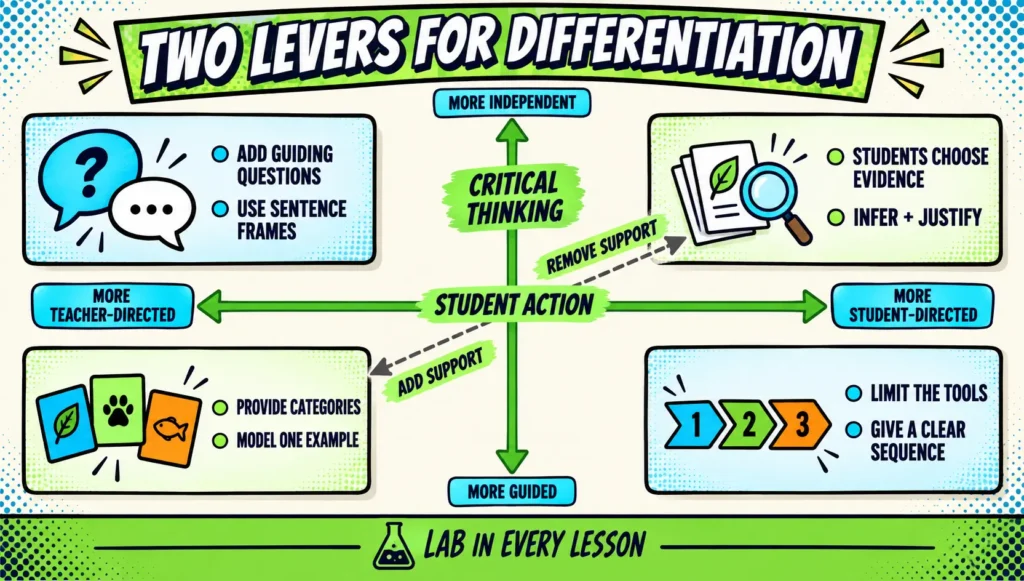
I think about differentiation on two axes: the amount of action students complete and the amount of critical thinking they’re responsible for. Changing either one lets me adjust this characteristics of life activity without abandoning its inquiry structure.
Students who need more support can investigate fewer evidence trails, use a sentence starter such as “Living things ______,” or complete the final inferences through teacher-guided discussion. Students ready for greater independence might examine all 21 trails, work without sentence starters, and construct the complete list themselves.
Guided inquiry is especially appropriate at the beginning of the year, when students are still learning what this kind of intellectual work requires. If they don’t immediately recognize the patterns, that doesn’t mean inquiry is too difficult for them. It means I need to make the thinking more visible, scaffold it deliberately, and release responsibility over time.
Why This Introduction to Biology Does More Than Teach Seven Terms
The seven characteristics of life will reappear throughout the biology course. Students will encounter growth and reproduction, cells, energy transfer, heredity, environmental response, and homeostasis in far greater depth. This opening investigation gives those future units an early conceptual frame.
Just as importantly, the activity introduces the culture of the course. Students learn that they’ll be expected to observe closely, collect evidence, communicate with one another, recognize patterns, and construct meaning. They experience science as something they do, not just a collection of facts told to them.
Will students remember a list they helped build more readily than one they copied from a slide? I believe they will!
But even if they need reminders later in the year, they’ll have more than seven isolated terms to return to. They’ll have the strawberry, the bee, the soil, and the reasoning that connected them.
“A strong first content lesson doesn’t only introduce what students will learn. It introduces how they’ll be expected to learn it.”
Let Students Find the Pattern
The next time a science topic appears to be “just a list,” resist the urge to begin with the clean final version. Ask yourself, “What resources do I have or can I find that students could observe, compare, sort, model, or test to discover or make sense of?”. Then decide which examples and counterexamples will help them see the pattern for themselves.
If you teach biology and want to use this complete lesson without building 21 evidence trails from scratch, download a sample of the entire Characteristics of Life inquiry-based lesson. The interactive investigation, student organizer, and teacher supports are ready for you to adapt to your classroom.
If you’d like to learn more about the philosophy behind the lesson, explore Discovery by Design, my approach to creating science experiences in which purposeful student action comes before explanation.