You’re staring at a science standard with all three dimensions in front of you: a disciplinary core idea, a science and engineering practice, and a crosscutting concept. Which one should lead the lesson?
Most of us instinctively begin with the content. We decide what students need to know, build an explanation around it, and then look for an activity that fits. The crosscutting concept can become one more label we’re supposed to include somewhere in the plan.
But what if it could do far more than check a standards box?
Crosscutting concepts give students a way to examine evidence and make sense of a scientific idea. They can also give us a practical starting point for designing inquiry-based lessons. Instead of beginning with, how will I explain this core idea?’ we can ask, what pattern, relationship, system, flow, structure, scale, or change could students investigate?’
In this guide, you’ll learn what the seven crosscutting concepts are, how they differ from the science and engineering practices, and how to turn each one into questions that shape what students actually do during a lesson.
Table of Contents
- What Crosscutting Concepts Add to a Science Lesson
- How Crosscutting Concepts Differ From Science and Engineering Practices
- The Seven Crosscutting Concepts as Lesson-Planning Lenses
- How to Choose a Crosscutting Concept for Your Lesson
- Why One Science Lesson May Include Several Crosscutting Concepts
- Use Crosscutting Concepts to Put the Thinking in Students’ Hands
What Crosscutting Concepts Add to a Science Lesson
The Next Generation Science Standards identify seven crosscutting concepts that connect ideas across science and engineering. Students may meet completely different content in biology, chemistry, physics, earth science, or environmental science, but they can use the same lenses to make sense of it.
- Patterns
- Cause and Effect
- Scale, Proportion, and Quantity
- Systems and System Models
- Energy and Matter
- Structure and Function
- Stability and Change
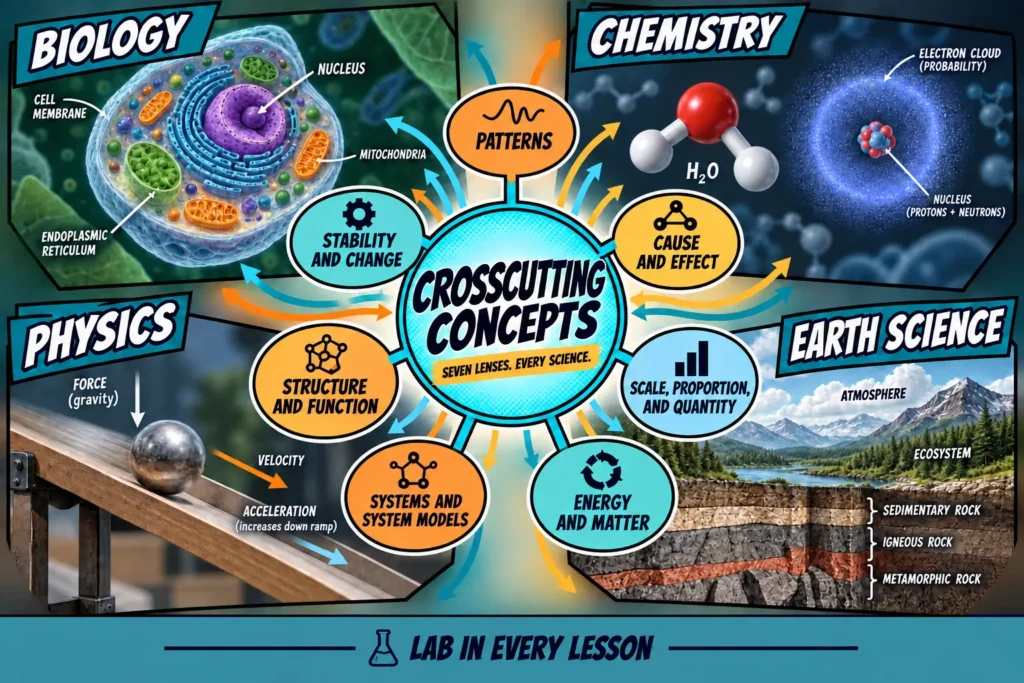
The content changes across science disciplines but students can return to the same seven ways of examining and making sense of itThe official NGSS guidance describes these concepts as intellectual tools that help students connect disciplinary content, apply scientific practices, and build a more coherent understanding of the natural world. They aren’t seven vocabulary terms to memorize and test in isolation. Students need repeated opportunities to use them while investigating real phenomena and problems.
“The core idea tells us what students are learning. The crosscutting concept helps us decide what relationship students can investigate to make sense of it.”
That distinction changes lesson planning. A core idea such as conservation of matter may tempt us to begin with notes and definitions. If we begin with energy and matter as a lens, however, we start looking for a system students can observe.
- What enters it?
- What leaves?
- What remains accounted for even when the matter appears to change?
Now the crosscutting concept isn’t decoration added after the lesson is written. It’s helping to create the lesson.
How Crosscutting Concepts Differ From Science and Engineering Practices
Crosscutting concepts and science and engineering practices work together, but they don’t do the same job.
The science and engineering practices (SEP) describe what students do:
- analyze data
- develop models
- construct explanations
- argue from evidence
- carry out investigations
The crosscutting concepts (CCC) focus what students notice and think about while doing that work:
- a pattern in the data
- a cause-and-effect relationship
- the boundaries of a system
- the movement of energy and matter
The disciplinary core idea (DCI) is the scientific understanding that emerges and becomes more sophisticated through that work.
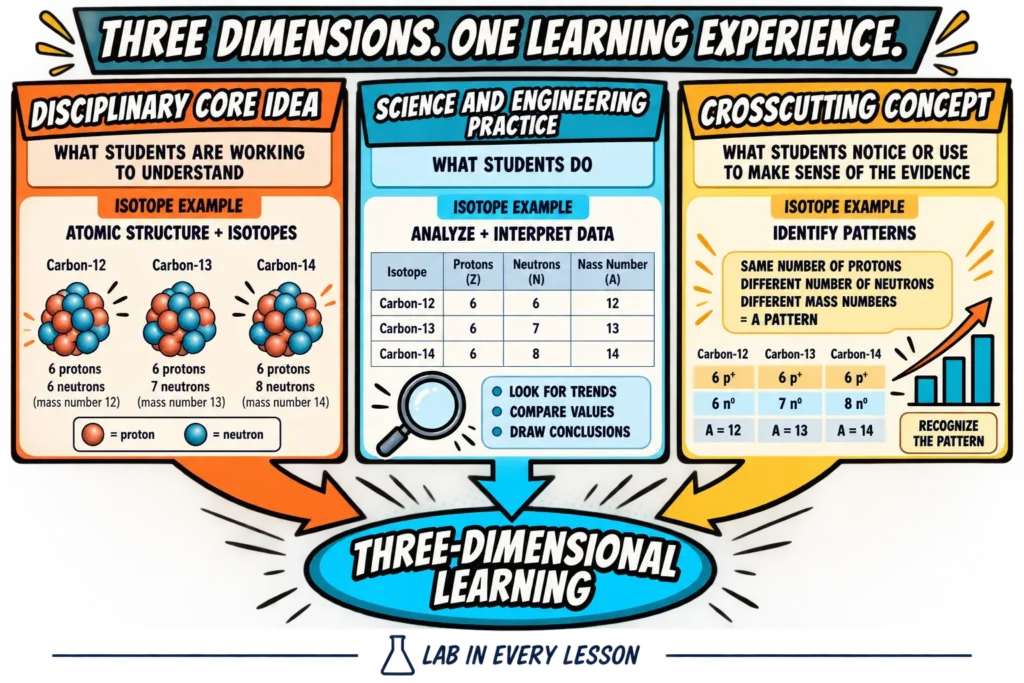
Three dimensional learning happens when the content student action and sense making lens function together inside the same taskFor example, students might analyze and interpret data (the SEP) to identify a repeating relationship (“patterns” CCC) and use it to explain why isotopes of the same element share one defining feature while differing in others (the DCI).
That is three-dimensional learning in action!
The dimensions aren’t three separate pieces we mention during a lesson. They work together inside the intellectual task students complete.
Turn the Seven Crosscutting Concepts Into Lesson-Planning Lenses
You don’t have to force all seven concepts into every activity. Begin with the one that reveals the most important relationship in the content students are about to study. Then use it to shape the resource they’ll examine, the artifact they’ll create, and the questions they’ll answer.
1. Use Patterns to Help Students Notice Trends and Make Predictions
Patterns are often my first doorway into inquiry because every student can observe. Students may notice different details or describe them with different levels of precision, but everyone has somewhere to begin.
My job is to organize the evidence so the important regularity becomes visible. Students might compare images, collect values in a table, sort examples, or combine observations in a shared organizer. Once the pattern appears, they can use it — not merely name it.
In my isotope lesson, for example, each student builds stable and unstable isotopes of one element in a simulation. Small groups combine their results in a shared spreadsheet. That collective data makes it possible to notice that isotopes of the same element always have the same number of protons even though their neutron counts and masses vary.
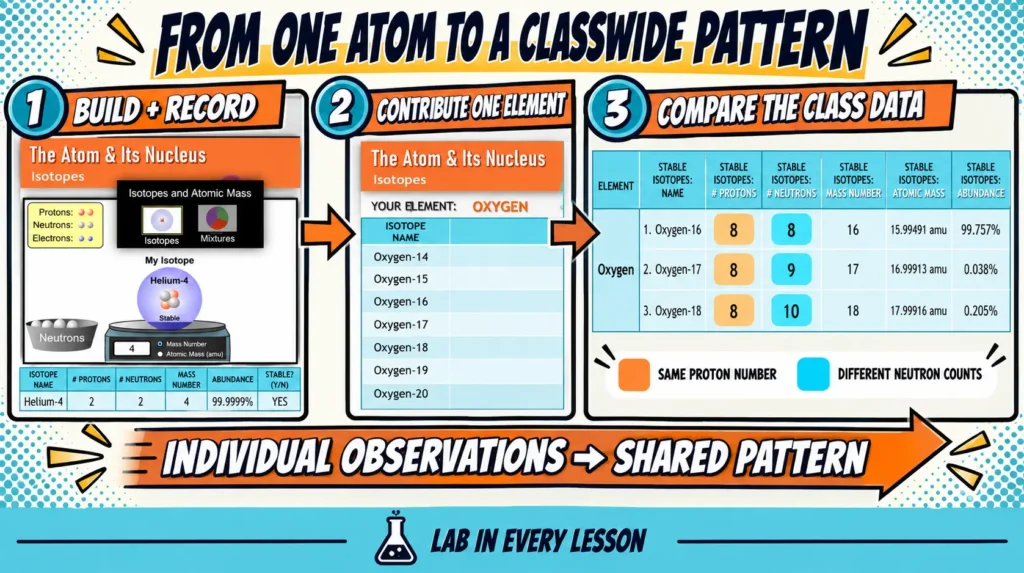
Combining students isotope data makes the defining pattern visible the proton number remains constant while the neutron number variesUseful patterns prompts for your own lesson planning OR for your students while they work include:
- What similarities, differences, or repeating trends do you notice?
- How could you organize or represent the evidence so the pattern is easier to see?
- Which observations don’t fit the pattern?
- What could you predict if the pattern continues?
- What might explain the pattern?
2. Use Cause and Effect to Investigate Scientific Relationships
Cause and effect asks students to move beyond noticing that two things occurred together. They must consider the mechanism connecting them, identify evidence for that relationship, and remain open to alternative explanations.
Look for a resource that allows students to manipulate one factor, compare conditions, or examine evidence across a sequence of events. The experience can come from a physical investigation, simulation, time-lapse, animation, case study, or carefully selected data set.
Useful cause-and-effect prompts include:
- What changed, and what happened next?
- Which factor appears to influence the outcome?
- What evidence supports a causal relationship rather than a simple correlation?
- What mechanism could connect the cause and the effect?
- What alternative explanation should we consider?
That final question matters. When more than one explanation remains possible, students have a reason to discuss evidence instead of waiting for the teacher to announce the correct answer.
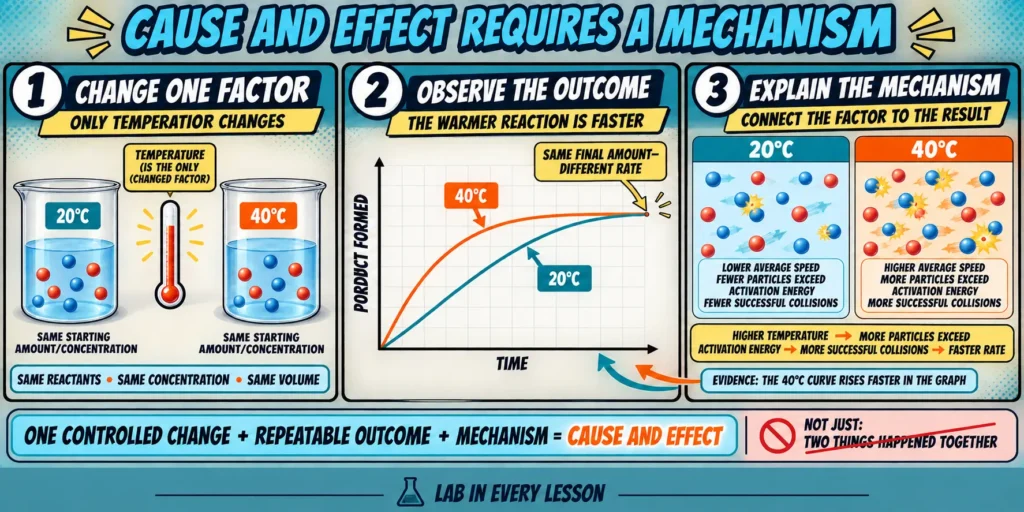
Cause and effect reasoning asks students to connect a changed condition with an outcomeand explain the mechanism using evidence3. Use Scale Proportion and Quantity to Make Comparisons Meaningful
Scale, proportion, and quantity help students reason about size, time, energy, and numerical relationships that may be impossible to experience directly.
- Atoms are too small to see.
- Astronomical distances are too large to picture.
- A mole is too numerous to count.
- Models and mathematics make those quantities available for investigation.
This concept becomes meaningful when students use a measurement or comparison to explain how a system behaves. It isn’t alive when they calculate something simply to arrive at a numerical answer or because a formula appears in the unit.
Useful scale, proportion, and quantity prompts for planning or prompting include:
- Which scale is most useful for examining this phenomenon?
- How does one quantity compare with another?
- What becomes visible—or invisible—when we change the scale?
- How does the system’s behavior change as this quantity increases or decreases?
- How could a model, ratio, graph, or calculation make the relationship easier to understand?
In chemistry, students might compare atomic and macroscopic representations of the same process, use proportional relationships to interpret a balanced equation, or investigate why surface-area-to-volume ratio changes reaction behavior. The numbers have a scientific job: they help reveal the relationship.
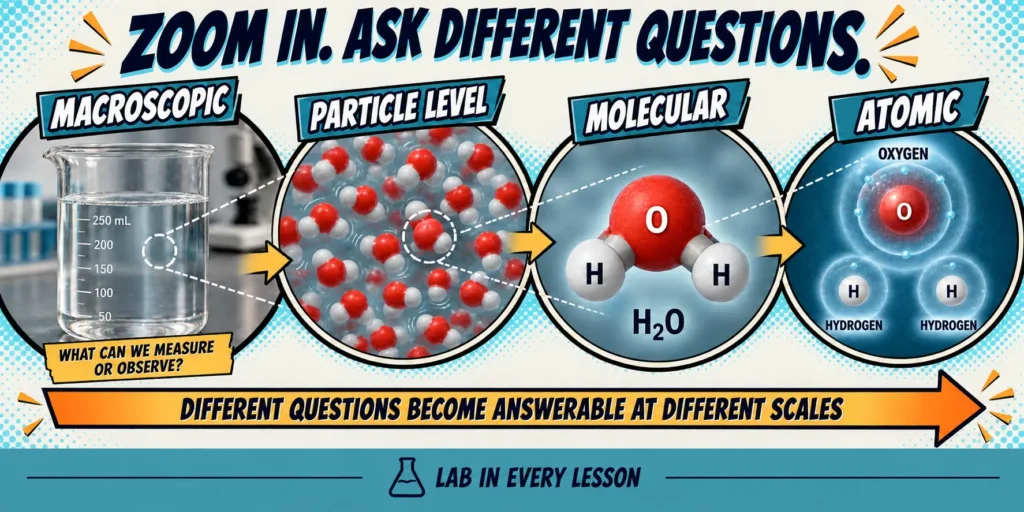
Changing scale can reveal structures and relationships that students cant observe from the macroscopic level alone4. Use Systems and System Models to Examine Parts and Interactions
Every science discipline asks students to understand systems. An atom, cell, ecosystem, human body, atmosphere, and chemical reaction can each be treated as a system with components, boundaries, inputs, outputs, and interactions.
Students can begin by identifying parts, but recall is only the starting point. The deeper work is deciding what belongs inside the system, how the components influence one another, and what the model helps or fails to explain.
Useful systems and system models prompts include:
- What are the boundaries of the system we’re studying?
- Which components belong inside those boundaries?
- How do the components interact?
- What enters or leaves the system?
- What does this model help us explain or predict?
- What are the model’s limitations?
In my Bohr-model lesson, students use a simulation to examine energy changes associated with electrons in an atom. Their organizer helps them connect the system’s components, changes in energy, and observable light. The model is useful because it gives them something dynamic to investigate and it also creates an opportunity to discuss what that model can and cannot represent accurately.
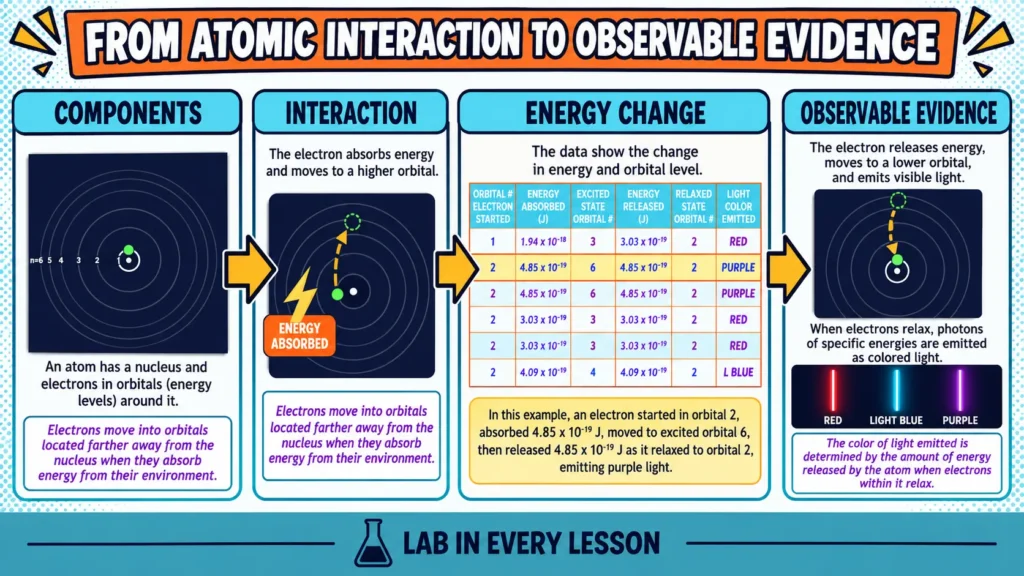
Students use the atomic model as an investigative system connecting its components and energy changes with observable evidence5. Use Energy and Matter to Trace Flows Cycles and Conservation
Energy and matter appear across science courses because every system has limits. Tracking what enters, leaves, changes form, cycles, or remains conserved helps students understand what the system can do.
This is where a diagram can become more than a picture students color or memorize. Ask students to use arrows, labels, quantities, or before-and-after evidence to account for energy and matter throughout a process.
Useful energy and matter prompts for planning and perspective include:
- What matter enters, leaves, or remains within the system?
- Where is energy transferred or transformed?
- How could we trace the flow through the system?
- What evidence shows that matter or energy is conserved?
- Where might matter or energy appear to be missing, and how can we account for it?
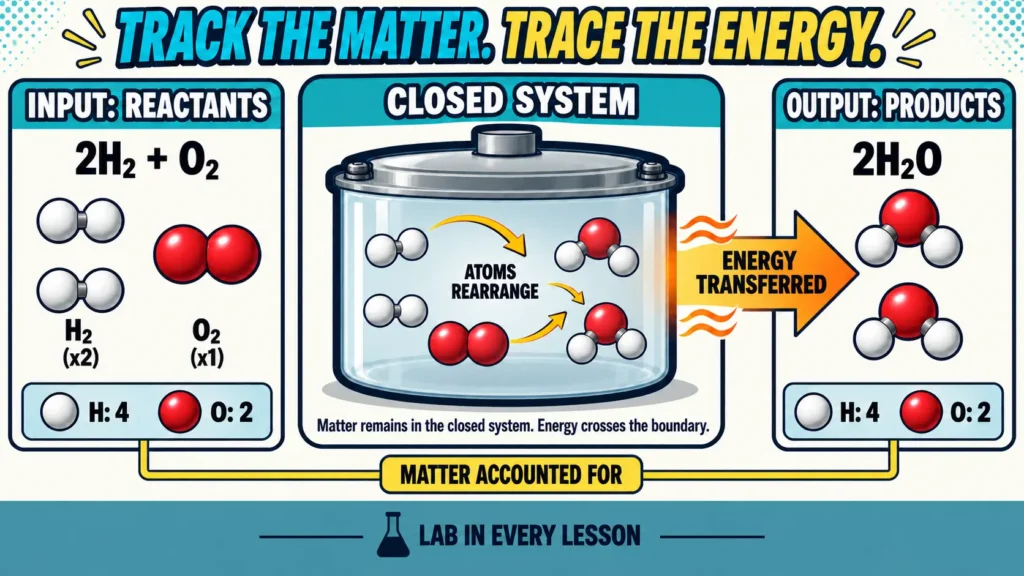
Defining the system and tracing its inputs and outputs helps students account for matter and energy throughout a changeStudents might trace radiant energy into chemical energy during photosynthesis, account for mass before and after a chemical reaction, or follow matter through a food web. The disciplinary content changes, but the sense-making lens remains recognizable.
6. Use Structure and Function to Connect Form With Behavior
Structure and function focuses attention on how shape, composition, arrangement, and substructure contribute to what an object or organism can do. This connection appears in cells, proteins, body systems, materials, molecules, and engineered designs.
A comparison is especially useful here. When students examine two related structures with different functions — or one structure before and after a change — they have evidence from which to infer the relationship.
Useful structure-and-function prompts include:
- Which structural features are most important?
- How does the arrangement of the parts contribute to the function?
- What changes when the structure changes?
- How do two structures support different functions?
- How could the structure be modified to improve or alter its function?
Students might compare prokaryotic and eukaryotic cells, connect molecular shape with intermolecular attraction, or test how a change in an engineered design affects its performance. The function is no longer another fact to memorize; it becomes an outcome students can connect to observable features.
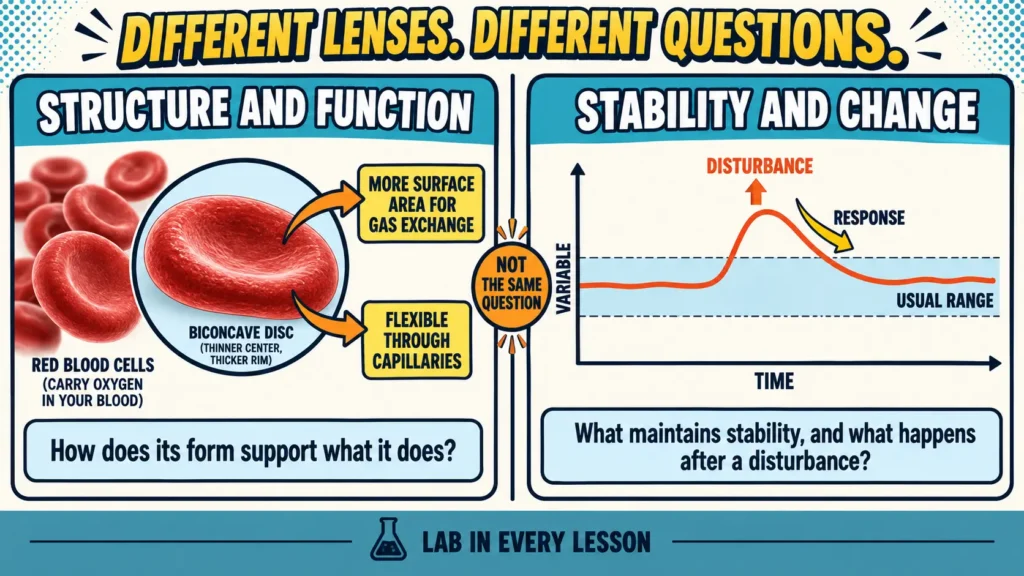
Structure and function connects form with behavior while stability and change examines balance disturbance and response over time7. Use Stability and Change to Explain How Systems Respond Over Time
Stability and change asks students to examine the conditions that keep a system relatively stable, the factors that disturb it, and the rates at which change occurs. A system doesn’t have to remain motionless to be stable. Dynamic systems may continue changing while maintaining an overall balance.
This concept is a natural fit for chemical equilibrium, homeostasis, population dynamics, climate systems, erosion, and motion. It also creates opportunities for students to use other crosscutting concepts like patterns to portray evidence and cause-and-effect reasoning to explain a disturbance.
Useful stability-and-change prompts include:
- What evidence suggests that the system is stable or changing?
- Which conditions help maintain the current state?
- What disturbance could move the system away from stability?
- How does the system respond to that disturbance?
- At what rate is the change occurring?
- What long-term behavior could we predict from the evidence?
In chemistry, students can investigate how an equilibrium system responds when concentration or temperature changes. In biology, they can examine how feedback helps maintain homeostasis. In both cases, students are using evidence to reason about balance, disturbance, and response.
How to Choose a Crosscutting Concept for Your Science Lesson
If all seven concepts sound relevant, don’t begin by asking which labels you can attach to the lesson. Begin with the core relationship students need to uncover.
Try this planning sequence:
- Name the core idea students need to understand.
- Identify the relationship inside that idea: a pattern, cause, scale, system, flow, structure, or change.
- Choose a phenomenon, model, data set, text, video, simulation, or investigation that makes that relationship observable.
- Decide what students will do with the resource: compare, sort, trace, calculate, manipulate, model, or test.
- Create an artifact that organizes their observations so the relationship becomes visible.
- Write questions that move students from observation to interpretation, explanation, and prediction.
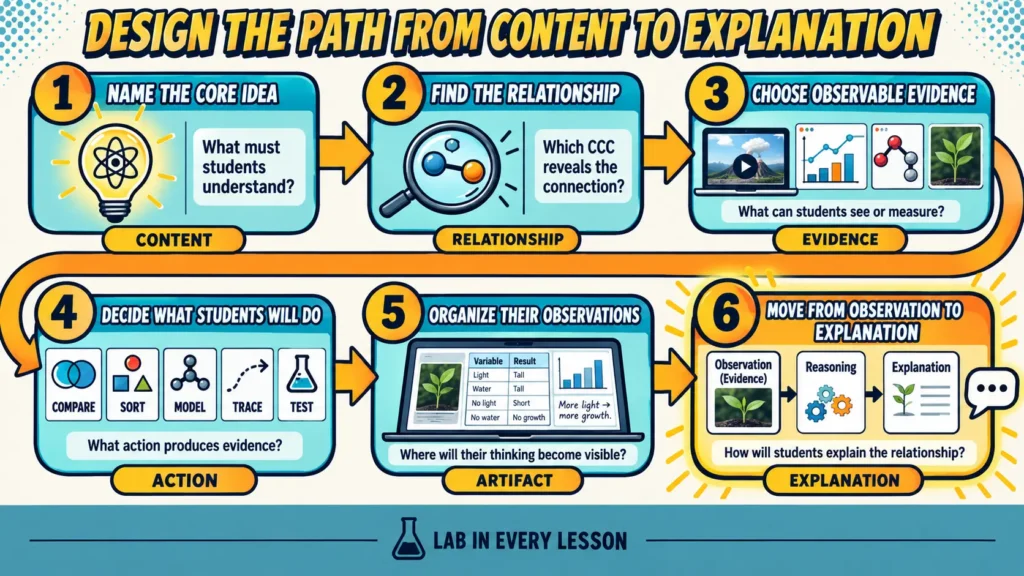
Begin with the core relationship students need to uncover then build the resource student action artifact and questions around it“Don’t choose the crosscutting concept because its name appears beside the standard. Choose it because it helps students see what the content means.”
The NGSS identifies particular crosscutting concepts within its performance expectations, and those connections matter. But this planning process helps us understand why the concept belongs there and how to make it function inside instruction rather than merely appear on the lesson plan.
One Science Lesson May Include Several Crosscutting Concepts
Crosscutting concepts overlap because scientific phenomena don’t arrive in seven tidy boxes.
A student working with an atomic model might:
- Define the atom as a system and identify its components.
- Track transfers of energy within that system.
- Recognize a pattern in the energy associated with electron transitions.
- Use cause-and-effect reasoning to connect those transitions with emitted light.
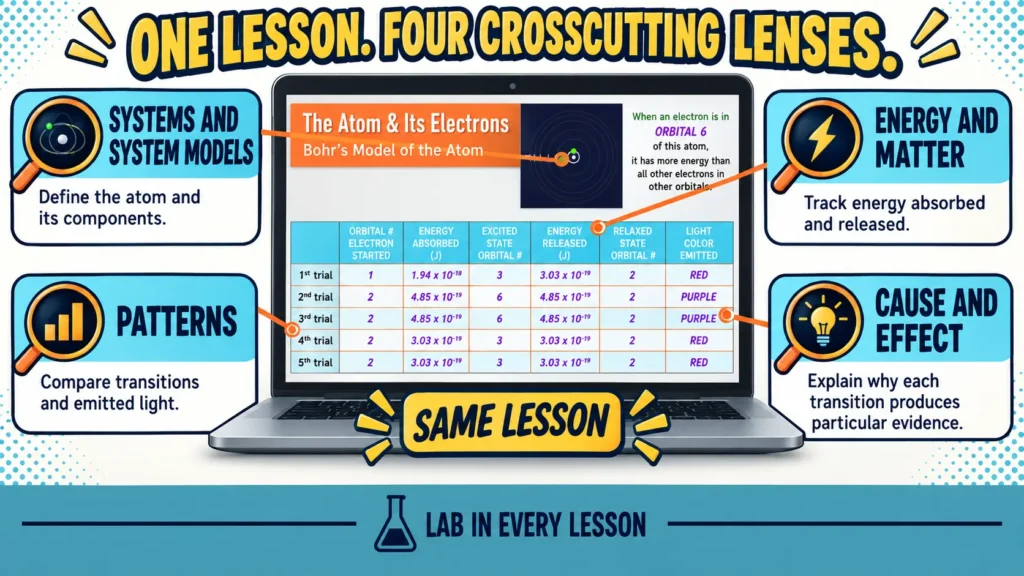
One well designed science lesson may use several crosscutting concepts even when one provides the primary sense making lensThat doesn’t mean the lesson needs four separate crosscutting-concept objectives! One concept can provide the primary lens while the others strengthen the reasoning students naturally perform.
This is also why I wouldn’t treat the seven concepts as a checklist to complete once and leave behind. Students need to meet them repeatedly in new contexts. Over time, the concepts become familiar ways of thinking that transfer from one unit — and even one science subject — to another.
Use Crosscutting Concepts to Put the Thinking in Students’ Hands
Crosscutting concepts matter because they help us shift the intellectual work of a science lesson.
Instead of explaining every relationship and asking students to remember it, we can give them evidence worth examining and a lens that directs their attention. Students can find the pattern, trace the flow, define the system, compare the scale, connect the structure with the function, or explain what caused the change.
We still bring the disciplinary expertise. We know the content well enough to choose productive examples, anticipate misconceptions, organize the evidence, and decide where students will need support. The challenge is using that expertise without doing all the sense-making for them.
“Your job isn’t to hide the science from students. It’s to design a path that lets them encounter it through purposeful action before you formalize what they’ve discovered.”
Understanding the seven crosscutting concepts is one thing. Turning them into a lesson students can actually investigate is the more challenging and overwhelming task!
If you want students to do more of the observing, comparing, modeling, and sense-making, but you don’t want to begin every lesson with a blank page, the Digital Instructional Design Studio will give you a repeatable way forward. Inside, you’ll find the complete Crosscutting Concepts Question Guide along with practical planning tools, templates, examples, and professional learning designed to help you turn science content into purposeful student action.
You’ll spend less time wondering how to make a lesson inquiry-based and more time shaping experiences in which students can uncover the important relationships for themselves.
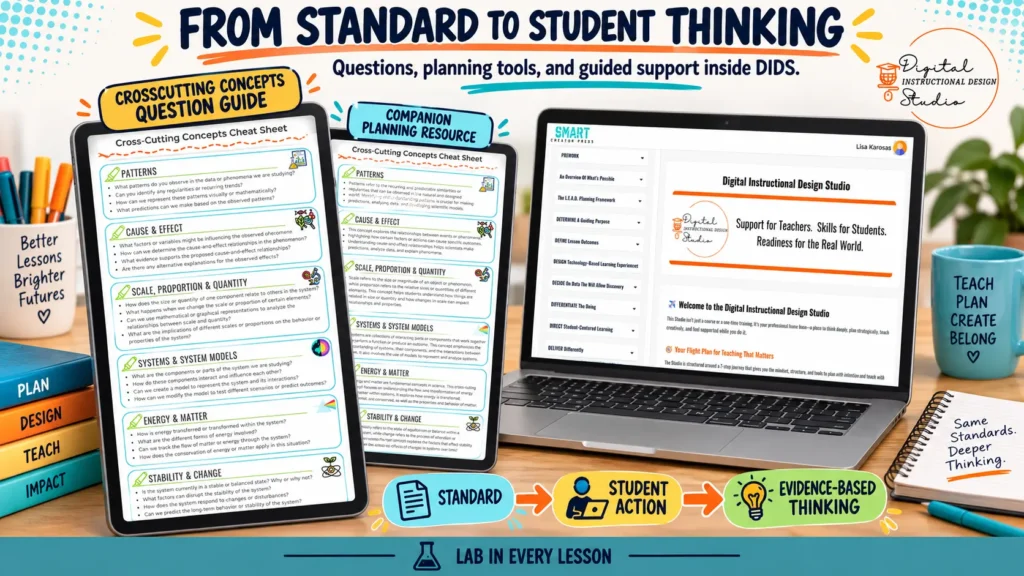
The Crosscutting Concepts Question Guide and supporting DIDS tools help teachers move from a science standard to purposeful student action