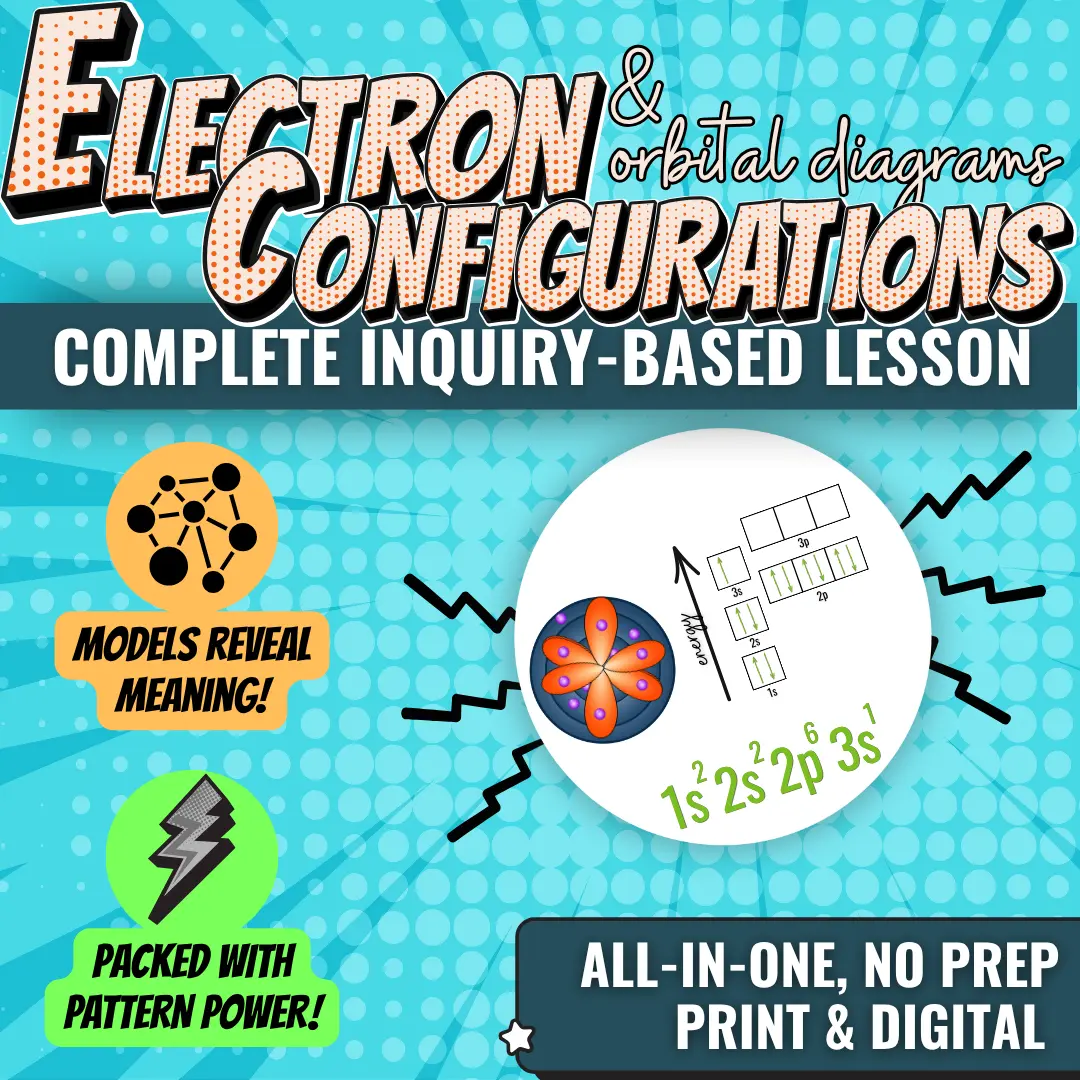
Electron Configuration & Orbital Diagrams Inquiry-Based Lesson
Standards & NGSS Connections
NGSS CODE:
DCI:
SEP:
CCC:
COURSE:
TEACHING DURATION:
FORMATS INCLUDED:
Overview
Electron Configuration Makes More Sense When Students BUILD MODELS to Discover the Patterns Behind Orbital Diagrams
Electron configurations are often introduced as a procedure students need to follow => Memorize the filling order. Draw the arrows. Write the numbers, letters, and superscripts.
But what if students could investigate the electron arrangements within Schrodinger’s model before being given the rules?
In this Electron Configuration and Orbital Diagrams Inquiry-Based Chemistry Lesson, students use a custom-built interactive simulation to assemble electron-cloud models and observe how those arrangements connect with orbital diagrams and electron configuration notation.
As students build and compare models, they must consider:
- Which orbitals fill first?
- How many electrons can occupy one orbital?
- What happens when several equal-energy orbitals are available?
- What do the numbers, letters, and superscripts communicate?
- What patterns remain consistent as the number of electrons increases?
Students document orbital diagrams and electron configurations for carbon, sodium, and argon, then use their observations to propose the rules that govern electron filling.
THE RESULT:
Students build an understanding of electron configuration through connected visual and symbolic models, giving the notation meaning and the filling rules an observable foundation.
What Students Will Do
Students will:
- revisit the relationship between electron energy levels and energy changes
- connect a neutral atom’s atomic number with its electron count
- use an interactive simulation to assemble electron-cloud models
- add orbital representations and electrons according to the activity’s guidance
- observe how electron arrangements connect with orbital filling diagrams
- record orbital diagrams for carbon, sodium, and argon
- write the corresponding electron configurations
- interpret the numbers and letters used in orbital labels
- determine the maximum electron occupancy of a single orbital
- compare filling behavior across multiple atoms
- propose three rules for filling orbital diagrams based on their observations
- connect those observations with the Aufbau principle, Pauli exclusion principle, and Hund’s rule
The lesson intentionally builds from:
prior knowledge → interactive model building → observation → representation → comparison → pattern recognition → student-proposed rules
helping students understand how electron configurations represent electron arrangements within atoms.
What's Included

✔ Teacher-Guided PowerPoint Lesson (EDITABLE)
A visually structured presentation guides students through:
- reviewing electron energy levels
- connecting prior atomic models with the electron-cloud model
- reviewing electrically neutral atoms
- introducing orbital diagrams and electron configuration notation
- launching the interactive investigation
- building models and recording observations
- comparing carbon, sodium, and argon
- proposing orbital filling rules
- formalizing the three principles
- checking understanding of notation and electron capacity
The included lesson provides a complete suggested instructional sequence while allowing teachers to adjust pacing, discussion, and student collaboration.
✔ Digital BookWidgets Version
A fully interactive version aligned to the lesson flow of the presentation file.
Students can use it to:
- follow along in class
- complete work asynchronously
- complete it as station work
- submit work directly to your LMS
No student or teacher accounts are required to distribute or collect student work in this format. Video training and a case study on the use of BookWidgets are included with the product.
✔ SeeSaw Teacher Activity Links
Ready-to-assign activities are included within the PowerPoint notes so you can quickly add them to your SeeSaw library.
These links allow:
- fast assignment or scheduling
- curation of student artifacts throughout the year
- quick teacher review to determine proficiency or mastery
- direct communication between teacher and student about completed work
New to SeeSaw? No worries!
Links to a quick start guide and more comprehensive training is included with this product.
✔ Links to Required Instructional Media
The interactive simulation is central to the investigation.
SIMULATION (exclusive to Lab In Every Lesson!)
This tool connects three representations:
- an electron-cloud model
- an Aufbau orbital filling diagram
- electron configuration notation
Students use it to build models, observe electron filling, and collect the information needed to complete their diagrams and configurations.
They will drag orbital shapes into the model, add electrons, and observe the corresponding representations as they work through the guided sequence.
Please preview the links provided before purchasing to confirm they function on your school network and student devices. The lesson relies on students being able to access and manipulate the activity.
Instructional Flow
This Electron Configuration activity connects students’ prior understanding of atoms and energy levels with more detailed representations of electron arrangement.
Students investigate the filling process before formalizing its rules.
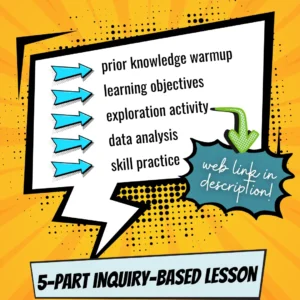
Phase 1 → REVIEW & PREVIEW (bellringer)
- Students revisit electron energy levels and what happens when electrons absorb or release energy.
- The lesson connects this prior learning with the developing atomic model and reviews the relationship between proton and electron counts in a neutral atom.
Phase 2 → LEARNING EXPERIENCE (interactive model building)
- Students access the updated simulation and follow its guided instructions.
- They add orbital shapes and electrons to build electron-cloud representations while observing the corresponding orbital diagram and electron configuration.
- The connected displays help students examine how the same arrangement can be represented in different ways.
Phase 3 → DATA-DEPENDENT ANALYSIS
- Students use their observations to propose three rules for filling orbital diagrams.
- Teacher-guided discussion connects those proposals with the Aufbau principle, Pauli exclusion principle, and Hund’s rule.
- The formal rules become descriptions of patterns students have investigated.
Phase 4 → SKILL PRACTICE & FORMATIVE ASSESSMENT
- Students answer questions about orbital labels and electron capacity.
- They revisit the success criteria and check their ability to complete orbital diagrams, write electron configurations, and describe the filling process.
Important Notes For Instruction
This lesson works best after students have encountered:
- atomic number
- protons and electrons
- electrically neutral atoms
- introductory atomic models
- electron energy levels
The opening review connects that prior learning with the investigation.
Teachers can and should adjust:
- whether students explore independently or with partners
- how much navigation support students receive
- when observations are shared with the class
- how much time is devoted to comparing representations
- whether students propose rules individually or collaboratively
The recording tasks focus on carbon, sodium, and argon.
This provides a manageable introduction to filling s and p subshells.
The lesson includes a check on d-subshell capacity, but its central investigation does not provide a comprehensive treatment of transition-metal configurations, filling exceptions, or noble-gas shorthand.
The instructional progression matters most:
Students should have an opportunity to observe and describe the filling behavior before receiving the formal rule summaries.
Lesson-Level NGSS Alignment
This lesson uses electron arrangement as a context for building models and identifying patterns.
Science & Engineering Practices (SEPs)
• Developing & Using Models
Students assemble electron-cloud representations and use them alongside orbital diagrams and electron configuration notation. They translate observations between visual and symbolic representations to describe electron arrangements in atoms. This is the primary practice developed through the lesson.
• Analyzing & Interpreting Data
Students organize and compare qualitative observations from the simulation. They use the recurring filling behavior across examples to propose rules.
Crosscutting Concepts (CCC)
• Patterns
Students identify consistent relationships in orbital filling, electron occupancy, and configuration notation. Those patterns provide the basis for the rules they propose and subsequently formalize.
Disciplinary Core Ideas (DCIs)
The lesson develops foundational ideas related to PS1.A: Structure and Properties of Matter, including:
- electrons within atoms
- electron arrangements and energy
- representations of atomic structure
- outermost electron arrangements as a foundation for later study of periodic patterns and chemical behavior
This lesson builds the representational foundation students can use in later investigations of valence electrons, periodic properties, and bonding.
Grade Level & Use
Designed for high school chemistry, this lesson works especially well as an introduction to electron configuration and orbital diagrams.
No prior ability to write electron configurations is required.
Students use their existing understanding of atoms and electron counts to investigate the new representations.
The lesson can be used to:
- introduce electron configuration
- introduce orbital diagrams and Aufbau diagrams
- connect electron-cloud models with symbolic notation
- develop understanding of orbital filling rules
- practice configurations for carbon, sodium, and argon
- reinforce electron capacity and orbital labels
- prepare students for later study of valence electrons, periodic patterns, and bonding
- establish expectations for discovering rules through observation and comparison
Why Teachers Love This Lesson
Teachers appreciate that:
- students investigate the filling process before formalizing the rules
- the updated custom-built simulation replaces the retired third-party activity
- electron-cloud models, orbital diagrams, and configurations appear in a connected experience
- students actively assemble representations
- three examples keep the introductory investigation manageable
- students explain patterns they observed
- completed examples support review and discussion
- checks for understanding address common points of confusion
- prior learning about atoms becomes useful in a new context
- the included PowerPoint provides a complete suggested instructional sequence
- technology is thoughtfully and purposefully integrated
Explore More From Lab In Every Lesson
Learn more about the Discovery By Design philosophy behind all our lesson products and professional development.
Bring inquiry to your entire chemistry year.
Love this approach? Explore Beyond the Beaker, a full-year chemistry curriculum with structured inquiry lessons, interactive investigations, and teaching resources that help students build understanding while saving you planning time.
See science lessons get an inquiry makeover!
Visit Lab In Every Lesson on YouTube for before-and-after transformations that show how familiar lessons can become investigations where students use evidence, models, and reasoning to build understanding.
Plan your own inquiry-based lessons!
Download my free Lesson Plan Template to organize learning experiences that put student thinking at the center.